- 19,920
- 10,967
Definition/Summary
Snell's Law relates the angles of incidence and refraction, for a light ray that passes between two media of different refractive indices.
The refractive index of a medium is the speed of light in vacuum divided by the speed of light in the medium: n = c/v. It is the "optical density" of the medium. It is always greater than 1, as long as there is a physical medium other than vacuum.
Equations
Snell's law:
[tex]n_1 \ \sin \theta_1 <br /> \ = \ n_2 \ \sin \theta_2[/tex]
or equivalently:
[tex] \frac{\sin \theta_1}{\sin \theta_2} <br /> \ =\ \frac{n_2}{n_1}<br /> \ =\ \frac{v_1}{v_2}[/tex]
Critical angle for total internal reflection:
[tex]\sin\theta_c\ =\ \frac{n_2}{n_1}[/tex]
Refractive index:
[tex]n\ =\ \frac{c}{v}[/tex]
Typical refractive indices:
Vacuum: n = 1 exactly
Air: n = 1.0003, often approximated by 1
Water: n = 1.34, average over visible range
Glass: n = 1.5 is typically used in optics homework problems
Fused silica (pure SiO2 glass): n = 1.46, average over visible range
For a comprehensive list, see http://en.wikipedia.org/wiki/List_of_refractive_indices
Extended explanation
Definitions of terms:
n1, n2 are the refractive indices for the two media.
θ1, θ2 are the angles that the rays make, with respect to the normal, for each medium. Usually θ1 is taken as the angle of incidence, and θ2 is the angle of refraction; however this distinction is unimportant due to the symmetry of Snell's Law.
Illustrative figure
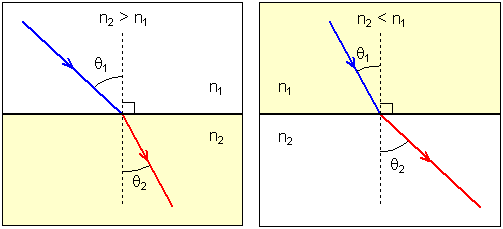 For n2 > n1, the ray bends towards the normal upon refraction at the interface.
For n2 < n1, the ray bends away from the normal.
Total internal reflection:
Snell's law requires that light bends towards the surface (away from the normal) on passing from a denser medium to a less dense medium. So there is a critical angle of incidence, θc, at which light would bend so much that it would skim the surface; at any greater angle of incidence, Snell's law does not allow an angle of refraction, and so the light is completely reflected back into the denser medium.
Dependence on wavelength (dispersion):
The speed of light (and therefore the refractive index) in a medium generally depends on wavelength, and light of different wavelengths will be refracted at different angles.
Chromatic aberration:
And so light of mixed wavelengths (such as sunlight) will spread out (disperse) into its component colours.
In optical instruments, this dispersion causes light of different wavelengths to focus at different points. This blurring of the image is called chromatic aberration.
Dependence on direction (anisotropy):
In some media, the speed of light depends on the direction through the medium and on the polarisation of the light.
* This entry is from our old Library feature. If you know who wrote it, please let us know so we can attribute a writer. Thanks!
Snell's Law relates the angles of incidence and refraction, for a light ray that passes between two media of different refractive indices.
The refractive index of a medium is the speed of light in vacuum divided by the speed of light in the medium: n = c/v. It is the "optical density" of the medium. It is always greater than 1, as long as there is a physical medium other than vacuum.
Equations
Snell's law:
[tex]n_1 \ \sin \theta_1 <br /> \ = \ n_2 \ \sin \theta_2[/tex]
or equivalently:
[tex] \frac{\sin \theta_1}{\sin \theta_2} <br /> \ =\ \frac{n_2}{n_1}<br /> \ =\ \frac{v_1}{v_2}[/tex]
Critical angle for total internal reflection:
[tex]\sin\theta_c\ =\ \frac{n_2}{n_1}[/tex]
Refractive index:
[tex]n\ =\ \frac{c}{v}[/tex]
Typical refractive indices:
Vacuum: n = 1 exactly
Air: n = 1.0003, often approximated by 1
Water: n = 1.34, average over visible range
Glass: n = 1.5 is typically used in optics homework problems
Fused silica (pure SiO2 glass): n = 1.46, average over visible range
For a comprehensive list, see http://en.wikipedia.org/wiki/List_of_refractive_indices
Extended explanation
Definitions of terms:
n1, n2 are the refractive indices for the two media.
θ1, θ2 are the angles that the rays make, with respect to the normal, for each medium. Usually θ1 is taken as the angle of incidence, and θ2 is the angle of refraction; however this distinction is unimportant due to the symmetry of Snell's Law.
Illustrative figure
For n2 < n1, the ray bends away from the normal.
Total internal reflection:
Snell's law requires that light bends towards the surface (away from the normal) on passing from a denser medium to a less dense medium. So there is a critical angle of incidence, θc, at which light would bend so much that it would skim the surface; at any greater angle of incidence, Snell's law does not allow an angle of refraction, and so the light is completely reflected back into the denser medium.
Dependence on wavelength (dispersion):
The speed of light (and therefore the refractive index) in a medium generally depends on wavelength, and light of different wavelengths will be refracted at different angles.
Chromatic aberration:
And so light of mixed wavelengths (such as sunlight) will spread out (disperse) into its component colours.
In optical instruments, this dispersion causes light of different wavelengths to focus at different points. This blurring of the image is called chromatic aberration.
Dependence on direction (anisotropy):
In some media, the speed of light depends on the direction through the medium and on the polarisation of the light.
* This entry is from our old Library feature. If you know who wrote it, please let us know so we can attribute a writer. Thanks!