Solenoid Magnetic Field calculation

Click For Summary

Discussion Overview

The discussion revolves around the calculation of the magnetic field of a solenoid, focusing on the application of Ampere's law and the implications of current direction and symmetry in the magnetic field calculation. Participants explore theoretical aspects, potential misconceptions, and the relevance of different laws in determining the magnetic field.

Discussion Character

  • Technical explanation
  • Debate/contested
  • Mathematical reasoning

Main Points Raised

  • One participant questions why only the current going into the page is included in the magnetic field calculation, suggesting that the field should be doubled due to the current going out of the page.
  • Another participant clarifies that Ampere's law states only the current passing through the area of the rectangle is included in the calculation, and that vertical components cancel due to symmetry.
  • There is a discussion about the assumption that the upper side of the rectangle is far enough away to have no influence on the magnetic field.
  • One participant expresses confusion about the role of the circular winding of the wire in the magnetic field inside the solenoid, questioning its relevance when applying Ampere's law.
  • Another participant suggests that to account for the winding's effect, Biot-Savart's law should be used instead of Ampere's law, noting that Biot-Savart's law is more accurate for finite lengths of solenoids.

Areas of Agreement / Disagreement

Participants express differing views on the application of Ampere's law versus Biot-Savart's law, with no consensus reached on the implications of the winding of the wire and the calculation of the magnetic field.

Contextual Notes

There are unresolved assumptions regarding the symmetry of the solenoid and the influence of the wire's winding on the magnetic field, as well as the conditions under which Ampere's law is applicable.

UMath1
Messages
361
Reaction score
9
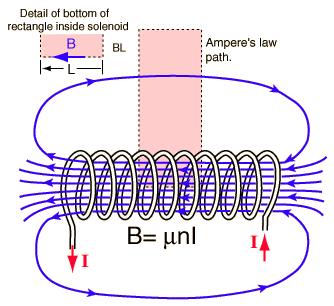
I am confused about how the magnetic field of a solenoid is calculated in this image.
sol.gif

Why is only the current going into the page included in calculating the magnetic field? Shouldn't the field be twice the amount calculated because there is a magnetic field generated by the part of the turns the bottom with current going out of the page? And I don't understand why the vertical components of the path are taken to be zero. Although it is said that the field is perpendicular, the diagram shows that there is a portion of the field parallel to the vertical path.
 
Physics news on Phys.org
Yes. But it doesn't answer my question.
 
UMath1 said:
Why is only the current going into the page included in calculating the magnetic field? Shouldn't the field be twice the amount calculated because there is a magnetic field generated by the part of the turns the bottom with current going out of the page?
Ampere's law is used.
It says that only the current passing through the area of the rectangle is to be included in the calculation:

circ H ⋅ ds = N * I

UMath1 said:
And I don't understand why the vertical components of the path are taken to be zero.

They are not taken to be zero, but they cancel each other due to symmetrical reasons. The formula is only valid as for the center of the solenoid.

The upper side of the rectangle is assumed to be so far away, that it has no influence, so this horizontal component is taken to be zero.
You are the one to sketch the rectangle.
 
Yes I understand that. But if you use ampere's law that way, the circular winding of the wire seems to have no bearing on the field inside the wire. I thought that the field inside the solenoid is increased because of the winding if the wire.
 
UMath1 said:
But if you use ampere's law that way, the circular winding of the wire seems to have no bearing on the field inside the wire. I thought that the field inside the solenoid is increased because of the winding if the wire.
I'm not using Ampere's law that way, just using Ampere's law.

If you want a "bearing", you must use Biot-Savart's law. It doesn't need symmetry, infinite length of the solenoid, and so on.

Biot-Savart is accurate in case of finite length of the solenoid. Ampere is an approximation.
 

Similar threads

  • · Replies 12 ·
Replies
12
Views
1K
Replies
5
Views
2K
  • · Replies 6 ·
Replies
6
Views
2K
  • · Replies 5 ·
Replies
5
Views
2K
  • · Replies 1 ·
Replies
1
Views
1K
  • · Replies 2 ·
Replies
2
Views
2K
  • · Replies 5 ·
Replies
5
Views
3K
  • · Replies 8 ·
Replies
8
Views
2K
  • · Replies 5 ·
Replies
5
Views
2K
  • · Replies 3 ·
Replies
3
Views
1K