Nihi
- 2
- 0
Hi all
I am facing a problem and I hope that you can give me a hand. Here I describe the situation
I am working on a digitizer that can detect the pen position by measuring the antennae energy that are placed in a grid fashion. To get the x coordinate of the pen I measure the energy of three antennae where the pen is supposed to be and then I interpolate this 3 energy-value with Lagrange algorithm.
Finally I determine the pen coordinate by finding the highest f(x) of the curve using a loop.
With Lagrange method it approximates pretty well the actual relationship position-energy but it's not linear.
So here is the problem: when the pen is in the middle of two antennae I get 2 similar energy value whereas the 3rd is lower then these latter, so the highest point of the curve remains about the same when I move the pen around the middle position of 2 antennae. The result is that when the pen crosses these middle points it moves slowly because there is not much changes in the curve which is limited by these 2 similar energy-value.
Is it possible to introduce a factor that changes the curve making it more narrow at the highest point? it's just a thought, I appreciate any solution.
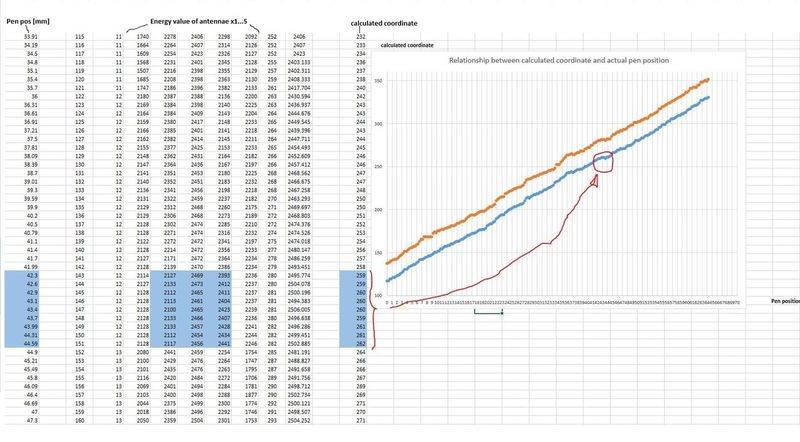
In the picture you can see the measurement and the coordinate calculated through Lagrange algorithm. I hope that someone can help me. Thank you!
I am facing a problem and I hope that you can give me a hand. Here I describe the situation
I am working on a digitizer that can detect the pen position by measuring the antennae energy that are placed in a grid fashion. To get the x coordinate of the pen I measure the energy of three antennae where the pen is supposed to be and then I interpolate this 3 energy-value with Lagrange algorithm.
Finally I determine the pen coordinate by finding the highest f(x) of the curve using a loop.
With Lagrange method it approximates pretty well the actual relationship position-energy but it's not linear.
So here is the problem: when the pen is in the middle of two antennae I get 2 similar energy value whereas the 3rd is lower then these latter, so the highest point of the curve remains about the same when I move the pen around the middle position of 2 antennae. The result is that when the pen crosses these middle points it moves slowly because there is not much changes in the curve which is limited by these 2 similar energy-value.
Is it possible to introduce a factor that changes the curve making it more narrow at the highest point? it's just a thought, I appreciate any solution.
In the picture you can see the measurement and the coordinate calculated through Lagrange algorithm. I hope that someone can help me. Thank you!