Can You Solve This Infinite Grid of Resistors Problem?

Click For Summary
SUMMARY

The discussion centers on the calculation of resistance in an infinite grid of resistors, a classic physics problem. The key insight is that total resistance can be determined by analyzing paths that are electrically parallel, ensuring no current flows between them. This occurs when neighboring paths maintain the same electrical potential. A web resource is suggested for further exploration of this problem.

PREREQUISITES
  • Understanding of electrical resistance and Ohm's Law
  • Familiarity with concepts of parallel circuits
  • Basic knowledge of resistivity and its implications in materials
  • Experience with mathematical modeling in physics
NEXT STEPS
  • Research the concept of electrical potential in parallel circuits
  • Explore the mathematical derivation of resistance in infinite resistor networks
  • Learn about numerical methods for solving complex electrical problems
  • Investigate online calculators or simulations for infinite grids of resistors
USEFUL FOR

Physics students, electrical engineers, and anyone interested in advanced circuit analysis and mathematical modeling of electrical systems.

excrucio
Messages
3
Reaction score
0
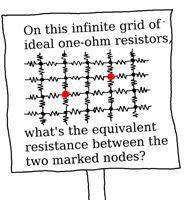
Could you solve this?
problem.JPG
 
Physics news on Phys.org
That's a famous physics "puzzle". Can you solve it?
 
I believe back in college I had to calculate the continuous case of this, e.g. you stick two metal rods into the ground a meter apart. What is the resistance between the rods given the resistivity of the ground.
(EDIT: Or maybe I just imagine having solved it. I definitely pondered it in the past)

The key insight in this problem is that you calculate the total resistance of it by calculating resistance along paths that are all electrically parallel with each other. More importantly, to be able to do so, you choose the paths so that there is no current flowing between those paths. That scenario happens when two neighboring paths have the same potential along their paths.

Sorry, that's all I recall :)
 
NO, I cannot solve it :(
 
Just FYI, there's a neat web page on the matter that calculates it.
 
Link?
 

Similar threads

  • · Replies 4 ·
Replies
4
Views
3K
  • · Replies 4 ·
Replies
4
Views
2K
  • · Replies 12 ·
Replies
12
Views
2K
  • · Replies 4 ·
Replies
4
Views
17K
  • · Replies 17 ·
Replies
17
Views
2K
  • · Replies 8 ·
Replies
8
Views
1K
  • · Replies 2 ·
Replies
2
Views
3K
  • · Replies 17 ·
Replies
17
Views
2K
Replies
9
Views
1K
  • · Replies 8 ·
Replies
8
Views
2K