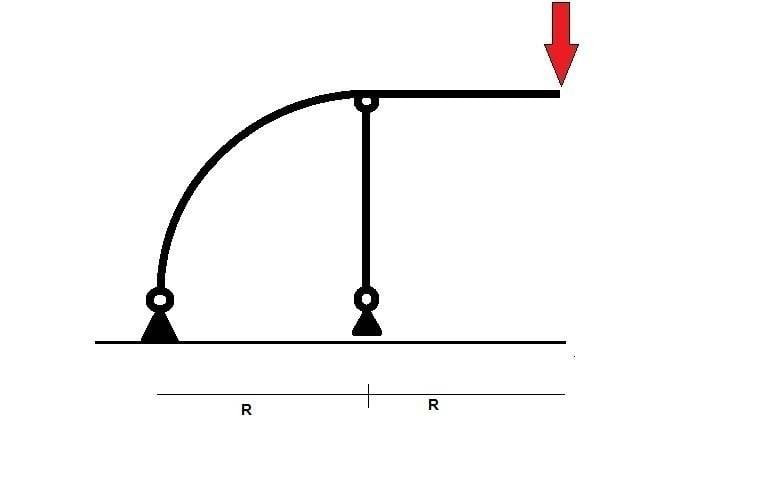
Solve the structure in the diagram below
Click For Summary

Discussion Overview

The discussion revolves around the stability of a structure depicted in a diagram, which includes arcs and supports. Participants explore the mechanics of the structure, including the forces acting on it and the nature of the joints involved. The conversation touches on theoretical and practical aspects of structural stability and mechanics.

Discussion Character

  • Exploratory
  • Technical explanation
  • Debate/contested
  • Mathematical reasoning

Main Points Raised

  • One participant questions the stability of the structure, suggesting that the middle leg cannot resist moments and will cause the arc to fall.
  • Another participant seeks clarification on the representation of three circles in the diagram, which are identified as joints with specific mechanical properties.
  • A participant describes the geometry of a triangle formed between the joints, arguing that it will not collapse due to its dimensions.
  • Concerns are raised about the nature of the supports, with one participant asserting that the bottom left support is fixed while the other is not, leading to different reactions.
  • Another participant suggests that the drawing may be misleading and proposes that both supports should be considered hinged, which affects the analysis of forces.

Areas of Agreement / Disagreement

Participants express differing views on the stability of the structure and the nature of the supports. There is no consensus on whether the structure is stable or how the forces interact, indicating ongoing debate and uncertainty.

Contextual Notes

Participants note potential misunderstandings regarding the diagram and the mechanical properties of the joints. There are unresolved assumptions about the nature of the supports and the effects of friction.

Who May Find This Useful

Individuals interested in structural mechanics, engineering design, and stability analysis may find this discussion relevant.

Dell
Messages
555
Reaction score
0
I have been asked to solve the structure in the diagram below
Untitled.jpg

where the arcs radius is R, and the force acting is P

my question is whether this structure is at all stable?? surely the middle leg cannot resist and moment about about the joint at its top end and will fall (it only has a vertical reaction)causing the arc to fall with it, ( the arc developing a moment about the permanent joint support at its base)

is there a problem in the question or am i not understanding it correctly?

i have only learned to solve stable structures
 
Physics news on Phys.org


Dell said:
I have been asked to solve the structure in the diagram below
View attachment 23918
where the arcs radius is R, and the force acting is P

my question is whether this structure is at all stable?? surely the middle leg cannot resist and moment about about the joint at its top end and will fall (it only has a vertical reaction)causing the arc to fall with it, ( the arc developing a moment about the permanent joint support at its base)

is there a problem in the question or am i not understanding it correctly?

i have only learned to solve stable structures

What are the 3 little circles meant to represent?


sorry, should have added names for the points,
the bottom left hand and bottom right hand circles are section joints- like a ball and socket joint- which do not at all resist to circular motion (no moment) the top joint is a half joint meaning - a permanent connection to the top piece and a ball and socket joint to the vertical bar.

i am not sure what the correct term is in english
hope that it is clear now


There is a triangle between the joints, two of its sides being r, and the third is [tex]\sqrt{2} r[/tex]
As [tex]\sqrt{2} < 2[/tex] The thing won't collapse to the ground.
Moreover (setting mechanics aside for a moment) as none of the sides of the triangle would change geometry, it won't even move.
Now with mechanics. As the parts stretch, contract and bend, the system will move a bit.
I am also courious how to calculate tension in non-straight beams. I feel I will learn something from this thread.


agwas
mim not 100% sure i sunderstand what you are saying but i think you misunderstood the diagram, the bottom left hand support is a fixed support, let's call it A, so i have reactions Ax and Ay
the second support -lets call it B, is not fixed and i only have reaction Bx,

i think the straight beam can fall causing the arc to fall with it.


I see.
And I suppose we suppose there is no friction between B and ground.


correct,


It may be badly drawn. It looks like A and B are both supposed to be hinged supports. But at B, there can only be a By force. I think Magwas would learn more from this thread if P was horizontal, because then, Ax would have a value. Really this is just a simply supported bent beam, isn't it?
 

Similar threads

  • · Replies 13 ·
Replies
13
Views
3K
  • · Replies 1 ·
Replies
1
Views
3K
  • · Replies 3 ·
Replies
3
Views
3K
Replies
20
Views
5K
  • · Replies 7 ·
Replies
7
Views
4K
  • · Replies 48 ·
2
Replies
48
Views
8K
  • · Replies 2 ·
Replies
2
Views
3K
Replies
3
Views
3K
  • · Replies 1 ·
Replies
1
Views
2K
Replies
40
Views
5K