Solve the variance problem below - statistics

Click For Summary
SUMMARY

The discussion focuses on solving the variance problem in statistics, specifically using the equation for variance: ##\sum (x - \bar x)^2 = \sum x^2 - N \cdot \bar x^2##. A user shares their working and seeks alternative approaches, demonstrating a solid understanding of the proof involving summations. The conversation highlights the importance of clarity in notation, as one participant corrects 'n' to 'N' for better comprehension. Overall, the exchange emphasizes collaborative learning and the refinement of statistical proofs.

PREREQUISITES
  • Understanding of variance and its calculation in statistics
  • Familiarity with summation notation and basic algebra
  • Knowledge of statistical means and their properties
  • Experience with collaborative problem-solving in academic settings
NEXT STEPS
  • Study the derivation of variance formulas in statistics
  • Explore alternative methods for calculating variance, such as using sample data
  • Learn about the implications of variance in data analysis
  • Investigate common pitfalls in statistical proofs and how to avoid them
USEFUL FOR

Students studying statistics, educators teaching statistical concepts, and anyone interested in enhancing their understanding of variance and its applications in data analysis.

chwala
Gold Member
Messages
2,828
Reaction score
421
Homework Statement
see attached
Relevant Equations
variance
The question is below:

1635595952630.png


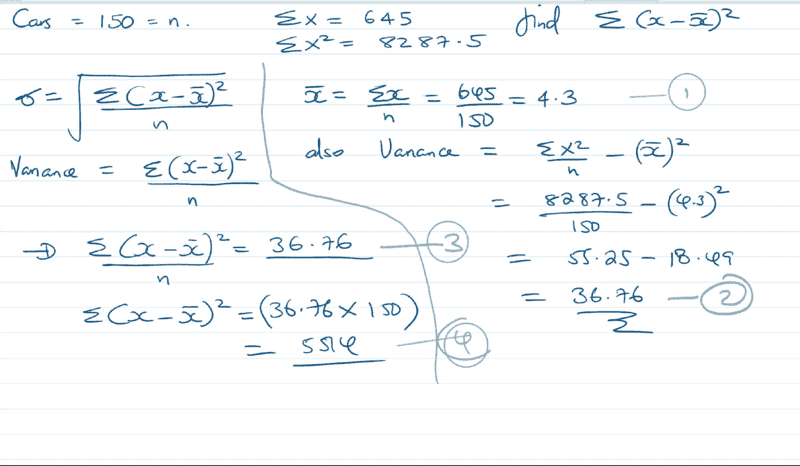
below is my own working;
1635596053833.png
the mark scheme for the question is below here;
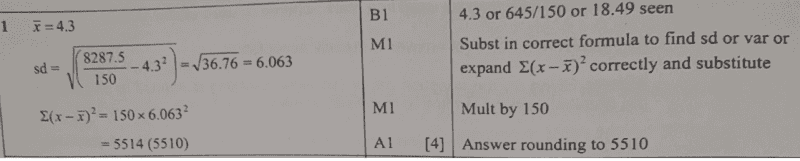
1635596099561.png


i am seeking for any other approach that may be there...am now trying to refresh on stats...bingo!
 
  • Like
Likes   Reactions: Delta2
Physics news on Phys.org
chwala said:
Homework Statement:: see attached
Relevant Equations:: variance

The question is below:

View attachment 291394

below is my own working;
View attachment 291395the mark scheme for the question is below here;
View attachment 291396

i am seeking for any other approach that may be there...am now trying to refresh on stats...bingo!
Here's a quicker way:
##\sum (x - \bar x)^2 = \sum x^2 - N \cdot \bar x^2##

Proof:
##\sum (x - \bar x)^2 = \sum(x^2 - 2x\cdot \bar x + \bar x^2) ##
##= \sum x^2 - 2\cdot \bar x \sum x + \sum \bar x^2 = \sum x^2 - 2\bar x \cdot N \cdot \bar x + N \bar x^2 = \sum x^2 - N \cdot \bar x^2##
All summations are from n = 1 to N.
In the proof above, I'm using the fact that ##\sum x = N \bar x##
 
Last edited:
  • Like
Likes   Reactions: chwala
Is the proof missing something...I will counter check it later...
 
I just had a look at your proof...thanks Mark...I wasn't certain on the last part of your equation involving the mean. Its now clear to me from my study (shown below). Bingo!

1635679616725.png
 
Last edited:
chwala said:
I just had a look at your proof...thanks Mark...I wasn't certain on the last part of your equation involving the mean. Its now clear to me from my study. Bingo!
Yes, that's it. I've edited my post to change 'n' to 'N', which I hope makes it clearer.
 

Similar threads

  • · Replies 2 ·
Replies
2
Views
2K
  • · Replies 8 ·
Replies
8
Views
1K
  • · Replies 7 ·
Replies
7
Views
2K
  • · Replies 3 ·
Replies
3
Views
1K
Replies
2
Views
1K
Replies
0
Views
892
  • · Replies 8 ·
Replies
8
Views
2K
Replies
5
Views
2K
  • · Replies 4 ·
Replies
4
Views
1K
Replies
3
Views
1K