Solving a Problem with Transformer Load Resistance and Source Resistance

  • Thread starter Thread starter RigelulZ
  • Start date Start date
  • Tags Tags
    Transformer Weird
Click For Summary
The discussion revolves around solving a transformer problem involving load resistance, turns ratio, and source voltage. The user initially calculated the source resistance but arrived at an incorrect value of 77.4 Ohms. Participants suggested analyzing the voltage drop across the source resistance and the power relationship between the primary and secondary coils. Following this advice, the user recalculated using power and found the correct solution, emphasizing the importance of avoiding premature rounding in calculations. The exchange highlights the collaborative nature of problem-solving in physics.
RigelulZ
Messages
10
Reaction score
0
Weird Transformer Problem :(

Homework Statement


"In the transformer shown in the figure below, the load resistance RL is 44.0 Ω. The turns ratio N1/N2 is 2.10, and the rms source voltage is ΔVS = 77.0 V. If a voltmeter across the load resistance measures an rms voltage of 26.5 V, what is the source resistance Rs?"
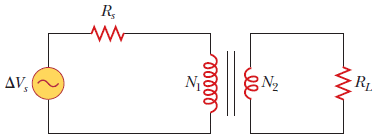

circuit.gif


Homework Equations


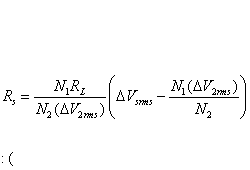
See attachment for Equation of Rs

Rs.gif


The Attempt at a Solution


I plugged in my values for the formula i got for Rs but got it wrong? I got 77.4 Ohms

Does anybody know what I'm doing wrong? Because i sure don't.

Any help will be greatly appreciated, thanks in advance!

-Rígel
 
Physics news on Phys.org


RigelulZ said:

The Attempt at a Solution


I plugged in my values for the formula i got for Rs but got it wrong? I got 77.4 Ohms

Does anybody know what I'm doing wrong? Because i sure don't.
How are you analysing the problem?

Can you determine the voltage drop across the source resistance? Can you determine the power in the secondary coil? How is that related to the power passing through the primary coil?

AM


Andrew Mason said:
How are you analysing the problem?

Can you determine the voltage drop across the source resistance? Can you determine the power in the secondary coil? How is that related to the power passing through the primary coil?

AM

Wow, you were absolutely right, i did it through power like you instructed and it worked like a charm.. I also learned not to round too soon into the problem.. :/

Thank you!
 
The book claims the answer is that all the magnitudes are the same because "the gravitational force on the penguin is the same". I'm having trouble understanding this. I thought the buoyant force was equal to the weight of the fluid displaced. Weight depends on mass which depends on density. Therefore, due to the differing densities the buoyant force will be different in each case? Is this incorrect?

Similar threads

  • · Replies 4 ·
Replies
4
Views
5K
  • · Replies 4 ·
Replies
4
Views
2K
  • · Replies 11 ·
Replies
11
Views
2K
  • · Replies 14 ·
Replies
14
Views
3K
  • · Replies 3 ·
Replies
3
Views
2K
  • · Replies 4 ·
Replies
4
Views
2K
  • · Replies 1 ·
Replies
1
Views
2K
  • · Replies 10 ·
Replies
10
Views
3K
  • · Replies 6 ·
Replies
6
Views
2K
  • · Replies 2 ·
Replies
2
Views
2K