Solving a system of differential equations

Click For Summary

Homework Help Overview

The discussion revolves around solving a system of differential equations involving functions ##g(y,t)## and ##f(y,t)##. The original poster presents a system of equations and expresses a desire to find explicit solutions for these functions, referencing a similar solved example for guidance.

Discussion Character

  • Exploratory, Assumption checking, Problem interpretation

Approaches and Questions Raised

  • Participants explore the implications of combining equations (1) and (2) and question the validity of the resulting equation (4). There is discussion about the implications of equation (2) leading to ##f = 0## and whether it is appropriate to add equations. Some participants suggest focusing on individual equations to derive solutions, while others express uncertainty about the approach.

Discussion Status

The discussion is ongoing, with participants sharing insights and questioning assumptions. Some guidance has been offered regarding the interpretation of equation (2) and its relationship to the other equations. There is a recognition of the need to clarify the roles of the functions and their dependencies on variables.

Contextual Notes

Participants note that the problem may be part of exam preparation, which adds pressure to find a solution. There is also mention of potential typographical errors in the expressions being discussed, indicating a need for careful review of the equations.

JD_PM
Messages
1,125
Reaction score
156
Summary:: We want to find explicit functions ##g(y,t)## and ##f(y,t)## satisfying the following system of differential equations.

I attached a very similar solved example.

Given the following system of differential equations (assuming ##y \neq 0##)

\begin{equation*}
-y\partial_t \left( g(y,t)\right) + f(y,t) = 0 \tag{1}
\end{equation*}

\begin{equation*}
y\partial_y \left( f(y,t)\right) -f(y,t) = 0 \tag{2}
\end{equation*}

\begin{equation*}
\frac{1}{y^2} \partial_t \left( f(y,t) \right) - \partial_y \left( \frac{1}{y^2} g(y,t) \right) - \frac{2}{y^3} g(y,t) = 0 \tag{3}
\end{equation*}

We want to find explicit functions ##g(y,t)## and ##f(y,t)## satisfying such system

Adding up ##(1)## and ##(2)##

\begin{equation*}
\partial_y \left( f(y,t)\right) - \partial_t \left( g(y,t)\right) = 0 \tag{4}
\end{equation*}

Equation ##(4)## is satisfied when

\begin{equation*}
f(y,t) = f(t), \ \ \ \ g(y,t) = g(y) \tag{5}
\end{equation*}

Plugging ##(5)## into ##(3)## yields

\begin{equation*}
\partial_t f(t) - \partial_y g(y) =0 \tag{6}
\end{equation*}

But I do not see how ##(6)## is going to lead us to get explicit functions for ##g(y,t)## and ##f(y,t)##.

I actually expect to get a second order differential equation out of working out the system, whose solution should provide us with explicit functions for ##g(y,t)## and ##f(y,t)##.

Could you please help me out to move forward?

Thank you! :biggrin:

PS: I attach an analogous example. I am following the same procedure to solve our original problem
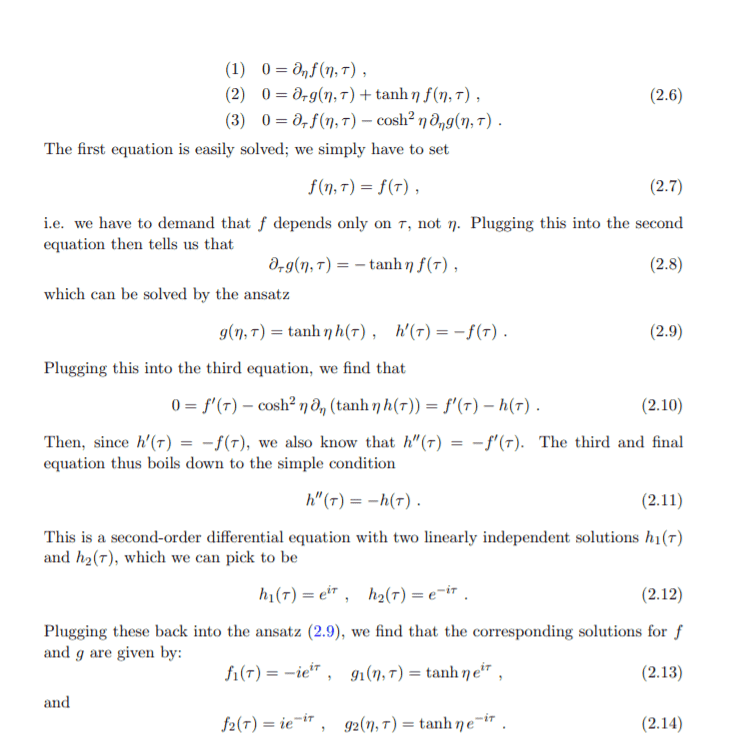
3727329372932793823232.png
 
  • Like
Likes   Reactions: Delta2
Physics news on Phys.org
Is this homework ?

JD_PM said:
Equation (4) is satisfied when
But then (2) yields ##f = 0## !

By the way, (2) is easily solved for ##y## !
 
BvU said:
Is this homework ?

This is a system of differential equations I encountered while solving a specific problem I am solving to study for my exam. I guess you can call it homework 😅

BvU said:
But then (2) yields ##f = 0## !

By the way, (2) is easily solved for ##y## !

So if I am not mistaken you are suggesting not to add up ##(1)## and ##(2)## (?) How to proceed then? (sorry I am a bit rusty with differential equations).
 
JD_PM said:
I guess you can call it homework
Thread moved the schoolwork forums.
 
  • Like
Likes   Reactions: JD_PM
JD_PM said:
sorry I am a bit rusty with differential equations
JD_PM said:
solving a specific problem I am solving to study for my exam
If (2) is already a stumbling block, and the 'analogous example' is typical for the exam, I fear with great fear ... :nb)

Compare
$$
\begin{equation*}

y\partial_y \left( f(y,t)\right) -f(y,t) = 0 \tag{2}

\end{equation*}
$$
with ##\ x \, f'(x) = f(x) \ ## :rolleyes:
 
  • Like
Likes   Reactions: JD_PM
BvU said:
If (2) is already a stumbling block, and the 'analogous example' is typical for the exam, I fear with great fear ... :nb)

:oops:... let's not panic though!

BvU said:
Compare
$$
\begin{equation*}

y\partial_y \left( f(y,t)\right) -f(y,t) = 0 \tag{2}

\end{equation*}
$$
with ##\ x \, f'(x) = f(x) \ ## :rolleyes:

Thanks for the guidance! Let's start over

Focusing on ##(2)##, we deduce that it takes the form

\begin{equation*}
\partial_y \left( y \ f(x,y) \right) = 0
\end{equation*}

Where we need to impose

\begin{equation*}
\partial_y f(x,y) = - f(x,y)
\end{equation*}

The simplest function I can think of that satisfies this equation (setting the constant of integration equal to zero) is ##f(x,y) = e^{-\ln(y)}## i.e.

\begin{equation*}
\partial_y \left( y \ e^{-\ln(y)} \right) = e^{-\ln(y)} - y\left( \frac{1}{y} \right) \ e^{-\ln(y)} = \frac{1}{y} - \frac{1}{y} = 0
\end{equation*}

Plugging ##f(x,y) = e^{-\ln(y)}## into ##(1)## yields

\begin{equation*}
-y\partial_t \left( g(y,t) \right) + e^{-\ln(y)} = 0 \Rightarrow \partial_t \left( g(y,t) \right) = \frac{1}{y^2}
\end{equation*}

Thus (setting the constant of integration equal to zero) we get that ##g(x,y) = t/y^2##

But I have missed something as ##(3)## is not satisfied due to a factor of ##2## i.e.

\begin{equation*}
-\partial_y \left( \frac{t}{y^4} \right) - \frac{2t}{y^5} = \frac{2t}{y^5} \neq 0
\end{equation*}

What am I missing? I guess that I should impose a specific initial condition to get it done but I do not see it...
 
##\qquad##Funny, from $$
\begin{equation*}

\partial_y \left( y \; f(x,y) \right) = 0

\end{equation*}$$##\qquad## I get $$
\begin{equation*}
y\,\partial_y \left( f(y,t)\right) +f(y,t) = 0
\end{equation*}$$ where ##(2)## has a minus sign !

By the way, we physicists usually write ##e^{-\ln y} \ ## as ##\ \displaystyle{1\over y}\ ## :wink:

JD_PM said:
:oops:... let's not panic though!
That's the spirit !👍
 
  • Like
Likes   Reactions: JD_PM
OK let's make it simpler

BvU said:
Compare
$$
\begin{equation*}

y\partial_y \left( f(y,t)\right) -f(y,t) = 0 \tag{2}

\end{equation*}
$$
with ##\ x \, f'(x) = f(x) \ ## :rolleyes:

So we see that ##f(y,t) = f(y) = e^{\ln y} = \frac{1}{y}## (so everyone is happy! haha) is a solution for ##(2)##

Then all we need to do is plugging it into ##(1)## and find ##g(y,t)## so that the following equation is satisfied

\begin{equation*}
\partial_t \left( g(y,t)\right) = \frac{1}{y^2}
\end{equation*}

Besides, ##g(y,t)## and ##f(y,t)## must be a solution for ##(3)## of course.

Thank you, I think I can get it done now (time to go back to study! 🤓).
 
JD_PM said:
so everyone is happy! haha
Hoho! Not yet! I'll let you know when I'm happy :wink:

As long as you write
JD_PM said:
So we see that ##f(y,t) = f(y) = e^{\ln y} = \frac{1}{y}##
I'm not happy by a long shot ! And the last bit ##e^{\ln y} = \frac{1}{y} ## is (probably :rolleyes:?) a typo, so that does not count.

##f(y,t)=f(y) ## is the one that is really irking me. We solve (we try to ...) for ##y## but that doesn't mean ##t## goes away.

We are still working on ##(2)## and are nearly there ...
 
  • Like
Likes   Reactions: JD_PM
  • #10
BvU said:
Hoho! Not yet! I'll let you know when I'm happy :wink:

As long as you write
I'm not happy by a long shot ! And the last bit ##e^{\ln y} = \frac{1}{y} ## is (probably :rolleyes:?) a typo, so that does not count.

Oops a typo indeed. Let's go slowly

I meant that a solution for ##(2)## is given by

\begin{equation*}
f(y,t) = e^{\ln y} = y
\end{equation*}

Next step would be going to ##(1)## and solve for ##g(y,t)##, wouldn't it?
 
  • #11
No: any function of ##t## can be factored in in both terms of ##(2)## without affecting the validity of the equation.
 
  • #12
BvU said:
By the way, we physicists usually write ##e^{-\ln y} \ ## as ##\ \displaystyle{1\over y}\ ##
As do mathematicians...
 
  • #13
BvU said:
No: any function of ##t## can be factored in in both terms of ##(2)## without affecting the validity of the equation.

I better take more time to study and then reply. I do not want to exhaust your patience 😅
 

Similar threads

Replies
3
Views
2K
  • · Replies 11 ·
Replies
11
Views
3K
Replies
2
Views
2K
  • · Replies 3 ·
Replies
3
Views
2K
Replies
2
Views
1K
  • · Replies 2 ·
Replies
2
Views
2K
Replies
8
Views
2K
  • · Replies 1 ·
Replies
1
Views
2K
  • · Replies 5 ·
Replies
5
Views
1K
  • · Replies 11 ·
Replies
11
Views
2K