Solving an equation for ##x## involving inverse circular functions

Click For Summary
SUMMARY

The discussion focuses on solving the equation involving inverse circular functions, specifically $$\tan^{-1}\frac{1-x}{1+x} = k\tan^{-1}x$$. The primary solution derived is $$x = \frac{1}{\sqrt{3}}$$, while the book's alternative solution $$x = -\frac{1}{\sqrt{3}}$$ is identified as incorrect. The participants clarify that the principal value of $$\tan^{-1}(1) = \frac{\pi}{4}$$ does not support the existence of the negative solution, leading to the conclusion that the book contains a typo. The discussion emphasizes the importance of understanding the range of the inverse tangent function.

PREREQUISITES
  • Understanding of inverse trigonometric functions, specifically $$\tan^{-1}$$.
  • Familiarity with the properties of the tangent function and its principal values.
  • Knowledge of solving equations involving trigonometric identities.
  • Basic skills in algebraic manipulation and equation solving.
NEXT STEPS
  • Study the properties of inverse trigonometric functions, particularly $$\tan^{-1}$$ and its range.
  • Explore the implications of the tangent function's periodicity on solutions to trigonometric equations.
  • Investigate the general case of $$\tan^{-1}\frac{1-x}{1+x} = k\tan^{-1}x$$ for various values of $$k$$.
  • Review common pitfalls in solving equations involving inverse functions to avoid misinterpretations.
USEFUL FOR

Mathematicians, students studying trigonometry, and educators looking to clarify concepts related to inverse circular functions and their applications in solving equations.

brotherbobby
Messages
756
Reaction score
170
Homework Statement
Solve the following equation : ##\pmb{\tan^{-1}\frac{1-x}{1+x}=\frac{1}{2}\tan^{-1}x}##
Relevant Equations
1. If ##\tan\theta=1\Rightarrow \theta =\tan^{-1} 1 = \tfrac{\pi}{4}##, ##\underline{\text{the principal value}}##.
2. ##\tan(A-B) = \frac{\tan A - \tan B}{1+\tan A \tan B}##
Problem Statement : Solve for ##x## :

1640285637938.png


Attempt : If I take ##x=\tan\theta##, the L.H.S. reads $$\tan^{-1}\frac{1-\tan\theta}{1+\tan\theta}= \tan^{-1}\left[\tan\left(\frac{\pi}{4}-\theta \right) \right ]=\frac{\pi}{4}-\theta.$$

On going back to ##x## from ##\theta##, the given equation now reads : $$\frac{\pi}{4}-\tan^{-1}x = \frac{1}{2}\tan^{-1}x\Rightarrow \tan^{-1}x=\frac{2}{3}\times \frac{\pi}{4}=\frac{\pi}{6}\Rightarrow \boxed{x=\frac{1}{\sqrt{3}}}.$$

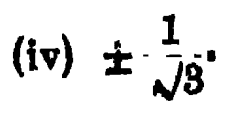
Answer : I copy and paste the answer from the book :
1640286252910.png


Doubt : Where does the answer ##-\frac{1}{\sqrt{3}}## come from? If we take the principal value of ##\tan^{-1}1=\dfrac{\pi}{4}##, I don't see how there can be a second answer.

A hint or suggestion will be welcome.
 
Physics news on Phys.org
I can't work through this at the moment. What I would do is to check whether ##-\frac 1{\sqrt 3}## is a solution of the original equation. If not, the book's answer is a typo.
 
  • Like
Likes   Reactions: vela
brotherbobby said:
Attempt : If I take ##x=\tan\theta##, the L.H.S. reads $$\tan^{-1}\frac{1-\tan\theta}{1+\tan\theta}= \tan^{-1}\left[\tan\left(\frac{\pi}{4}-\theta \right) \right ]=\frac{\pi}{4}-\theta.$$

Note that ##\tan^{-1}\tan x = x## only when ##x \in (-\frac \pi 2, \frac \pi 2)##
 
  • Like
Likes   Reactions: sysprog
Although, in this case this subtlety does not produce a second solution.
 
I did a bit of investigating. If we try: $$\tan^{-1}\frac{1-x}{1+x} = k\tan^{-1}x$$then we always get one solution (for ##k > -1##). And, we get a second solution for ##\frac 1 2 < k < 2##.

There is almost a second solution for ##k = \frac 1 2##, which is ##x \rightarrow -\infty##, or ##\theta = -\frac \pi 2##.
 
Last edited:
I think there's a typo in the answer for ##x = -\frac 1 {\sqrt 3}##
From Excel, with that value, ##\arctan(\frac{1 - x}{1 + x}) \approx 1.308997##, while ##.5\arctan x \approx -0.2618##.
 
Mark44 said:
I think there's a typo in the answer for ##x = -\frac 1 {\sqrt 3}##
From Excel, with that value, ##\arctan(\frac{1 - x}{1 + x}) \approx 1.308997##, while ##.5\arctan x \approx -0.2618##.
Try ##x## large and negative instead!
 
PeroK said:
Try x large and negative instead!
I was just comparing the two posted solutions.
 
PeroK said:
I did a bit of investigating. If we try: $$\tan^{-1}\frac{1-x}{1+x} = k\tan^{-1}x$$then we always get one solution (for ##k > -1##). And, we get a second solution for ##\frac 1 2 < k < 2##.

There is almost a second solution for ##k = \frac 1 2##, which is ##x \rightarrow -\infty##, or ##\theta = -\frac \pi 2##.
Just to correct this after having double-checked everything. ##x = \tan \theta## is a solution, where
$$\theta = \frac{\pi}{4(k+1)} \ \ (k < -2 \ or \ k > -\frac 1 2)$$ $$\theta = \frac{-3\pi}{4(k+1)} \ \ (\frac 1 2 < k < 2)$$ And we have two solutions when ##\frac 1 2 < k < 2##. For example, with ##k = 1## we have:
$$\theta = -\frac{3\pi}{8} \ and \ \theta = \frac{\pi}{8}$$
 
  • Like
Likes   Reactions: sysprog
  • #10
PS I think you learn a lot more about these equations by working out the general case, than doing one problem with a specific value of ##k = \frac 1 2 ## and then moving on.
 
  • #11
Mark44 said:
I think there's a typo in the answer for ##x = -\frac 1 {\sqrt 3}##
From Excel, with that value, ##\arctan(\frac{1 - x}{1 + x}) \approx 1.308997##, while ##.5\arctan x \approx -0.2618##.
The difference between those two values is ##\pi/2##. It looks like they're getting a second solution from
$$\frac \pi 4 - \theta = \frac 12 (\theta + \pi),$$ which implies ##\theta = -\frac \pi 6##.
 
  • Like
Likes   Reactions: sysprog and PeroK
  • #12
vela said:
The difference between those two values is ##\pi/2##. It looks like they're getting a second solution from
$$\frac \pi 4 - \theta = \frac 12 (\theta + \pi),$$ which implies ##\theta = -\frac \pi 6##.
And the problem with that is that it requires ##\frac \pi 4 - \theta < -\frac \pi 2##. Which requires ##\theta > \frac{3\pi}{4}##. That would give the equivalent solution of ##\theta = \frac{5\pi}{6}##. But, when we set up ##x = \tan \theta## we needed a single range for ##\theta##, such as ##\theta \in (-\frac \pi 2, \frac \pi 2)##.

In other words, solutions with ##\theta## outside this range must be excluded.

Note that in general we may have ##\frac \pi 4 - \theta > \frac \pi 2##, which happens if ##-\frac \pi 2 < \theta < -\frac \pi 4##. That's why we get a second solution for some values of ##k##.

Ironically, the book got the completely wrong solution ##\theta = -\frac \pi 6##, but missed the near solution ##\theta = -\frac \pi 2##, which equates to infinitely large negative ##x##.
 
  • #13
Thank you all for your comments. I am the creator (OP) of this thread and I lost most of what you said towards the end. For now I respond to @Mark44 's post #2 :
Mark44 said:
What I would do is to check whether ##-\tfrac{1}{\sqrt{3}}##is a solution of the original equation. If not, the book's answer is a typo.
Problem Statement : Solve the equation :
1640285637938-png.png


Attempt : I have solved the problem in my post #1 above. I got the answer ##\boxed{x = \tfrac{1}{\sqrt{3}}}##.

Issue : The text gives the answer : ##\pmb{x = \pm \frac{1}{\sqrt{3}}}##. Where does it get the answer ##x=-\tfrac{1}{\sqrt{3}}## from, when we know that the principal value of ##\tan^{-1}(1) = \tfrac{\pi}{4}##? (see my solutions in post#1 above).

Resolution : Let me put ##x=-\tfrac{1}{\sqrt{3}}## on both sides of the equation to see if the answers match.

L.H.S. = ##\tan^{-1}\frac{1+\frac{1}{\sqrt{3}}}{1-\frac{1}{\sqrt{3}}}= \tan^{-1}\frac{\sqrt{3}+1}{\sqrt{3}-1}=-\tan^{-1}\frac{1+\sqrt{3}}{1-\sqrt{3}}=-\tan^{-1}\left[ \tan\left(\pi/4+\pi/3 \right) \right]=-7\pi/12##.

R.H.S. = ##\frac{1}{2}\tan^{-1}\left(-\frac{1}{\sqrt{3}}\right)=-\frac{1}{2}\tan^{-1}\frac{1}{\sqrt{3}} = -\frac{1}{2}\times\frac{\pi}{6} = -\pi/12.##

Clearly the two sides are different when ##x = -1/\sqrt 3##, unless I am mistaken in my workings above.

That should be enough to rule out ##x = -1/\sqrt 3## as a solution to the given equation.
 
  • Like
Likes   Reactions: sysprog
  • #14
PeroK said:
Note that ##\tan^{-1}\tan x = x## only when ##x \in (-\frac \pi 2, \frac \pi 2)##
I did not understand, so if you can explain.

Isn't it always the case that ##\tan (\tan^{-1}x) = x##, irrespective of the value of ##x##?

Of course I am aware that ##\tan \pi/2## blows up.
 
  • #15
brotherbobby said:
I did not understand, so if you can explain.

Isn't it always the case that ##\tan (\tan^{-1}x) = x##, irrespective of the value of ##x##?

Of course I am aware that ##\tan \pi/2## blows up.
Yes, ##\tan (\tan^{-1}x) = x##. But, ##\tan^{-1} (\tan x) = x## only when ##x \in (-\frac \pi 2, \frac \pi 2)##
 
  • #16
brotherbobby said:
That should be enough to rule out ##x = -1/\sqrt 3## as a solution to the given equation.
Yes, the book is wrong. But, likewise, you potentially missed a second solution. In this case, ##\theta = -\frac \pi 2## is a solution of sorts.
 

Similar threads

  • · Replies 11 ·
Replies
11
Views
3K
  • · Replies 7 ·
Replies
7
Views
2K
Replies
2
Views
2K
  • · Replies 2 ·
Replies
2
Views
2K
  • · Replies 17 ·
Replies
17
Views
4K
  • · Replies 15 ·
Replies
15
Views
3K
  • · Replies 6 ·
Replies
6
Views
2K
  • · Replies 8 ·
Replies
8
Views
2K
Replies
6
Views
2K
  • · Replies 21 ·
Replies
21
Views
2K