Solving an Exercise Involving Particle P Moving Along the X-Axis

  • Thread starter Thread starter PhoenixWright
  • Start date Start date
  • Tags Tags
    Exercise Particle
Click For Summary

Homework Help Overview

The discussion revolves around a particle P moving with constant speed along the X-axis and the challenge of describing its movement from a rotating reference frame. The original poster seeks clarification on their approach and the need to find acceleration in this context.

Discussion Character

  • Exploratory, Assumption checking, Problem interpretation

Approaches and Questions Raised

  • The original poster attempts to determine the correct approach to describe the movement of the particle in a rotating frame, questioning their own calculations regarding acceleration. Some participants suggest differentiating again to find velocity and acceleration vectors, while expressing uncertainty about the specific requirements of the problem.

Discussion Status

The discussion is ongoing, with participants exploring different interpretations of the problem. Guidance has been offered regarding differentiation, and there is a recognition of the potential need to consider Coriolis and centrifugal effects in the analysis.

Contextual Notes

There is mention of the original poster's uncertainty about the requirements of the exercise and the implications of working within a rotating reference frame.

PhoenixWright
Messages
20
Reaction score
1
Hello.

I have the following exercise, and I would like you to say to me if I have it right and how to proceed:

"A particle P moves with constant speed v along the X axis of a reference system O, being x0 = 0 the position in t = 0. Describe the movement on another system O' with the same origin of coordinates and rotating with angular velocity constant ω in the sense clockwise."
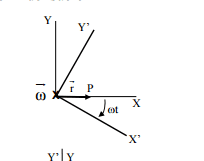
H56wp4r.png


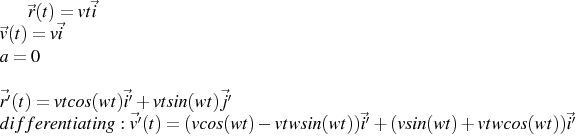
I have tried to solve as follows:
54J53Vp.png


So far, is my point correct?

Now, I had thought find the acceleration:

CmvBXqb.png

Is it correct?

Thank you!
 
Physics news on Phys.org
up :frown:
 
Why don't you just differentiate again?
But I'm not sure what the question is asking for. Isn't your expression for r' an adequate description? Do you need to find the velocity and acceleration vectors?
 
  • Like
Likes   Reactions: PhoenixWright
haruspex said:
Why don't you just differentiate again?
But I'm not sure what the question is asking for. Isn't your expression for r' an adequate description? Do you need to find the velocity and acceleration vectors?

Thank you!

Eventually I realized I could differentiate again. I believed that in this case I need to apply Coriolis and centrifugal acceleration, but I was reading and saw that could also solve in this way a moment ago.
 

Similar threads

Replies
18
Views
2K
  • · Replies 13 ·
Replies
13
Views
2K
  • · Replies 40 ·
2
Replies
40
Views
3K
Replies
11
Views
4K
  • · Replies 10 ·
Replies
10
Views
2K
  • · Replies 2 ·
Replies
2
Views
2K
  • · Replies 29 ·
Replies
29
Views
2K
  • · Replies 4 ·
Replies
4
Views
2K
Replies
67
Views
5K
  • · Replies 2 ·
Replies
2
Views
2K