MHB How Do You Solve These Simultaneous Equations?

  • Thread starter Thread starter Yordana
  • Start date Start date
  • Tags Tags
    Solving equations
Click For Summary
SUMMARY

This discussion focuses on solving simultaneous equations involving complex numbers. The equations derived from the original expression (3 + 2i)x - (1 - 2i)y = 1 + 6i are 3x - y = 1 and 2x + 2y = 6. The solution process involves equating the real and imaginary components, leading to a system of linear equations. Participants confirm the method and provide clarity on the separation of real and imaginary parts.

PREREQUISITES
  • Understanding of complex numbers and their components
  • Knowledge of solving linear equations
  • Familiarity with algebraic manipulation techniques
  • Basic skills in mathematical notation and terminology
NEXT STEPS
  • Study methods for solving systems of linear equations
  • Learn about complex number operations and properties
  • Explore graphical representations of complex equations
  • Investigate applications of complex numbers in engineering and physics
USEFUL FOR

Students, mathematicians, and educators looking to enhance their understanding of complex numbers and simultaneous equations.

Yordana
Messages
3
Reaction score
0
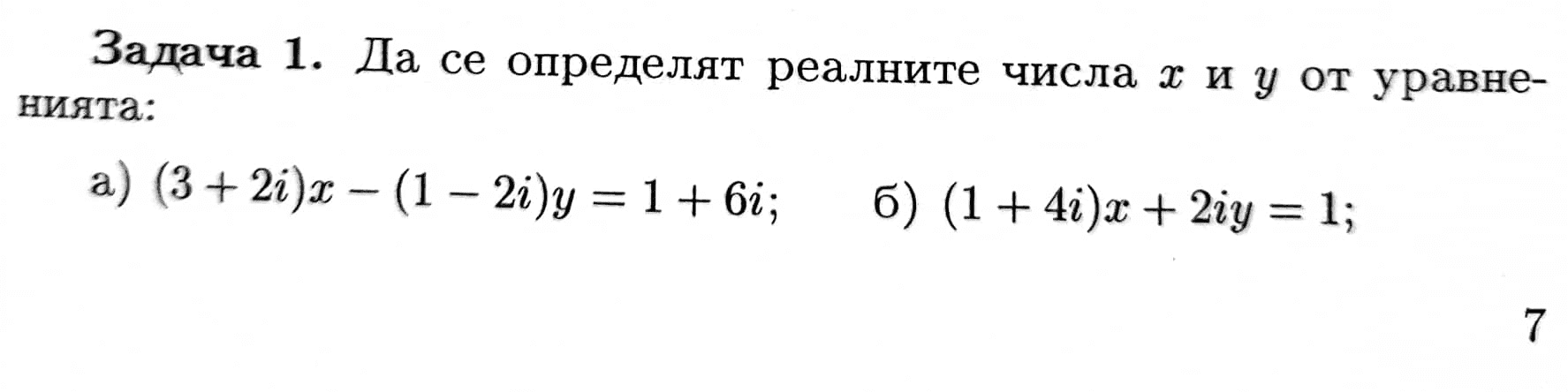
Determine the real numbers x and y from the equations:
1658397240563.png
I would appreciate it if someone could show me the solution to the first sub point.. 😢
 
Physics news on Phys.org
Yordana said:
Determine the real numbers x and y from the equations: View attachment 11876 I would appreciate it if someone could show me the solution to the first sub point.. 😢
The idea is that the real and imaginary components are the same on both sides of the equations. So for the first part:
(3 + 2i)x - (1 - 2i)y = 1 + 6i

(3x - y) + (2x + 2y)i = 1 + 6i

So now you have the simultaneous equations
3x - y = 1
2x + 2y = 6

-Dan
 
topsquark said:
The idea is that the real and imaginary components are the same on both sides of the equations. So for the first part:
(3 + 2i)x - (1 - 2i)y = 1 + 6i

(3x - y) + (2x + 2y)i = 1 + 6i

So now you have the simultaneous equations
3x - y = 1
2x + 2y = 6

-Dan
Thank you!
 
I am studying the mathematical formalism behind non-commutative geometry approach to quantum gravity. I was reading about Hopf algebras and their Drinfeld twist with a specific example of the Moyal-Weyl twist defined as F=exp(-iλ/2θ^(μν)∂_μ⊗∂_ν) where λ is a constant parametar and θ antisymmetric constant tensor. {∂_μ} is the basis of the tangent vector space over the underlying spacetime Now, from my understanding the enveloping algebra which appears in the definition of the Hopf algebra...

Similar threads

  • · Replies 1 ·
Replies
1
Views
2K
  • · Replies 10 ·
Replies
10
Views
3K
  • · Replies 13 ·
Replies
13
Views
3K
  • · Replies 17 ·
Replies
17
Views
3K
  • · Replies 11 ·
Replies
11
Views
2K
  • · Replies 8 ·
Replies
8
Views
1K
Replies
2
Views
2K
  • · Replies 4 ·
Replies
4
Views
2K
  • · Replies 23 ·
Replies
23
Views
2K
  • · Replies 0 ·
Replies
0
Views
2K