astrodeva
- 1
- 0
The equation is Uxx + Uyy = 0
And domain of solution is 0 < x < a, 0 < y < b
Boundary conditions:
Ux(0,y) = Ux(a,y) = 0
U(x,0) = 1
U(x,b) = 2
What I've done is that I did separation of variables:
U(x,y)=X(x)Y(y)
Plugging into the equation gives:
X''Y + XY'' = 0
Rearranging:
X''/X = -Y''/Y = k
For case k > 0, I saw that it gives no non-trivial solutions.
For case k = 0, I solved it and found U(x,y) = y/b + 1
For case k < 0, I'm slightly lost.
X'' + kX = 0
Y'' - kX = 0
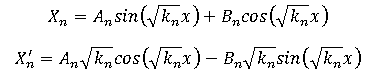
Using the X boundary conditions:
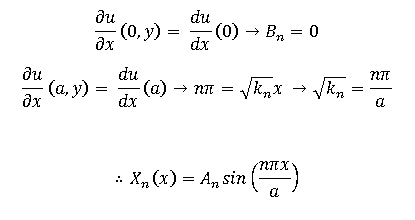

Using the Y boundary condition:
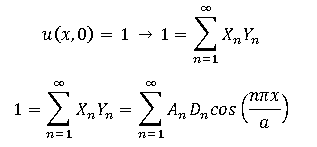
Using Fourier Series to find the coefficient:
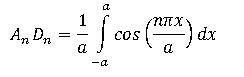
But the integral just gives Dn = 0, and this doesn't satisfy u(x,0) = 1.
Can someone explain where I went wrong?
Thanks!
And domain of solution is 0 < x < a, 0 < y < b
Boundary conditions:
Ux(0,y) = Ux(a,y) = 0
U(x,0) = 1
U(x,b) = 2
What I've done is that I did separation of variables:
U(x,y)=X(x)Y(y)
Plugging into the equation gives:
X''Y + XY'' = 0
Rearranging:
X''/X = -Y''/Y = k
For case k > 0, I saw that it gives no non-trivial solutions.
For case k = 0, I solved it and found U(x,y) = y/b + 1
For case k < 0, I'm slightly lost.
X'' + kX = 0
Y'' - kX = 0
Using the X boundary conditions:
Using the Y boundary condition:
Using Fourier Series to find the coefficient:
But the integral just gives Dn = 0, and this doesn't satisfy u(x,0) = 1.
Can someone explain where I went wrong?
Thanks!
Attachments

