Solving the Movement of a Cart with a Man on Top

  • Thread starter Thread starter wrobel
  • Start date Start date
  • Tags Tags
    Cart Movement
Click For Summary
The discussion revolves around a physics problem involving a cart with a massless platform and two wheels, where a man of mass m moves along the platform. The key question is determining the distance the cart travels when the man moves a distance L relative to it. Participants express varying opinions on the problem's complexity and educational value. Some find it interesting and suitable for teaching concepts like angular momentum and the relationship between forces and motion, while others criticize the artificiality of the scenario, particularly the massless platform and lack of friction. Concerns are raised about the potential confusion it may cause for students, especially regarding the conservation of momentum and the center of mass. The discussion highlights the balance between presenting challenging problems and ensuring students grasp fundamental concepts without becoming overwhelmed.
wrobel
Science Advisor
Insights Author
Messages
1,237
Reaction score
1,040
Is this an interesting problem what do you think?
9ef91c7ad043.png

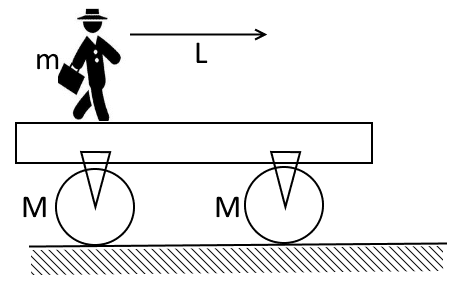
A cart consists of a massless platform and two wheels. Each wheel is a disk of mass M.
The cart stands on a horizontal road and a man of mass m stands upon the platform. Then the man started to go along the cart and after passing the distance L (relatively the cart) he stopped also relatively the cart. The wheels do not slip over the road and there is no friction in the axes.
Which distance the cart passed?
(warning: do not think that the center of mass keeps its position :)
 
Science news on Phys.org
Hello Wrobel,
Well, depends on what you consider 'interesting'. I don't know the context of your question, though. To me it seems the insights needed to see through this exercise are somewhat unnecessarily intertwined. Good students pick up the angular momentum part instantly and not so good students will be left in greater confusion than before they got the exercise presented to them, I fear.
I also find it a bit artificial to have a massless platform on massive wheels - and no friction.
 
wrobel said:
Is this an interesting problem what do you think?
9ef91c7ad043.png

A cart consists of a massless platform and two wheels. Each wheel is a disk of mass M.
The cart stands on a horizontal road and a man of mass m stands upon the platform. Then the man started to go along the cart and after passing the distance L (relatively the cart) he stopped also relatively the cart. The wheels do not slip over the road and there is no friction in the axes.
Which distance the cart passed?
(warning: do not think that the center of mass keeps its position :)
Yes, I like it. ##\frac{Lm}{3M+m}## right?
 
BvU said:
Hello Wrobel,
Well, depends on what you consider 'interesting'. I don't know the context of your question, though. To me it seems the insights needed to see through this exercise are somewhat unnecessarily intertwined. Good students pick up the angular momentum part instantly and not so good students will be left in greater confusion than before they got the exercise presented to them, I fear.
I also find it a bit artificial to have a massless platform on massive wheels - and no friction.
Angular momentum? That does not seem to me to be the way to approach it. About what axis?
 
About the axes where there is no friction ! Like in wheels that rotate.
 
BvU said:
About the axes where there is no friction ! Like in wheels that rotate.
Pick one axle. What forces have moments about that axle? What is the man's angular momentum about it? Would you like to know how tall the man is?
 
Am I misreading this ? Man wants to accelerate by stepping to the right, platform wants to move to the left. Road stays where it is so reaction force from road is torque on wheel.
 
BvU said:
Am I misreading this ? Man wants to accelerate by stepping to the right, platform wants to move to the left. Road stays where it is so reaction force from road is torque on wheel.
Yes, but now you are working with accelerations and torques, as I did. Not any momentum conservation.
 
I see. I only brought it up because with massless wheels total momentum conservation leaves center of mass in place and poster warned against that misconception for massive wheels.
So in a PF context this (apparently) is interesting; in a teaching environment I would not recommend it.
 
  • #10
BvU said:
I see. I only brought it up because with massless wheels total momentum conservation leaves center of mass in place and poster warned against that misconception for massive wheels.
So in a PF context this (apparently) is interesting; in a teaching environment I would not recommend it.
It bothers me that there are certain standard questions that are churned out at a given level, like conservation of momentum for a boat on a lake, which can leave the student with the impression that that approach always works. Even if the student is not expected to solve this more advanced problem, it is a useful lesson. Anyway, it depends on the level.
 
  • #11
BvU said:
Well, depends on what you consider 'interesting'. I don't know the context of your question,
usually I propose this problem in the beginning of the Lagrangian mechanics studies. But what about undergraduate courses of physics?
BvU said:
I also find it a bit artificial to have a massless platform
You can impose weight of the platform but this will not bring any new idea in the solution
BvU said:
and no friction.
for example we can add an angular momentum of linear viscous friction in the axes. Then the question like that " where does the cart tend as ##t\to \infty##?" will not for standard classes I guess
haruspex said:
t. Lm3M+m\frac{Lm}{3M+m} right?
Yessss!
 
  • #12
None of the concepts required are very advanced. Just basic F=ma and τ=Iω, together with the understanding that if two objects have a fixed ratio of accelerations then the same ratio applies to their velocity changes and displacements. UK GCE A level maths, perhaps?
 
  • #13
haruspex said:
None of the concepts required are very advanced. Just basic F=ma and τ=Iω, together with the understanding that if two objects have a fixed ratio of accelerations then the same ratio applies to their velocity changes and displacement
yes, sure but this sounds as a little bit informal argument
 
  • #14
wrobel said:
yes, sure but this sounds as a little bit informal argument
Do you mean regarding displacement ratio? ##\ddot x_2=\lambda\ddot x_1##, ##\dot x_2=\lambda\dot x_1## (both initial velocity zero), ##\Delta x_2=\lambda \Delta x_1##.
 
  • #15
I mean that all the formulas must be derived (on mathematical level of rigor) from the fundamental equations of dynamics. And it seems to me that in our case such a derivation is not so trivial task for students. Some people regard such a demand as tediousness and excess.
 

Similar threads

Replies
18
Views
3K
  • · Replies 2 ·
Replies
2
Views
2K
Replies
2
Views
2K
  • · Replies 9 ·
Replies
9
Views
3K
  • · Replies 8 ·
Replies
8
Views
2K
  • · Replies 8 ·
Replies
8
Views
6K
Replies
17
Views
5K
  • · Replies 4 ·
Replies
4
Views
4K
Replies
15
Views
2K
  • · Replies 1 ·
Replies
1
Views
3K