Solving Transistor KFY34 Switching Load Homework

Click For Summary
SUMMARY

The discussion focuses on solving a homework problem involving the KFY34 NPN transistor, which is required to switch a load with a nominal supply voltage of 24V and a resistance of 60Ω. Key calculations include determining the base current (Ib) necessary to ensure the transistor operates in saturation, with the current gain (h21E) specified between 35 and 125. The participants clarify that the voltage across the transistor in cutoff mode is 24V and in saturation mode is approximately 0.6-0.7V. Additionally, they emphasize the importance of designing for the worst-case scenario regarding beta (β) to ensure reliable operation.

PREREQUISITES
  • Understanding of transistor operation, specifically NPN transistors.
  • Familiarity with the concept of current gain (h21E) and its variability.
  • Knowledge of basic electrical circuit principles, including Ohm's Law.
  • Ability to read and interpret transistor datasheets.
NEXT STEPS
  • Study the KFY34 transistor datasheet to understand its specifications and characteristics.
  • Learn how to calculate base current (Ib) using the formula Ib = Ic/β.
  • Explore the concept of transistor saturation and cutoff states in detail.
  • Research methods for plotting current and voltage as functions of time in transistor circuits.
USEFUL FOR

Electrical engineering students, hobbyists working with transistors, and anyone involved in designing or analyzing switching circuits using BJTs (Bipolar Junction Transistors).

-SJ-
Messages
44
Reaction score
0
Hello,
I've spend a lot of time at following example of my homework but still unable to find a solution. In fact I have no idea how to solve that, any help would be very appreciate.

Homework Statement


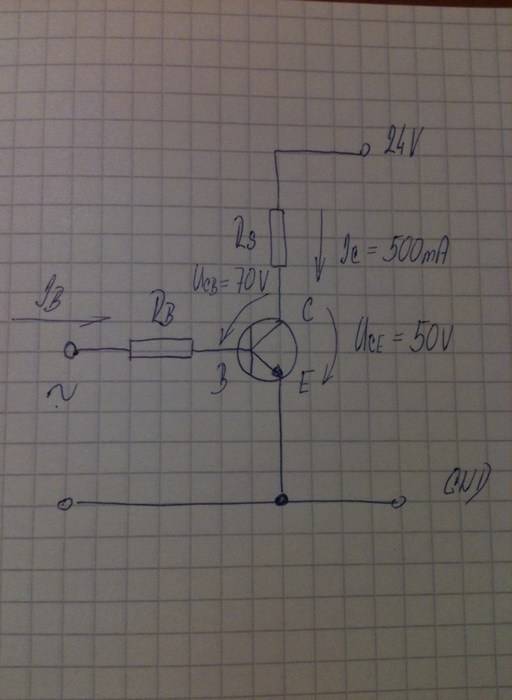
Transistor KFY34 has to switch a load of nominal supply voltage 24V and resistance Rs=60Ω.
a)Draw a schematic of electrical circuits.
b)Determinate Ib while the load is switched on.
c)Determinate currents and voltages in the circuit I B = f(t), IC= f(t), UBE = f(t) a U CE = f(t) with the load switched on and off and draw them to a graph.
d)Decide if additional cooling is necessary.
KFY34: NPN, h21E = 35 až 125, UCB0 = 70V, UCER = 50V, ICmax = 500 mA, UCES ≈ 1,5V, PC = 800mW


Homework Equations


Ib=Ic/β
Rb=(Uin-Ube)/Ib


The Attempt at a Solution


obr_zek.jpg
 
Physics news on Phys.org
The voltages and currents you have drawn are the maximum allowed specifications, not the values that the transistor experiences in this circuit. How could you get 50V or 70V across the transistor, with only a 24V power supply? :biggrin;

Calculate the voltages in the circuit assuming two conditions: 1) the transistor is cut off (Off state), 2) the transistor is in saturation (On state).
 
Thank you for your answer, 70V with a 24 power supply is a great mistake of mine, of course :)
1)if the transistor is cut off, there would be a full voltage at it, wouldn't it?
2)in saturation mode there's should be voltage drop of 0,6-0,7 due to diode-juction.
 
-SJ- said:
Thank you for your answer, 70V with a 24 power supply is a great mistake of mine, of course :)
1)if the transistor is cut off, there would be a full voltage at it, wouldn't it?

Correct. Vce would be 24V in cutoff. What would Ic be?

-SJ- said:
2)in saturation mode there's should be voltage drop of 0,6-0,7 due to diode-juction.

Somewhere around there, perhaps Vce would be a bit lower than 0.6V. So what does that mean for Ic? And then how can you work back to finding the Ib needed to support that Ic?
 
If 24V be cutoff, there will be none Ic.
And there would be relative height Ic while transistor switched on determinated by Rd. But not sure how to calculate it because I don't know beta neither Rd.
 
-SJ- said:
If 24V be cutoff, there will be none Ic.
And there would be relative height Ic while transistor switched on determinated by Rd. But not sure how to calculate it because I don't know beta neither Rd.
Compared to 60 Ohm, you can hopefully neglect the internal resistance of the transistor. You can probably assume it conducts perfectly (just with the internal voltage drop).
 
So, Ic=400mA. Hm, but what about Ib if assumed we don't know beta?
 
-SJ- said:
So, Ic=400mA. Hm, but what about Ib if assumed we don't know beta?
In practice, you'll never know β. You design for the worst case, plus allow an extra margin for safety. If you don't observe this cautious approach, then you risk losing the transistor.

So, what worst-case β will you design for?
 
Ic can't get over 500mA, so beta should be appropriate to that. But we don't know Ib, do we?
 
  • #10
-SJ- said:
Ic can't get over 500mA, so beta should be appropriate to that. But we don't know Ib, do we?
You are trying to determine what value you will set IB ... such that the transistor is guaranteed to operate in saturation, regardless of who builds it. So you base your calculations on the worst-case you can anticipate. You will need to refer to the device's specs for this.
 
  • #11
I've read some pages about transistors but nowhere found how to calculate it. In fact, I have no idea how to set Ib and any guidance would be really appreciate.
 
  • #12
You cited the relevant equation in the OP.

Edit: Well ok you need to rearrange it a bit. Ic=Ib*β

However β isn't a constant. It varies because the manufacturing process isn't perfect. If you need to achieve a certain Ic you had better assume β is at the lower end of the specified range when you calculate how much Ib you need to feed it. Otherwise not all transistors of that type would work.
 
Last edited:
  • #13
But which value of beta I should assume to determinate Ib? I've tried to look up it's range in a data sheet but it is not stated there. How can I find it out?
 
  • #14
-SJ- said:
But which value of beta I should assume to determinate Ib? I've tried to look up it's range in a data sheet but it is not stated there. How can I find it out?

You are not finding Beta information in the datasheet? Can you post a link to the datasheet?
 
  • #15
Google suggests this transistor dates from the 1970's and found what I think is a Czech data sheet.

http://www.datasheetarchive.com/dl/Scans-048/DSAGER000349.pdf

Looks like the static Current Gain is "Proudove zesileni" and is the parameter h21E.

Note that the gain is specified at various values of IE and temperature.
 
Last edited by a moderator:
  • #16
-SJ- said:
But which value of beta I should assume to determinate Ib? I've tried to look up it's range in a data sheet but it is not stated there. How can I find it out?
Refer to part (d) in your first post.
 
  • #17
Hello,
I am sorry for my very late response due to my work responsibilities. Thanks for help with the current gain, I've find some data sheet but was looking for the greek symbol beta and didn't realized that h21e may be the same.
It looks like the current gain is 35-125 for this particular transistor manufactured by Tesla (indeed wide range seems to me), so the base current would be Ib=4mA while h21e=125 and Icmax=500mA. But is there a guarantee the transistor will be in saturated region with so low current? If the internal resistance is negligible are we able to determine the voltages across the transistor how we are asked?
 
  • #18
4mA would be the best case. You have to plan for the worst case where you need more base current.
 
  • #19
-SJ- said:
It looks like the current gain is 35-125 for this particular transistor manufactured by Tesla (indeed wide range seems to me), so
... the base current would be Ib= ... mA while hFE=35 [/color]and Icmax=500mA.

To ensure the transistor will be saturated for all β in the range, you have to take the conservative approach.
 
  • #20
OK, for h21e=35 is the base current Ib=14mA. But what happens if we set this value and the h21e will be 125?
 
Last edited:
  • #21
-SJ- said:
OK, for h21e=35 is the base current Ib=14mA. But what if we set this value and the h21e will be 125?
What do you predict will happen? Base this on your understanding of transistors, including their characteristic graphs (which you should be able to sketch from memory).
 
  • #22
I would say it will damage the transistor, but so it is not more safety to set the Ib at lower current?
 
  • #23
Why would it damage the transistor? Suppose β was 1,000,000 do you think the collector current would be 14,000A? Unlikely. What else might limit the current?
 
  • #24
-SJ- said:
I would say it will damage the transistor, but so it is not more safety to set the Ib at lower current?
Which transistor rating would be exceeded by making IB to be 14mA? Only by exceeding some rating can you expect to damage the device.
 
  • #25
The current will be also limited by the collector load resistance. Ic=24/60=400mA, so the base current would be Ib=400/35=cca 12mA to ensure the transistor will be open. Is that correct?
 
  • #26
-SJ- said:
The current will be also limited by the collector load resistance. Ic=24/60=400mA, so the base current would be Ib=400/35=cca 12mA to ensure the transistor will be open. Is that correct?
That's the idea. But recognize that in practice that exact choice would be sailing too close to the wind. To ensure there is a margin of safety, you'd probably round out to 16 - 20 mA.

Your use of "open" is not correct, though I know what you mean. A better word is "closed", because when a switch is in the conducting state we say it is closed. An open switch is an open circuit = no current. Though I'd prefer "on" because the transistor is being used as a switch here, so it is either ON or OFF. (Well, it will be either ON or OFF if it's been designed properly.) :smile:
 
  • #27
OK, thank you. I'll be using either ON or OFF :-) But can be calculate the voltage between base and emitter and between collector and emitter? I was looking for it on the Internet but never find it (again:-).
 
  • #28
-SJ- said:
OK, thank you. I'll be using either ON or OFF :-) But can be calculate the voltage between base and emitter and between collector and emitter? I was looking for it on the Internet but never find it (again:-).

Look at the transistor datasheet. There will be specs and curves for Vbe and Vcesat as functions of temperature, current, etc. Ballpark numbers are a diode drop (0.6V-0.7V) for Vbe, and a few hundred milivolts (0.3-0.4V) for Vcesat.
 
  • #29
I've read following values fro the graphs: Uce=f(Ic)=3,5V; Ubesat=f(Ic)=1,2V; Ucesat=f(Ic)=3V. Could it be right? But what confuses me are these values as a function of time as listed in the example. They are time independent, don't they?
 
  • #30
Functions of time?? Where do I see that?

They shouldn't be.
 

Similar threads

  • · Replies 2 ·
Replies
2
Views
3K
  • · Replies 1 ·
Replies
1
Views
2K
Replies
68
Views
7K
  • · Replies 3 ·
Replies
3
Views
2K
  • · Replies 2 ·
Replies
2
Views
2K
Replies
3
Views
3K
  • · Replies 8 ·
Replies
8
Views
5K
  • · Replies 1 ·
Replies
1
Views
2K
  • · Replies 5 ·
Replies
5
Views
14K
Replies
2
Views
2K