Willjeezy
- 29
- 0
I had a physics course a few years back that touched on constructive and destructive waves and only today did i notice this phenomenon with my speakers. I was curious about the theory behind this particular scenario in my room.
I have one of those mobile speakers, a bose soundlink II. It has 4 tiny speakers and two transducers facing the opposite way (see photo)
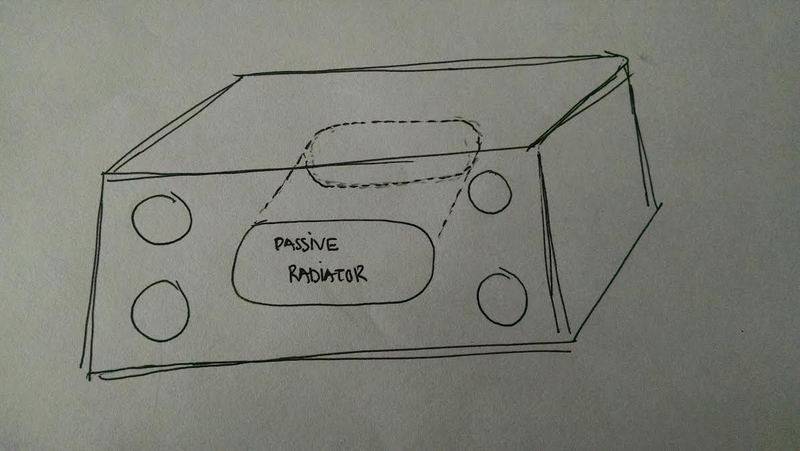
Now i notice as I walk backwards away from the speaker, i can actually audibly hear dead spots in the bass. I measured the distance between two dead spots and found it to be (350cm - 290cm = 60cm).
Why do I get dead spots at certain distances? Is it because the rear passive radiator bounces off the wall behind it and is out of phase with the front passive radiator? and why is it only the bass? If I bought the exact same mobile speaker and put it side by side is it possible i could cancel out the treble at certain distances?
I have one of those mobile speakers, a bose soundlink II. It has 4 tiny speakers and two transducers facing the opposite way (see photo)
Now i notice as I walk backwards away from the speaker, i can actually audibly hear dead spots in the bass. I measured the distance between two dead spots and found it to be (350cm - 290cm = 60cm).
Why do I get dead spots at certain distances? Is it because the rear passive radiator bounces off the wall behind it and is out of phase with the front passive radiator? and why is it only the bass? If I bought the exact same mobile speaker and put it side by side is it possible i could cancel out the treble at certain distances?