kent davidge
- 931
- 56
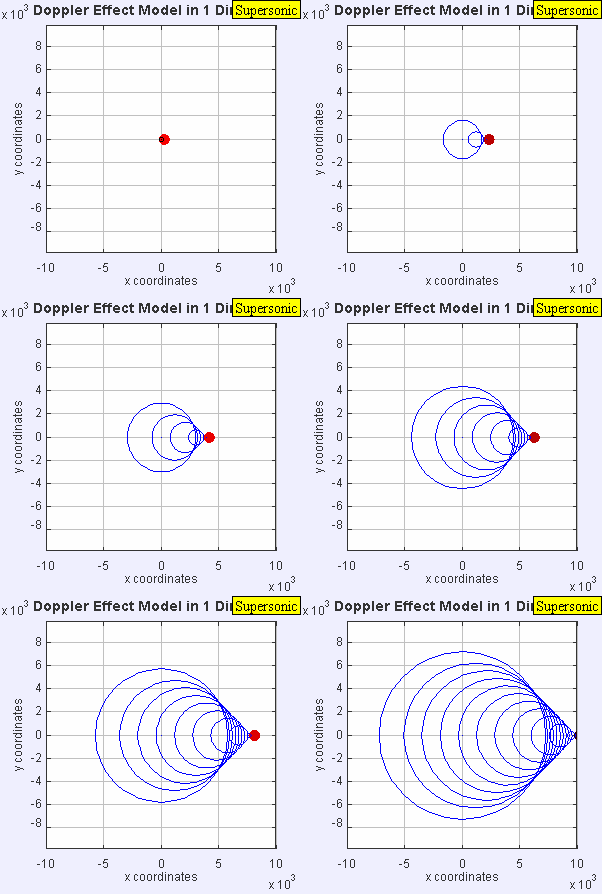
Suppose that an aircfract somehow is not moving. Then I would expect the sound waves it produces to spread out uniformely in a spherical fashion. Now imagine a airplane traveling at approximately the speed of sound. In this case, if the airplane produces a wave at point A and after a time T the sound sphere has a radius R, then at R the airplane will produce another sound wave. The centre of this later sound sphere would always lie at the surface of the earlier sound sphere, because both are traveling at the same speed. The result in a time lapse would be like this
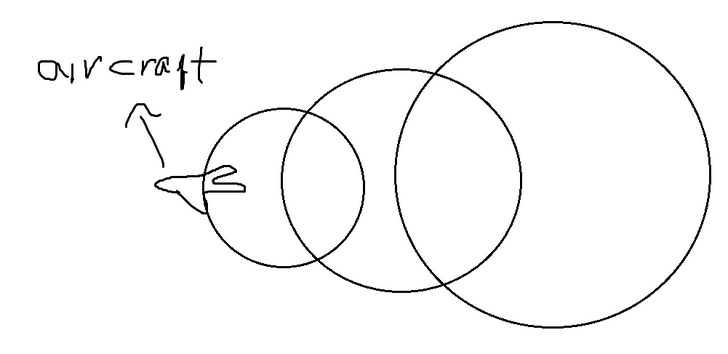
As opposed to this, an aircraft traveling at a lower than sound speed would draw a pattern like this
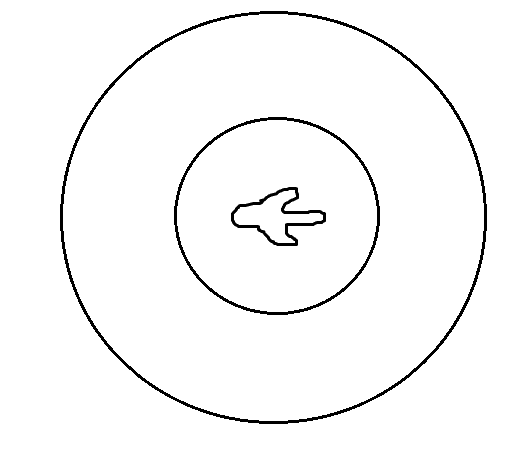
The main difference being that the two sphere surfaces don't "meet".
Now this reasoning is from my nearly zero understanding of waves.This is an attempt to explain sonic boom in simple terms. I did a previous search on web to find out whether this is correct or not, but didn't find any pictures like these above.
As opposed to this, an aircraft traveling at a lower than sound speed would draw a pattern like this
The main difference being that the two sphere surfaces don't "meet".
Now this reasoning is from my nearly zero understanding of waves.This is an attempt to explain sonic boom in simple terms. I did a previous search on web to find out whether this is correct or not, but didn't find any pictures like these above.
Attachments