Spaceship approaching Mars and relative motion

Click For Summary
The discussion focuses on calculating the relative motion of a spaceship approaching Mars, emphasizing that the spaceship's perspective requires setting its velocity to zero. The relative velocity of Mars is determined by subtracting the spaceship's speed from Mars' speed, which is noted as 24.1 - 19.3. It is clarified that the velocities should be treated as vectors rather than scalars, indicating a need for vector subtraction. The angle between the spaceship and Mars is questioned, with an assumption that it could be 90 degrees if their directions align. The conversation highlights the importance of correctly applying vector principles in relative motion scenarios.
Like Tony Stark
Messages
182
Reaction score
6
Homework Statement
The spaceship S approaches Mars following the trajectory ##b-b## with velocity ##\vec v_S=19.3 \frac{km}{s}## with respect to the Sun. If Mars has a velocity ##\vec v_M=24.1 \frac{km}{s}## along the trajectory ##a-a## with respect to the Sun, determine the angle between ##SM## and ##b-b## such that a person inside the spaceship "sees" that Mars is moving towards him.
Relevant Equations
##\vec v_{B/A}=\vec v_B - \vec v_A##
As the problem asks for the spaceship's perspective, I know that I should take ##\vec v_S=0## and ##\vec v_M=24.1-19.3## because the motion is relative to the spaceship. Then, the relative velocity of Mars and ##SM## should have the same direction. If they have the same direction, that angle would be 90°, wouldn't it? I mean, probably I'm forgetting something, but that's the way I tried to do it
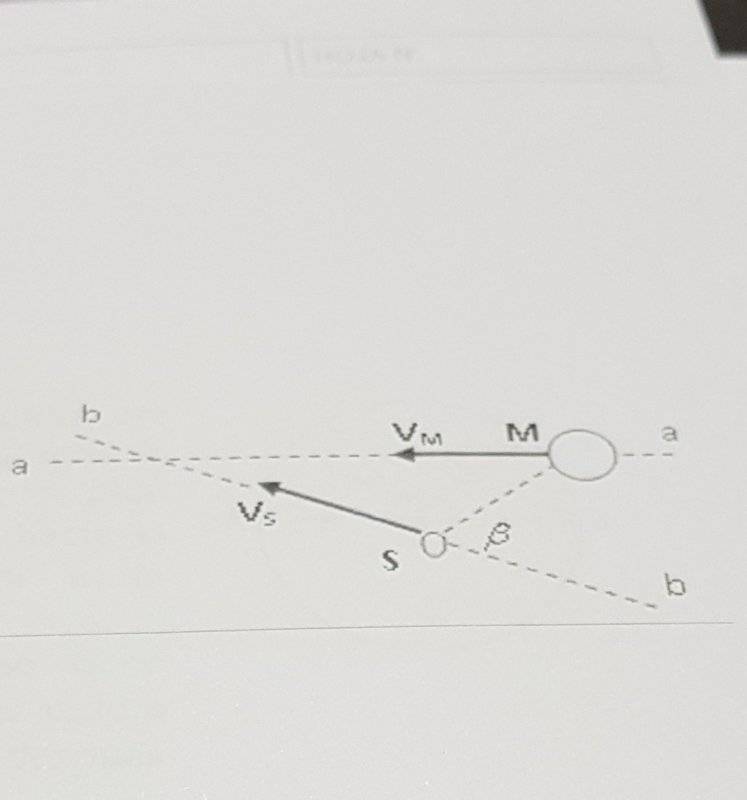
20190906_202027777.jpg
 
Physics news on Phys.org
Like Tony Stark said:
I know that I should take ##\vec v_S=0## and ##\mathbf{\vec v_M=24.1-19.3}## because the motion is relative to the spaceship.

The equation for ##\vec v_M## is a vector equation. So on the right hand side should be a vector subtraction. You have treated them as scalars.
 
The book claims the answer is that all the magnitudes are the same because "the gravitational force on the penguin is the same". I'm having trouble understanding this. I thought the buoyant force was equal to the weight of the fluid displaced. Weight depends on mass which depends on density. Therefore, due to the differing densities the buoyant force will be different in each case? Is this incorrect?

Similar threads

Replies
3
Views
1K
  • · Replies 14 ·
Replies
14
Views
2K
Replies
6
Views
2K
  • · Replies 27 ·
Replies
27
Views
4K
  • · Replies 2 ·
Replies
2
Views
2K
  • · Replies 20 ·
Replies
20
Views
1K
  • · Replies 21 ·
Replies
21
Views
1K
  • · Replies 9 ·
Replies
9
Views
4K
  • · Replies 1 ·
Replies
1
Views
1K
  • · Replies 4 ·
Replies
4
Views
2K