Special Relativity question using Lorentz Transformation time dilation

Click For Summary
The discussion revolves around a problem in special relativity involving time dilation and the Lorentz transformation. A spaceship traveling between two planets measures a distance of 4x10^8m and observes events that suggest an explosion occurs before a missile is fired, indicating the events are unrelated. Participants clarify that the direction of travel does not affect the calculations, as the Lorentz equations use speed rather than velocity. The conversation highlights the importance of understanding frame of reference and the validity of time differences in different inertial frames. Ultimately, the problem illustrates the complexities of relativity and the need for careful analysis of event sequences.
MyoPhilosopher
Messages
41
Reaction score
4
Homework Statement
Please see attached image
with distance between planets as 4x10^8m measured by you on the ship
Relevant Equations
t' = γ(t - ux/c^2)
with distance between planets as 4x10^8m measured by you on the ship

My attempt:
t' = γ(t - ux/c^2)
γ = 5/3
u = 0.8c
t = 0.9s
x = 4x10^8m
answer is: -0.278
Therefore not possible
My question is what if we traveled rightwards, from p2 to p1, would the answer change?
Should my above information make u = -0.8c instead of +?Thank you
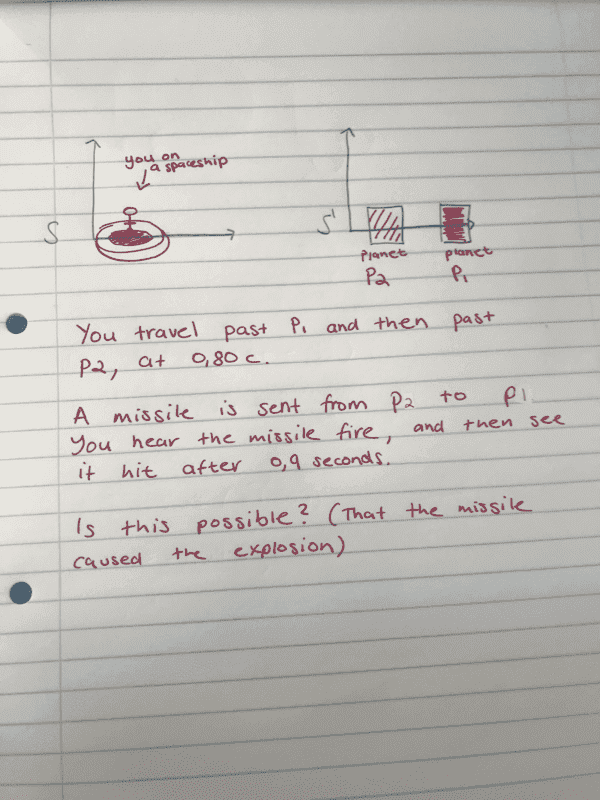
RelativityQuestion.png
 
Physics news on Phys.org
The "v" in the Lorentz equations is "speed" not "velocity". That is, the direction, whether from p1 to p2 or from p2 to p1, is not relevant.
 
HallsofIvy said:
The "v" in the Lorentz equations is "speed" not "velocity". That is, the direction, whether from p1 to p2 or from p2 to p1, is not relevant.
That's not correct. The ##v## is definitely velocity between frames.
 
MyoPhilosopher said:
Homework Statement: Please see attached image
with distance between planets as 4x10^8m measured by you on the ship
Homework Equations: t' = γ(t - ux/c^2)

with distance between planets as 4x10^8m measured by you on the ship

My attempt:
t' = γ(t - ux/c^2)
γ = 5/3
u = 0.8c
t = 0.9s
x = 4x10^8m
answer is: -0.278
Therefore not possible
My question is what if we traveled rightwards, from p2 to p1, would the answer change?
Should my above information make u = -0.8c instead of +?Thank you

View attachment 252879
Can you explain this problem? I can't work out what's supposed to be happening here.
 
PeroK said:
Can you explain this problem? I can't work out what's supposed to be happening here.
My best guess makes this a logic puzzle where special relativity plays no role at all.
 
jbriggs444 said:
My best guess makes this a logic puzzle where special relativity plays no role at all.

You are on a spaceship moving leftwards (from p1 towards p2).
You hear a missile fired from p2, and then 0.9s later see an explosion on p1.
Is it possible that the explosion on p1 is due to missile fired from p2?
Essentially we determine that the actual time difference between these events is negative - showing the explosion happens before the missile is sent.
 
PeroK said:
Can you explain this problem? I can't work out what's supposed to be happening here.
Please check one comment above
 
MyoPhilosopher said:
Please check one comment above
I guess the planets are ##4 × 10^8 m## apart in their rest frame?

I'm not sure how you can "hear" a missile. I assume that in your reference frame there are two events separated by ##0.9s##.

What is this time you have calculated?
 
MyoPhilosopher said:
You are on a spaceship moving leftwards (from p1 towards p2).
You hear a missile fired from p2, and then 0.9s later see an explosion on p1.
Is it possible that the explosion on p1 is due to missile fired from p2?
Essentially we determine that the actual time difference between these events is negative - showing the explosion happens before the missile is sent.
So the drawing in the first post is erroneous? The spacecraft is between p1 and p2 at the time the sound is heard?
 
  • #10
PeroK said:
I guess the planets are ##4 × 10^8 m## apart in their rest frame?

I'm not sure how you can "hear" a missile. I assume that in your reference frame there are two events separated by ##0.9s##.

What is this time you have calculated?
Yes that isn't accurate. I should have said you see a missile being sent by some light flash.
Yes that's correct about the time.
I was wondering why time dilation formula would give the same result independent if we travel left and right?
 
  • #11
jbriggs444 said:
So the drawing in the first post is erroneous? The spacecraft is between p1 and p2 at the time the sound is heard?
No the first drawing is not erroneous.
Question does not specify where we are.

https://slideplayer.com/slide/16889...ion+and+reversing+the+sequence+of+events:.jpg
Please check the pic, otherwise I may just make a new thread asking why we use the relative speed of the planet and moon and not the speed of the ship.
 
  • #12
MyoPhilosopher said:
Yes that isn't accurate. I should have said you see a missile being sent by some light flash.
Yes that's correct about the time.
I was wondering why time dilation formula would give the same result independent if we travel left and right?

It won't. Let me analyze this problem. First, it's a very poor question. Saying things like "hear" and "see" just creates the misconception that signal travel times are relevant.

Note also that I think it should be ##9s## not ##0.9s##.

The simplest approach is to analyze the situation in the rocket frame. The planets are ##1.6## light seconds apart. Planet 2 fires a missile at close to ##c##, but planet 1 is moving away from the source at ##0.8c##. The missile gains on p1 at a maximum of ##0.2c##, hence takes at least ##8s## to hit p1.

Note that if the planets were moving in the opposite direction, with p1 moving towards the source of the missile, then the missile and p1 would have a maximum separation speed of ##1.8c## and the missile would hit p1 about ##0.9s## later.

Perhaps this is the way the problem is supposed to be?

It makes a difference, therefore, whether the planets are moving in the opposite direction.

I imagine what you did was calculate the time between the events in the planets frame. If, however, you had got a positive time, what would that have told you?

Note that another way to solve the problem was to calculate whether the events are spacelike or time like separated.
 
  • #13
MyoPhilosopher said:
Essentially we determine that the actual time difference between these events is negative - showing the explosion happens before the missile is sent.
There is no such thing as an actual time difference. The 0.9 s you measure is a perfectly valid time difference between the two events. The time you calculated is the time between the events in the rest frame of the planets, but it is not any more valid or real than the time difference measured in any other inertial reference frame. That's one of the basic ideas in special relativity.

If the ship were going in the opposite direction and you still have ##\Delta t = 0.9~\rm s## and ##\Delta x = 4\times 10^{8}~\rm m##, you'd find the explosion occurred after the missile was launched in the rest frame of the planets. Yet one event still could not have caused the other.
 
  • #14
PeroK said:
Note also that I think it should be ##9s## not ##0.9s##.
Why?
 
  • #15
vela said:
Why?
Because the missile takes ##8s## in the rocket frame ro travel from p2 to p1. It would make more sense to have the two times close to each other.

Although, actually, I think that perhaps the missile is supposed to fired in the opposite direction, p1 to p2, as that gives a time of close to ##0.9s##.

PS the other thing I don't like about this question is that all the data is given in the rocket frame. There is no reason therefore, to transform to the planet frame.

That seems to be another misconception peddled by some who teach SR: that kinematics in a single frame no longer applies.
 
  • #16
PS I thought the distance was ##4.8 \times 10^8 m##, but I see now it's only ##4 \times 10^8 m##.

Anyway, the same principles apply even if the numbers aren't quite so neat!
 
  • #17
vela said:
There is no such thing as an actual time difference. The 0.9 s you measure is a perfectly valid time difference between the two events. The time you calculated is the time between the events in the rest frame of the planets, but it is not any more valid or real than the time difference measured in any other inertial reference frame. That's one of the basic ideas in special relativity.

If the ship were going in the opposite direction and you still have ##\Delta t = 0.9~\rm s## and ##\Delta x = 4\times 10^{8}~\rm m##, you'd find the explosion occurred after the missile was launched in the rest frame of the planets. Yet one event still could not have caused the other.
Alright thank you this helps me understand.
However, I found that the explosion occurs before the missile is sent - therefore events are unrelated.
I am just wondering what would change conceptually and mathematically if the ship traveled opposite direction?
 
  • #18
MyoPhilosopher said:
Alright thank you this helps me understand.
However, I found that the explosion occurs before the missile is sent - therefore events are unrelated.
I am just wondering what would change conceptually and mathematically if the ship traveled opposite direction?

Conceptually, in the frame of the rocket the target would be moving toward the source of the missile.

Mathematically, you would have ##v = -0.8c## in your LT.

Remember also that if another ship is moving in the opposite direction then its measurenents for these events would be different.

Note, finally, that you used ##x = 4 \times 10^8 m## in your calculation. But, that was the position of p1 at time ##t = 0##. At ##t = 0.9s## p1 has moved in the rocket frame.

This is my point about not thinking about the kinematics of the problem.
 
  • Like
Likes MyoPhilosopher

Similar threads

  • · Replies 35 ·
2
Replies
35
Views
5K
  • · Replies 4 ·
Replies
4
Views
1K
  • · Replies 36 ·
2
Replies
36
Views
3K
  • · Replies 21 ·
Replies
21
Views
5K
  • · Replies 4 ·
Replies
4
Views
2K
  • · Replies 4 ·
Replies
4
Views
2K
Replies
2
Views
2K
  • · Replies 2 ·
Replies
2
Views
2K
Replies
8
Views
2K
  • · Replies 4 ·
Replies
4
Views
1K