Spectrum of laser light absorbed and re-emitted by a white object

  • Context: Undergrad 
  • Thread starter Thread starter small physicist
  • Start date Start date
  • Tags Tags
    Laser Light Spectrum
Click For Summary

Discussion Overview

The discussion revolves around the behavior of laser light when it interacts with a white surface, specifically focusing on the spectrum of light that is absorbed and re-emitted. Participants explore concepts related to reflection, absorption, and potential fluorescence, as well as the implications of the narrow spectrum of laser light.

Discussion Character

  • Exploratory
  • Technical explanation
  • Conceptual clarification
  • Debate/contested

Main Points Raised

  • Some participants propose that when a red laser is shone on a white surface, a portion of the light is reflected, some is absorbed and converted into phonons, and some is absorbed and re-emitted.
  • It is suggested that the reflected energy will primarily be at the laser's wavelength of ## \lambda=632.8 ## nm, but this may vary depending on the specific characteristics of the white surface.
  • One participant notes the possibility of fluorescence occurring in white paint, which could affect the emitted spectrum, along with potential infrared emissions due to heating.
  • Another participant argues that the narrow line width of lasers means that the spectrum observed will closely match the source wavelength, with little variation due to color or wavelength-dependent reflection or absorption.
  • There is mention of the potential for materials to convert the 632 nm light to different frequencies, typically through fluorescence, although the effectiveness of this process may vary with the excitation wavelength.
  • Some participants discuss the implications of a white sheet having a 'flat' reflectance curve, suggesting it would not generate other frequencies due to being a linear medium.
  • There is a reference to non-classical effects such as Stokes and anti-Stokes shifts when light is absorbed and re-emitted, which introduces complexity to the discussion.

Areas of Agreement / Disagreement

Participants express a range of views on the behavior of light interacting with white surfaces, with no clear consensus on the specifics of the emitted spectrum or the effects of fluorescence and other phenomena. Multiple competing perspectives remain on how the characteristics of the white surface influence the outcome.

Contextual Notes

Limitations include the dependence on the specific composition of the white surface and the unresolved nature of how various factors, such as fluorescence and heating, may affect the emitted spectrum.

small physicist
Messages
3
Reaction score
0
Hello,

If I shine a red laser onto a white surface, I assume that:
  • some of the red light will be nearly instantly reflected,
  • some will be absorbed and converted into phonons
  • and some will be absorbed and re-emitted.
Is that correct?
I know that my laser has this extremely narrow spectrum:
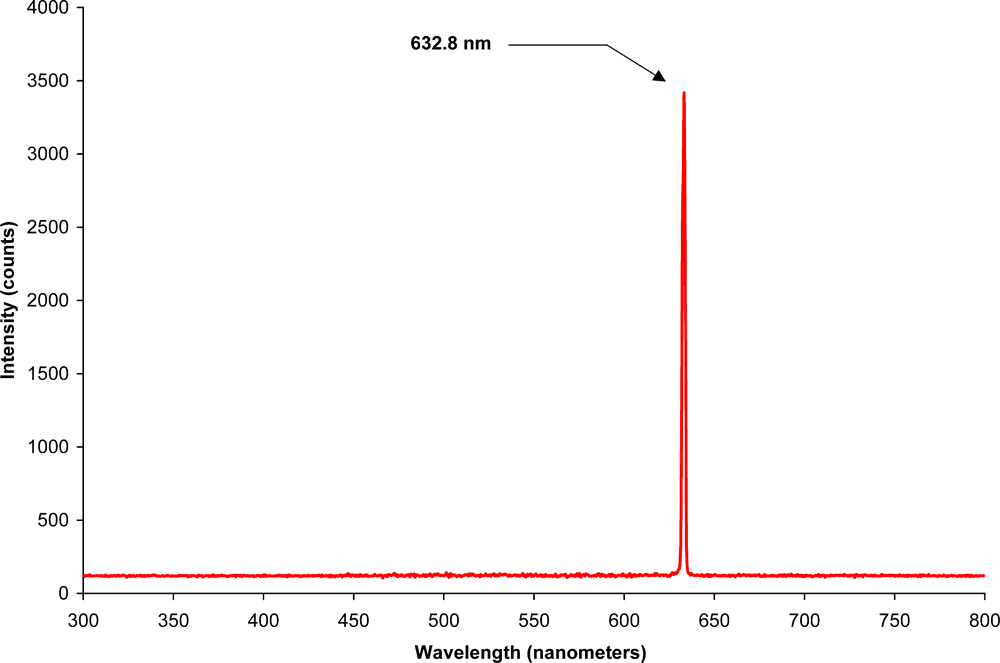
Helium_neon_laser_spectrum.png


but what spectrum does a white surface emit when I shine it with said laser?

Thanks in advance.

 
Science news on Phys.org
It's likely to differ slightly depending upon the nature of the white surface, but the vast majority of the reflected energy will normally be at ## \lambda=632.8 ## nm.:welcome:
 
  • Like
Likes   Reactions: sophiecentaur, DaveE and small physicist
Hello, thanks for answer. Do you have any spectrums i can see? I couldn't find in google.
 
I don't have any spectrums. For a white paint, there is always the possibility that some fluorescence will occur. In addition, if there is some absorption, there will be heating of the surface for possible infrared emissions. (Just because it is high reflectivity, near zero emissivity in the visible doesn't mean the infrared emissivity will be near zero.)
In general, because of the low signal level expected at wavelengths other than ## \lambda=632.8 ## nm, it's not something that would be commonly measured. In addition, the results will differ depending on the composition of the visibly reflective material.
 
  • Like
Likes   Reactions: small physicist
The line width of lasers is pretty narrow. So you really won't see any change do to "color", i.e. wavelength dependent reflection or absorption. That is why spectrometers have either a tunable source or a broadband source (i.e. white light). So, the spectrum you see reflected (or absorbed) will be the source wavelength, since that's all there is. The details of that spectrum depend on the design of the laser (primarily cavity length).

It is possible for the material to convert the 632nm to a different frequency, usually due to fluorescence. However the 632nm wavelength doesn't excite fluorescence as well as shorter wavelengths. For example, a common instrument for fluorescence analysis of materials uses x-rays. In biological assays, the most common excitation wavelength is 488nm. This is because, back in the day, this was a high power line available from Ar lasers, for which several fluorophores were developed. Then as light sources evolved newer technologies had to match that wavelength because people didn't want to change the chemicals.

Anyway, as others have said, it depends on the materials illuminated.
 
  • Like
Likes   Reactions: small physicist and Charles Link
small physicist said:
Summary:: When shinning a laser on a white object what's the spectrum of the light we get back?

what spectrum does a white surface emit when I shine it with said laser
Have you any reason to suspect it wouldn't be the same? A white sheet has a 'flat' reflectance curve and it could hardly generate (?). any other frequencies because it is a linear medium.
Apart from being pretty highly monochromatic, the light from a laser is, in most respects, much the same as light from any other slightly less monochromatic source - like a gas discharge tube with filters.
 
  • Like
Likes   Reactions: Charles Link
sophiecentaur said:
Have you any reason to suspect it wouldn't be the same? A white sheet has a 'flat' reflectance curve and it could hardly generate (?). any other frequencies because it is a linear medium.
Apart from being pretty highly monochromatic, the light from a laser is, in most respects, much the same as light from any other slightly less monochromatic source - like a gas discharge tube with filters.

When light is absorbed and re-emitted it can have different wavelengths (stokes shift and anti-stokes shift)
1024px-Stokes_shift-_Rh6G.png
 
small physicist said:
When light is absorbed and re-emitted it can have different wavelengths (stokes shift and anti-stokes shift)
Ah yes. A non-classical effect, I think? I was thinking that's outside the scope of the original question which refers to a "white object". That sort of implies a regular optics question but the situation is actually more interesting. I should have looked at the helpful A rating of the post.
 
  • Like
Likes   Reactions: Charles Link

Similar threads

  • · Replies 40 ·
2
Replies
40
Views
5K
  • · Replies 207 ·
7
Replies
207
Views
14K
  • · Replies 8 ·
Replies
8
Views
2K
Replies
9
Views
2K
  • · Replies 7 ·
Replies
7
Views
5K
  • · Replies 5 ·
Replies
5
Views
3K
  • · Replies 5 ·
Replies
5
Views
2K
  • · Replies 7 ·
Replies
7
Views
3K
  • · Replies 4 ·
Replies
4
Views
3K
  • · Replies 26 ·
Replies
26
Views
6K