LowBlackFast
- 2
- 1
Can someone help me evaluate an idea that I have?
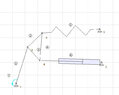
I'm investigating the idea of placing a very progressive pull spring and a digressive shock on a rocker to control the timing and rotation of an axle.
I could be way off, but here's the scenario in my head. Both shock and spring are being pulled when a torque is applied. Spring is progressive, eventually hitting a bushing and going solid. The shock is digressive in rebound and significantly stiffer than the spring at high speed. But as the spring goes solid rotation speed of the axle will decrease. As the velocity decreases the shock becomes softer, thus allowing rotational compliance that can be "timed"
I apologize in advance if I'm ignoring some fundamentals. I believe this would act in a similar manner as a series mass damper? I'm not sure on the math. It's kinda over my head.
Thanks
I'm investigating the idea of placing a very progressive pull spring and a digressive shock on a rocker to control the timing and rotation of an axle.
I could be way off, but here's the scenario in my head. Both shock and spring are being pulled when a torque is applied. Spring is progressive, eventually hitting a bushing and going solid. The shock is digressive in rebound and significantly stiffer than the spring at high speed. But as the spring goes solid rotation speed of the axle will decrease. As the velocity decreases the shock becomes softer, thus allowing rotational compliance that can be "timed"
I apologize in advance if I'm ignoring some fundamentals. I believe this would act in a similar manner as a series mass damper? I'm not sure on the math. It's kinda over my head.
Thanks
Attachments