Stabilizer Leg Linear Actuator Force to Jack up a Truck's rear tyres

Click For Summary

Homework Help Overview

The discussion revolves around calculating the force required by linear actuators to lift the rear tyres of a truck, focusing on the mechanics involved in stabilizing the vehicle during this process. The subject area includes concepts of torque, moment of inertia, and static equilibrium.

Discussion Character

  • Mixed

Approaches and Questions Raised

  • Participants explore the relationship between torque, moment of inertia, and angular acceleration in the context of lifting the vehicle. Questions arise regarding the assumptions made about static equilibrium and the implications of lifting the rear tyres off the ground.

Discussion Status

There is ongoing exploration of different scenarios related to the problem, with some participants suggesting that the situation may simplify the calculations. Guidance has been offered regarding the differences between the original and current problems, highlighting the implications for the forces involved.

Contextual Notes

Participants note that the original problem involved stabilizer legs just touching the ground, while the current scenario assumes the rear tyres are lifted, which changes the dynamics and the need to consider spring constants. There is a recognition of the need for clarity on the assumptions being made in the calculations.

Ashferico
Messages
9
Reaction score
0
Homework Statement
A truck weighing 80kN is supported at its two axles. The truck also carries a load on a lifting arm of 45kN. It has stabilizer legs at the rear of the vehicle. What is the required force of the linear actuators that are driving the stabilizer leg to jack the rear tyres so they are not in contact with the ground?
Relevant Equations
Resultant Torque = Moment of Intertia I x Angular Acceleration

Moment of Inertia I = Mass x (Radius of Gyration)^2

Parallel Axis Theorem: I = I(cm) + md^2

Angular Displacement = 0.5 x Angular Acceleration x (time^2)

Resultant Torque = Sum of Clockwise Moments - Sum of Anticlockwise Moments

Moment = Force x Perpendicular Distance from Pivot
Hi,

I previously posted about the statically indeterminate truck problem. Thank you to everyone who helped me. However, I now realized that isn't the problem I need to solve. I need to know the force of the linear actuators to lift the rear tyres off the ground.
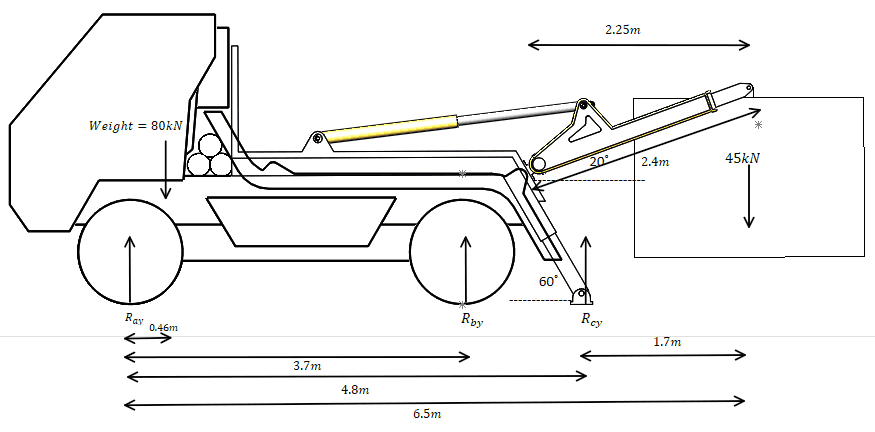
1588099618744.png


Since the tyres will be lifting off the ground, it can't be in static equilibrium.

If it rotating about the front tyres, then there must be a resultant torque:

Resultant Torque = Moment of Intertia I x Angular Acceleration

If I make the assumption that rear tyres are raised 1cm from the ground:
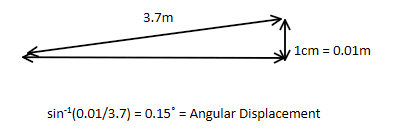
1588108230814.png


The angular displacement is 0.15 degrees.

If I make the assumption this happens over 5 seconds:

Angular Displacement = 0.5 x Angular Acceleration x (t^2)

Angular Acceleration = 0.012°/s^2 =0.0002 radians/s^2

Now if we use:

Resultant Torque = Moment of Intertia I x Angular Acceleration

&

Resultant Torque = Sum of Clockwise Moments - Sum of Anticlockwise Moments

Moment of Intertia I x (-0.0002) = (80 x 0.46) + (45 x 1.85) - (Rcy x 4.8)

If I calculated the Moment of Inertia of the entire truck and box combined, then I can calculate Rcy.

Is this Rcy, the linear actuator force required by the stabilizer leg to jack the vehicle?

Likewise, how can I calculate the Moment of Inertia of the truck about the front wheel's tyre?
 
Physics news on Phys.org
Ashferico said:
Since the tyres will be lifting off the ground, it can't be in static equilibrium.
As long as the stabilizers are extended slowly, it reasonable to assume that a stable static equilibrium exists at all times.

Certainly, that is a desirable state of affairs. You want to be able to stop the stabilizers at any point and not have the rig tip over.
 
jbriggs444 said:
As long as the stabilizers are extended slowly, it reasonable to assume that a stable static equilibrium exists at all times.

Certainly, that is a desirable state of affairs. You want to be able to stop the stabilizers at any point and not have the rig tip over.

Hi,

Thank you for the reply again. Does that mean the original statically indeterminate calculation was the force required of the linear actuators?
 
Ashferico said:
Thank you for the reply again. Does that mean the original statically indeterminate calculation was the force required of the linear actuators?
As I recall the original problem had you put down the stabilizer legs until they were just touching the ground. Then you raised the load and asked about the resulting support force from the legs. There was no requirement that the rear wheels be lifted from the ground. That was a difficult situation because lifting the load would raise the chassis somewhat off both front and rear springs. One needed to think about spring constants in order to determine the resulting equilibrium load distribution.

In this case, my understanding is that you have [perhaps foolishly] raised the load first and then put down the stabilizer legs sufficiently to force the rear wheels clear of the ground. This is a much easier problem. There is no need to worry about spring constants. The rear wheels are irrelevant this time. The only support is at the stabilizers and at the front wheels. No extra unknowns to solve for. Easy peazy.

But the two situations are different. Two different problems with two different solutions.
 
jbriggs444 said:
As I recall the original problem had you put down the stabilizer legs until they were just touching the ground. Then you raised the load and asked about the resulting support force from the legs. There was no requirement that the rear wheels be lifted from the ground. That was a difficult situation because lifting the load would raise the chassis somewhat off both front and rear springs. One needed to think about spring constants in order to determine the resulting equilibrium load distribution.

In this case, my understanding is that you have [perhaps foolishly] raised the load first and then put down the stabilizer legs sufficiently to force the rear wheels clear of the ground. This is a much easier problem. There is no need to worry about spring constants. The rear wheels are irrelevant this time. The only support is at the stabilizers and at the front wheels. No extra unknowns to solve for. Easy peazy.

But the two situations are different. Two different problems with two different solutions.

So, in this scenario. Its just two supports, front wheels and stabilizers. The force of the stabilizer in static equilibrium is also the force to jack the vehicle up? Thus it is the force of the linear actuators? It is for a mechanical design project and I need to specify the right components.
 

Similar threads

Replies
8
Views
3K
  • · Replies 42 ·
2
Replies
42
Views
4K
  • · Replies 97 ·
4
Replies
97
Views
6K
  • · Replies 29 ·
Replies
29
Views
3K
  • · Replies 7 ·
Replies
7
Views
2K
Replies
1
Views
5K
  • · Replies 21 ·
Replies
21
Views
7K
  • · Replies 69 ·
3
Replies
69
Views
6K
  • · Replies 11 ·
Replies
11
Views
3K
  • · Replies 121 ·
5
Replies
121
Views
12K