Stainless steel friction / galling

Click For Summary

Discussion Overview

The discussion revolves around material selection for a component in a clamp that involves stainless steel parts and concerns about friction and galling. Participants explore alternatives to stainless steel for a part that must withstand pressure without lubrication, considering various materials and their properties in relation to corrosion and wear.

Discussion Character

  • Technical explanation
  • Debate/contested
  • Exploratory

Main Points Raised

  • One participant expresses concern about galling with stainless steel and suggests considering plastics like Tufnol or ceramics for part D.
  • Another participant mentions that brass does not gall against stainless steel and recommends Nylatron as a suitable plastic for gears.
  • A suggestion is made to use a strip of PTFE or Nylon between D and C, with D potentially being made of brass or bronze for added strength.
  • It is proposed that brass or bronze would be effective where A and B contact D, and UHMW tape is recommended to reduce friction between C and D.
  • A participant expresses hesitation about using tape due to concerns about the force applied and the need for durability in the clamp's function.
  • Questions are raised about the corrosive fluid involved, with a note that bronze has fewer corrosion issues than brass, and that stainless steel's properties depend on the oxygen environment.
  • Concerns are discussed regarding the efficiency of lubrication due to the inability to seal the C to D surface, and the potential for grit to act as an abrasive if D is plastic.
  • Technical considerations are made about the force distribution and contact areas between A, B, and D, emphasizing the importance of alignment and contact geometry to minimize wear.
  • A participant acknowledges the relevance of the points made about surface contact and clarifies the environmental conditions for the clamp's use.

Areas of Agreement / Disagreement

Participants present multiple competing views on material choices and their properties, particularly regarding the suitability of brass, bronze, and various plastics. The discussion remains unresolved with no consensus on the best approach.

Contextual Notes

Participants express uncertainty about the specific corrosive environment and the implications for material selection. There are also unresolved considerations regarding the mechanical design and contact pressures that may affect performance.
pete
Messages
72
Reaction score
5
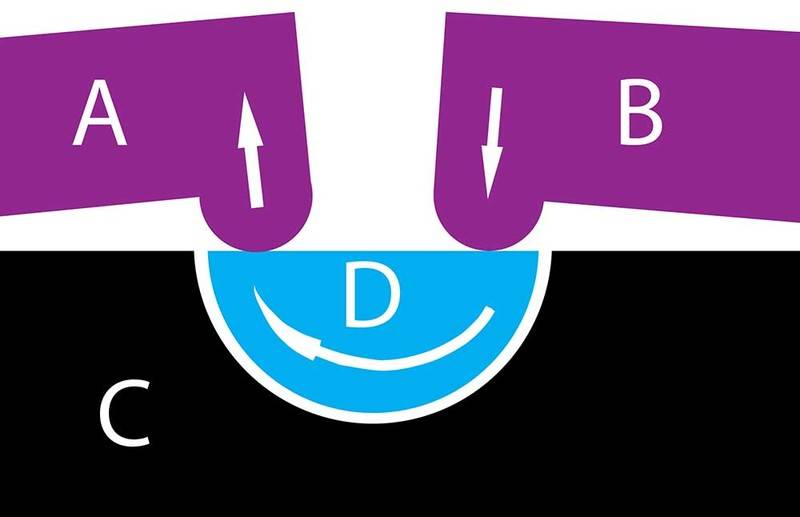
Hi, I’m looking for some advice on materials. In the picture A, B and C are stainless steel. Pressure is applied at B rotating D in the socket and raising A. D needs to be as strong as possible to resist the load but I’m concerned about D rubbing against C as there is no lubrication. I can't change A, B and C and need D to be non corrosive, stainless steel is going to course galling so was considering a plastic like Tufnol, or maybe some kind of ceramic? Any advice?

Galling_S.jpg
 

Attachments

  • Galling_S.jpg
    Galling_S.jpg
    20.3 KB · Views: 1,151
Engineering news on Phys.org
Brass does not gall against stainless steel. Nylatron is a good plastic, it is commonly used to make gears.
 
Thanks, both look like good suggestions, I'm looking to see if I can sit a strip of PTFE or Nylon between D and C then maybe
D in Brass or Bronze, I think Bronze is also good and makes for a stronger part?
 
I have to close this up and forget about it and know it’ll do it’s job for as long as possible so tape sounds a bit scary, the force at B is a M12 lever and A is a fixed surface, it’s part of a clamp. I’ll have a look at UHMW though sounds like interesting stuff.
 
What is the corrosive fluid? Water? Salt brine? Acid?

There are less corrosion problems with bronze than with brass. Stainless steel is only stainless in an excess oxygen environment.

Lubrication will be difficult or inefficient because the C to D surface cannot be sealed. If D is plastic, grit will become embedded in the surface of D and act as an abrasive against A, B and C.

The total force of A and B on D must be carried on the D-C contact. But the area of the A-D and B-D contacts are significantly smaller with much higher pressures. Any horizontal movement of the A-D or B-D will wear those surfaces. To reduce that horizontal movement, the axis of D should lie on the straight line, or plane, between the axes of rotation of A and B. If that cannot be done, the flat face of D should not be a diameter, but be cut as two planes or a chord.

The A to B lever ratio will be highly dependent on the distances of the A-D and B-D contact lines from the axis of D. That will change as movement occurs because of the shape of the A and B contact bumps will roll along the sloped flat surface of D.
 
Thanks for the input Baluncore, I missed you post. That's not really an accurate picture of the part I just wanted to describe the type of surface contact. Never the less some of the points you made are valid to the original component idea and were very helpful. It’s a type of clamp so just corrosive resistant as in left outdoors over night, it’s not a marine or corrosive industrial environment though I suppose it could be used around salt water.
 

Similar threads

  • · Replies 6 ·
Replies
6
Views
2K
  • · Replies 10 ·
Replies
10
Views
5K
  • · Replies 16 ·
Replies
16
Views
5K
  • · Replies 18 ·
Replies
18
Views
3K
  • · Replies 3 ·
Replies
3
Views
4K
  • · Replies 3 ·
Replies
3
Views
6K
  • · Replies 9 ·
Replies
9
Views
3K
Replies
4
Views
1K
  • · Replies 8 ·
Replies
8
Views
3K
  • · Replies 16 ·
Replies
16
Views
4K