What is the corrosive fluid? Water? Salt brine? Acid?
There are less corrosion problems with bronze than with brass. Stainless steel is only stainless in an excess oxygen environment.
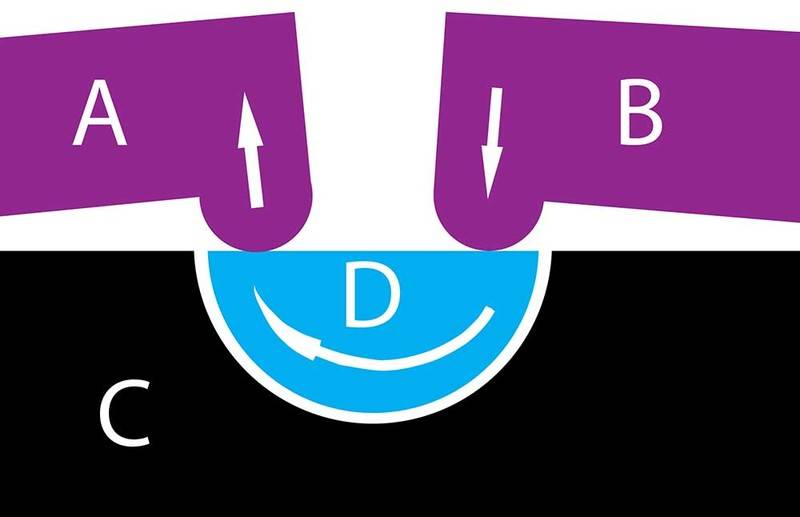
Lubrication will be difficult or inefficient because the C to D surface cannot be sealed. If D is plastic, grit will become embedded in the surface of D and act as an abrasive against A, B and C.
The total force of A and B on D must be carried on the D-C contact. But the area of the A-D and B-D contacts are significantly smaller with much higher pressures. Any horizontal movement of the A-D or B-D will wear those surfaces. To reduce that horizontal movement, the axis of D should lie on the straight line, or plane, between the axes of rotation of A and B. If that cannot be done, the flat face of D should not be a diameter, but be cut as two planes or a chord.
The A to B lever ratio will be highly dependent on the distances of the A-D and B-D contact lines from the axis of D. That will change as movement occurs because of the shape of the A and B contact bumps will roll along the sloped flat surface of D.