Is Static Friction Capable of Doing Work?

Click For Summary
Static friction does not do work in the traditional sense because it does not move; instead, it provides the necessary torque for rotational motion. While static friction can act on an object, such as a box in a truck, to change its kinetic energy, the total work done by static friction is zero when considering the action-reaction force pairs. The discussion highlights that static friction essentially acts as a passive force that facilitates the conversion of gravitational work into rotational kinetic energy. Additionally, when analyzing systems, the context of the forces and their interactions is crucial to understanding the work done. Overall, static friction plays a significant role in determining the dynamics of motion without directly contributing energy to the system.
Isaac0427
Insights Author
Gold Member
Messages
718
Reaction score
163
I understand the whole explanation about why static friction does no work-- I'm just confused about one of the consequences of that.
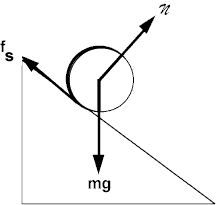
e25269f2-9e63-496a-a280-b5f82e2d27ec.gif

Consider the picture above. The ring is being pulled down the incline with a force of mg*sin(θ). If you analyze the system about the axis at the center of mass of the ring, the only force that can provide a torque to the ring is the force of static friction (all other forces are applied at the center of mass). The ring will rotate about that axis if it is rolling without slipping, at a rate of ω=v/r which will increase as the velocity of the center of mass (v) is accelerating. Since the angular speed changes with time, there is a net torque on the ring that has to be provided by the force of static friction. If a torque is applied, and there is an angular displacement (which must happen for the ring to be rotating) there is work done W=∫τdθ. Therefore, it seems as though the force of static friction must be doing work.
 
Physics news on Phys.org
I think the key point here is that the force does not move; it is the CM that moves. The non-moving force cannot do work. The motion of the CM allows work to be done by the force of gravity.
 
There is room for ambiguity. It depends on what one means by "the force of static friction".

The force of static friction can most certainly do work. If you put a box in the back of your truck and drive off, static friction from the bed of the truck on the box does work on the box. In this case we are considering only one side of the third law force pair. We are ignoring the force of the box on the truck.

If one considers the third law partner force of box on truck, the work that it does is equal and opposite. So total work done is zero. That is why one might say that "the force of static friction does no work".

Now, back to your example. The force of static friction of ramp on ball is applied at zero velocity in the ground frame. Accordingly, it does zero work in this case. As @Dr.D has already pointed out.
 
Last edited:
  • Like
Likes QuantumQuest and russ_watters
I'd be interested in what you say to someone who is sitting on the axis of the cylinder, not himself rotating, but moving with the axis in a direction parallel to the plane. I'm not sure whether he is allowed to imagine himself at rest watching the plane accelerate past him causing the cylinder to accelerate rotationally, but if he is, doesn't he see its being caused by friction with the plane? Only this time, the point of contact is moving at the same velocity as the plane, so the friction is now doing work?
 
Then what force causes a torque about the ring’s CM?
 
Ah, I think I understand it now. No energy is given to the system by the force of static friction—it just determines the amount of work done by gravity that gets turned into rotational kinetic energy. If you analyze the system about the CM axis of the ring, gravity can not give the system any rotational kinetic energy as it does not exert a torque—static friction provides the torque.

Is this right? Does static friction just provide the torque for the work done by gravity? It seems weird, but I can’t think of a different explanation.
 
Isaac0427 said:
Ah, I think I understand it now. No energy is given to the system by the force of static friction—it just determines the amount of work done by gravity that gets turned into rotational kinetic energy.
Yes, that is one way to think of it -- a passive anchor.

Here is another.

If you want to consider how the force of static friction acts as a torque and affects the ball's rotational kinetic energy, you could also consider how it affects the ball's linear kinetic energy.

Suppose that the ball has radius r and rolls a distance s down the slope. Suppose that the static frictional force is given by f.

Please calculate for us the work done by the torque and by the linear force separately.
 
It decreases linear kinetic energy at the same rate as it increases rotational kinetic energy. Thus it does no net work. This makes so much more sense now. Thank you!
Related question: this perfectly rigid ring (just talking theoretically, I know nothing is perfectly rigid) rolls onto a flat a surface that provides static friction, but there is no rolling resistance as the ring is rigid. Is it true that there is no static friction between the ring and the ground even if rolling without slipping exists? Mathematically that appears to be the case, it just seems a little off conceptually. If this is the case, the ring will roll forever, right?

Thank you all again.
 
jbriggs444 said:
In this case we are considering only one side of the third law force pair. We are ignoring the force of the box on the truck.
I disagree with this explanation. All forces, not only static friction, have reaction counterparts outside the system that do work opposite in sign to the action force. Once you decide what your system is, what's outside the system does not count. As far as the box in the back of the truck is concerned, (a) the kinetic energy of the box increases and (b) the only horizontal force acting on the box is static friction. If it is not responsible for the change in kinetic energy of the box, then what force is?
 
  • #10
kuruman said:
I disagree with this explanation. All forces, not only static friction, have reaction counterparts outside the system that do work opposite in sign to the action force.
Not all force pairs are such that the two affected bodies are in contact at the respective points of action and are not in relative motion at that shared point of action. For instance, kinetic friction or electrostatic force do not adhere to these requirements. The net effect of a force pair involving kinetic friction or electrostatic interaction can be that non-zero total work is done. In the case of kinetic friction the total work done is always negative.

This remains true if one draws system boundaries so that the force pair is internal.

Note well: The work done by action and reaction components are NOT always opposite in sign for forces other than static friction.
Once you decide what your system is, what's outside the system does not count. As far as the box in the back of the truck is concerned, (a) the kinetic energy of the box increases and (b) the only horizontal force acting on the box is static friction. If it is not responsible for the change in kinetic energy of the box, then what force is?
I agree with this and said as much in the post that you quoted:
jbriggs444 said:
The force of static friction can most certainly do work.

If you draw a system boundary so that one object is outside and one is inside, the force of static friction acting across the boundary into the system of interest can most certainly do work on the system.
 
Last edited:

Similar threads

  • · Replies 4 ·
Replies
4
Views
2K
  • · Replies 4 ·
Replies
4
Views
3K
  • · Replies 4 ·
Replies
4
Views
2K
  • · Replies 6 ·
Replies
6
Views
2K
  • · Replies 7 ·
Replies
7
Views
5K
  • · Replies 7 ·
Replies
7
Views
2K
  • · Replies 37 ·
2
Replies
37
Views
4K
  • · Replies 67 ·
3
Replies
67
Views
5K
  • · Replies 7 ·
Replies
7
Views
3K
  • · Replies 3 ·
Replies
3
Views
2K