Statics problem (moment and equilibrium)

Click For Summary
SUMMARY

The discussion focuses on calculating the force experienced by a worker's shoulder while carrying a 6kg uniform rigid board, utilizing concepts of moment and equilibrium in statics. The user successfully constructs a free body diagram (FBD) to analyze the forces acting on the board, determining that the total weight acts at the center of mass. By applying the moment equation, they calculate the force at point B and subsequently find the total force on the shoulder to be 88.29 Newtons. The importance of including units in calculations is emphasized throughout the discussion.

PREREQUISITES
  • Understanding of free body diagrams (FBD)
  • Knowledge of moment and equilibrium principles in statics
  • Familiarity with force calculations and unit conversions
  • Basic grasp of center of mass concepts
NEXT STEPS
  • Study the principles of static equilibrium in detail
  • Learn how to construct and analyze free body diagrams (FBDs)
  • Explore the calculation of moments and torques in various scenarios
  • Review the application of Newton's laws in static systems
USEFUL FOR

Students and professionals in engineering, physics, and architecture who are dealing with statics problems, particularly those involving forces, moments, and equilibrium in rigid bodies.

bardia sepehrnia
Messages
28
Reaction score
4
1. Having really hard time understanding the concept of moment and equilibrium in statics. In the following picture the man is carrying a 6kg uniform rigid board. I'm asked to calculate the amount of force the man feels on his shoulder. (at point A)
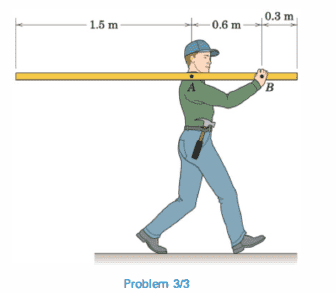
Moment.png


Now I know I'm supposed to start by making a free body diagram, but I don't know where would the weight of the board be placed. Is it in center of the board regardless of the support point at A, or do I have to separate the weight into 2 components based on its length, one in front of the man and one behind him?
 

Attachments

  • Moment.png
    Moment.png
    6.2 KB · Views: 1,006
Last edited by a moderator:
Physics news on Phys.org
Welcome to the PF. :smile:

The worker is having to pull down at point B in order to balance the board on their shoulder. Where is the center of mass of the board? How do the force down at B and the force up at A keep the board from falling or turning?

Please take a try at the FBD so we can work from there. Thanks.
 
berkeman said:
Welcome to the PF. :smile:

The worker is having to pull down at point B in order to balance the board on their shoulder. Where is the center of mass of the board? How do the force down at B and the force up at A keep the board from falling or turning?

Please take a try at the FBD so we can work from there. Thanks.

I think I figured it out but I'm not sure.
Moment.png

So ∑M=(W1×(1.5/2))-(W2×(0.9/2)-(0.6B)=0
Then by calculating Force at point B and adding it to the total weight, the total force on the worker shoulder is calculated?
 

Attachments

  • Moment.png
    Moment.png
    7.9 KB · Views: 714
The total free weight should be acting down at the center of mass -- I'm not able to tell if that's what you are doing yet from your FBD...
 
berkeman said:
The total free weight should be acting down at the center of mass -- I'm not able to tell if that's what you are doing yet from your FBD...
I separated the weight:into 2 components. But I also used your method and got the same answer! So I calculated the moment using point A as reference based on your method:
W=6×9.81=58.86 and the weight force is acting at 1.2 meter from the edge or 0.3 meter from worker's shoulder (1.2-0.9=0.3)
Then ΣM=Rd so ΣM= (58.86×0.3) - (0.6B) = 0 ⇒ B= 17.658/0.6 = 29.43
Force on worker's shoulder is then W+B = 58.86 + 29.43 = 88.29
 
Looks reasonable. Be sure to include units in all of your calculations. What are the units of Force or Weight? :smile:
 
It's Newton (N) :)
 
  • Like
Likes   Reactions: berkeman

Similar threads

Replies
4
Views
1K
  • · Replies 7 ·
Replies
7
Views
4K
  • · Replies 1 ·
Replies
1
Views
3K
  • · Replies 11 ·
Replies
11
Views
3K
Replies
6
Views
2K
Replies
7
Views
2K
  • · Replies 2 ·
Replies
2
Views
4K
  • · Replies 2 ·
Replies
2
Views
4K
  • · Replies 35 ·
2
Replies
35
Views
19K
  • · Replies 4 ·
Replies
4
Views
2K