Strategy for interference problems

  • Context: Graduate 
  • Thread starter Thread starter etotheipi
  • Start date Start date
  • Tags Tags
    Interference Strategy
Click For Summary
SUMMARY

The discussion centers on the strategy for analyzing interference problems involving two light sources, ##S_{1}## and ##S_{2}##, with differing phase angles and travel distances through media of refractive indices ##n_{1}## and ##n_{2}##. The phase angles at the point of constructive interference, X, are calculated as ##\phi_{1} = \frac{\pi}{4} + 2\pi\frac{OPL_{1}}{\lambda}## and ##\phi_{2} = 0 + 2\pi\frac{OPL_{2}}{\lambda} + \frac{\pi}{2}##. The method involves tracking phase angles modulo ##2\pi## and ensuring their difference is a multiple of ##2\pi## for constructive interference. The discussion concludes that while the approach may seem convoluted, it is indeed the correct method for solving the problem.

PREREQUISITES
  • Understanding of wave interference principles
  • Knowledge of phase angles in wave mechanics
  • Familiarity with refractive indices and their effects on light propagation
  • Basic proficiency in mathematical expressions involving wavelengths
NEXT STEPS
  • Research the concept of constructive and destructive interference in wave physics
  • Study the effects of refractive index on light speed and phase shifts
  • Learn about vector addition of electric fields in optics
  • Explore alternative methods for analyzing interference patterns in light waves
USEFUL FOR

Physicists, optical engineers, and students studying wave mechanics who are interested in understanding and solving interference problems in light.

etotheipi
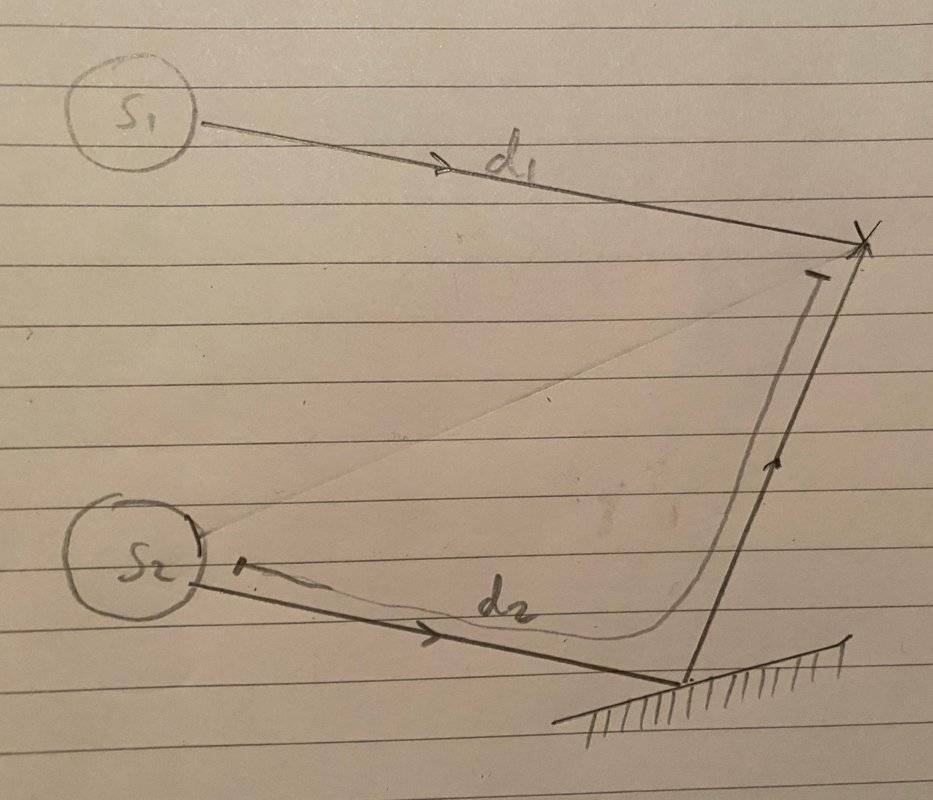
For instance, consider two sources of light ##S_{1}## and ##S_{2}## where ##S_{1}## is emitting with a phase angle ##\frac{\pi}{4}## greater than ##S_{2}##. The light from ##S_{1}## travels a straight distance ##d_{1}## through a medium of refractive index ##n_{1}##. The light from ##S_{2}## travels a total distance ##d_{2}## through a medium of refractive index ##n_{2}##, reflecting off of a plane mirror as well. Please see the below diagram:

(N.B. I forgot to draw in a barrier, but assume light cannot travel directly from ##S_{2}## to X!)
IMG_0415.jpeg


Let's say we want constructive interference at X where the rays meet. The strategy I came up with is keeping track of the phase angle (modulo an uninteresting ##2\pi##) of each light ray at points along the path of each. So I would say that if we set the phase of ##S_{1}## to ##\frac{\pi}{4}## at some constant time, the phase angle at X on the first light ray would be

##\phi_{1} = \frac{\pi}{4} + 2\pi\frac{OPL_{1}}{\lambda}## (where ##\frac{OPL}{\lambda} = \frac{n_{1}d_{1}}{\lambda}## is the number of wavelengths along the path).

whilst the phase at X on the second wave would be

##\phi_{2} = 0 + 2\pi\frac{OPL_{2}}{\lambda} + \frac{\pi}{2}## (with the final term due to the reflection).

Finally, I'd set the difference to be a multiple of ##2\pi## and would go from there to solve the system. I can't help but think this is a really convoluted way of going about the question, and I was wondering if anyone had a better method? Thank you in advance!
 

Attachments

  • IMG_0415.jpeg
    IMG_0415.jpeg
    45.2 KB · Views: 203
Last edited by a moderator:
Science news on Phys.org
The electric fields will add as vectors, and the way you have drawn it, the electric field vectors will be at nearly right angles to each other. The best I can tell, what you are trying to do will not work.
 
etotheipi said:
For instance, consider two sources of light ##S_{1}## and ##S_{2}## where ##S_{1}## is emitting with a phase angle ##\frac{\pi}{4}## greater than ##S_{2}##. The light from ##S_{1}## travels a straight distance ##d_{1}## through a medium of refractive index ##n_{1}##. The light from ##S_{2}## travels a total distance ##d_{2}## through a medium of refractive index ##n_{2}##, reflecting off of a plane mirror as well. Please see the below diagram:

(N.B. I forgot to draw in a barrier, but assume light cannot travel directly from ##S_{2}## to X!)

View attachment 255057

Let's say we want constructive interference at X where the rays meet. The strategy I came up with is keeping track of the phase angle (modulo an uninteresting ##2\pi##) of each light ray at points along the path of each. So I would say that if we set the phase of ##S_{1}## to ##\frac{\pi}{4}## at some constant time, the phase angle at X on the first light ray would be

##\phi_{1} = \frac{\pi}{4} + 2\pi\frac{OPL_{1}}{\lambda}## (where ##\frac{OPL}{\lambda} = \frac{n_{1}d_{1}}{\lambda}## is the number of wavelengths along the path).

whilst the phase at X on the second wave would be

##\phi_{2} = 0 + 2\pi\frac{OPL_{2}}{\lambda} + \frac{\pi}{2}## (with the final term due to the reflection).

Finally, I'd set the difference to be a multiple of ##2\pi## and would go from there to solve the system. I can't help but think this is a really convoluted way of going about the question, and I was wondering if anyone had a better method? Thank you in advance!
This is indeed correct and is the only way to do it. If it seems very convoluted, it is just that it is new. The only way to shorten it is to work directly with the difference of the phases at X (which is all that matters), but that really does not change all your reasoning.
 
  • Like
Likes   Reactions: etotheipi

Similar threads

  • · Replies 6 ·
Replies
6
Views
2K
Replies
12
Views
1K
  • · Replies 4 ·
Replies
4
Views
2K
  • · Replies 7 ·
Replies
7
Views
2K
  • · Replies 2 ·
Replies
2
Views
1K
  • · Replies 8 ·
Replies
8
Views
2K
  • · Replies 5 ·
Replies
5
Views
2K
  • · Replies 2 ·
Replies
2
Views
2K
  • · Replies 4 ·
Replies
4
Views
3K
  • · Replies 1 ·
Replies
1
Views
843