Discussion Overview
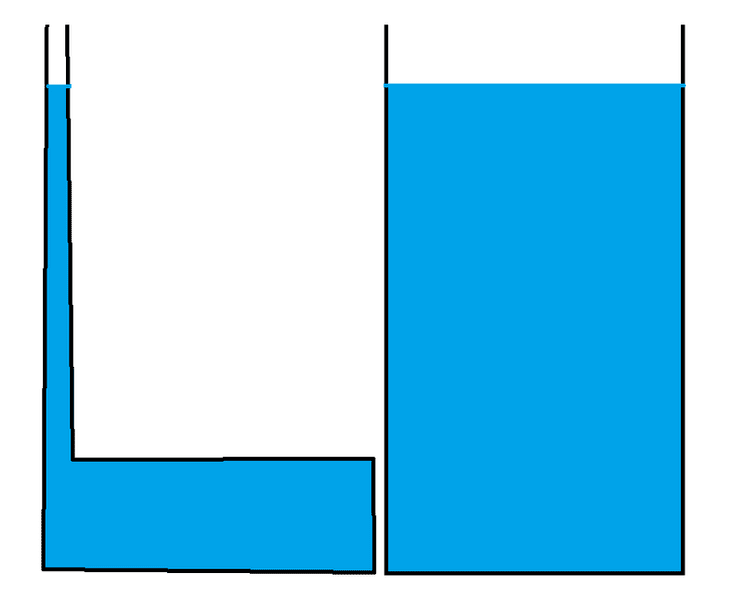
The discussion revolves around the implications of Pascal's principle in the context of two vessels filled with water to the same height. Participants explore the relationship between pressure and force, particularly how these concepts apply to different configurations of the vessels and the resulting pressures at the bottom of each vessel.
Discussion Character
- Exploratory
- Technical explanation
- Debate/contested
Main Points Raised
- One participant notes that while the right vessel has more weight, the pressure at the bottom of both vessels should be the same according to Pascal's principle.
- Another participant clarifies that force and pressure are distinct, emphasizing that the change in pressure is related to height, while the change in force also depends on cross-sectional area.
- A participant explains that the pressure on the horizontal section of the left vessel is determined by the height of the fluid, leading to equal forces at the base of both vessels.
- One participant expresses confusion about calculating pressure using the weight of the water and how it leads to different pressures for each vessel, indicating a potential misunderstanding of assumptions.
- Another participant raises a hypothetical scenario involving a large vessel, questioning whether such a configuration could lead to explosive pressures.
- Participants discuss the non-intuitive nature of pressure dynamics in fluids, with references to Pascal's barrel and hydraulic lifts.
- One participant suggests a simple experiment involving a balloon to illustrate the effects of pressure and fluid dynamics in a practical context.
Areas of Agreement / Disagreement
Participants generally agree on the application of Pascal's principle but express differing views on the implications of force versus pressure and how they relate to the configurations of the vessels. The discussion remains unresolved regarding the specific calculations of pressure based on weight and area.
Contextual Notes
Some participants mention assumptions about cross-sectional areas being equal and the effects of elasticity in real systems, indicating that the discussion may depend on these factors.