Studying "Useful" vs. "Useless" Stuff in School

Click For Summary

Discussion Overview

The discussion revolves around the value of studying various subjects in school, particularly in the context of preparing for future careers in STEM fields. Participants explore the balance between practical skills and broader educational experiences, touching on the implications of educational choices on employment and career paths.

Discussion Character

  • Debate/contested
  • Conceptual clarification
  • Exploratory

Main Points Raised

  • Some participants argue that college serves primarily as a trade school, emphasizing the importance of marketable skills over broad education.
  • Others suggest that a well-rounded education, including subjects outside one's specialty, can enhance lateral thinking and adaptability in the workforce.
  • A participant notes the historical context of educational requirements in the job market, linking it to a Supreme Court decision that influenced hiring practices.
  • There is a discussion about the necessity of solving partial differential equations (PDEs) in various careers, with some asserting that such skills are essential for scientists and engineers.
  • Concerns are raised about the employment rates of physics graduates compared to other majors, with some participants expressing surprise at the higher unemployment rates among physics majors.
  • One participant emphasizes the importance of learning complex subjects like PDEs in a structured educational environment rather than through self-study after graduation.
  • Another viewpoint suggests that engineers often need to understand fundamental concepts beyond their immediate job requirements to innovate and adapt in their roles.

Areas of Agreement / Disagreement

Participants express a range of opinions on the value of different educational approaches, with no clear consensus on whether a focus on practical skills or a broader educational experience is more beneficial. The discussion remains unresolved regarding the best educational path for future careers.

Contextual Notes

Participants highlight the difficulty of learning certain subjects outside of a classroom setting and the varying applicability of different skills in the job market. There are also references to the potential financial implications of different career paths, but these points are not fully explored.

BillTre
Science Advisor
Gold Member
Messages
2,746
Reaction score
12,006
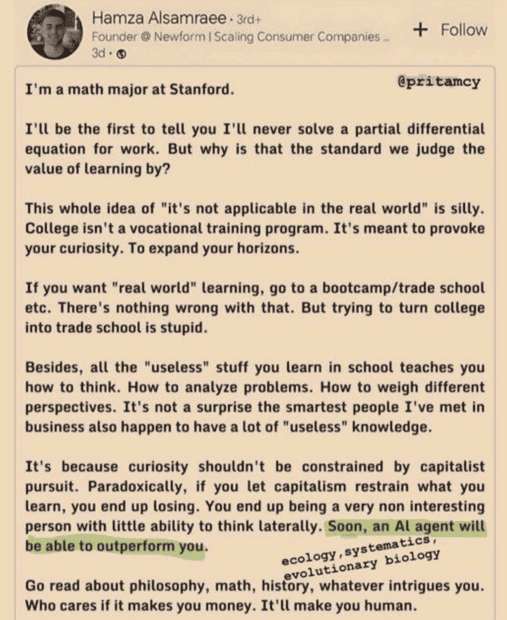
I recently found this on facebook.
It makes sense to me and addresses some common complaints on what one might study:
Screenshot 2024-04-22 at 7.57.30 AM.png
 
  • Like
Likes   Reactions: Klystron, pinball1970, Math100 and 5 others
Science news on Phys.org
How does the OP know he will not need to solve a PDE? I find this attitude somewhat silly. But I agree that one should study things that are "laterally offset" from your "specialty". IMHO all AI can do is lateral thought, and that is often sufficient. Knowledge is power: all of it.
 
  • Like
Likes   Reactions: chwala, PhDeezNutz and BillTre
The reality is that college IS a trade school for almost everybody in the US. Whether we like it or not.

A lot of this was driven by a supreme court decision in 1971 (Griggs vs. Duke Power Company). Duke, like a lot of companies, only required a high school diploma and a certain score on some aptitude tests to be eligible for a position. This was deemed problematic due to disparate impact. Since companies still needed a way to assess if their applicants had the right skills, they made a college degree a requirement for entry level roles as a proxy for the "aptitude". This drove a lot of people to go to college "to get a good job".

I think we would all be better served if entering freshman were clearly educated on some paths they could pursue and the pros / cons of this:

1. You are here for a trade school so major in something marketable and do what you can to keep the cost low. you can still take broadening / fun classes but don't forget the purpose you are here for. You can use this time to network, build connections with alumni, get internships / externships, etc. I actually put STEM grad school in this bucket as you need recs, research, good grades etc. Focus on the outcome helps.

2. You are here for the historical / traditional college experience focused on the big questions, deep learning, etc. You are willing and able to increase your risk of having a more difficult time finding a job (or for that job to be a good ROI on the college expense). There is a potential for longer-term over performance given you built skills that potentially play out better later in your career but you may have short-term job risks.

I'd much rather have a system where we had the ability to hire out of high school and train into roles that don't need a college education vs. forcing millions to take on student debt and spend 4 prime years at college that they might not have wanted to do. But, unfortunately, that's not the world we live in
 
  • Like
Likes   Reactions: PhDeezNutz, russ_watters, phinds and 2 others
You lost me at the first statement. I had to solve a partial differential equation at work before. New-hires at my workspace are encouraged to take courses to repair their mathematics and physics knowledge that their colleges did not develop sufficiently. I was fortunate enough to go to a university that developed these skills well.
I think you should make the most of Stanford's (apparent) requirement that a math major learn how to solve a partial differential equation. You never know where it could lead
 
  • Like
  • Informative
Likes   Reactions: Math100, symbolipoint and BillTre
I solve PDE's for work quite often. But I'm a professional scientist, so I guess it doesn't count. :D

What do people with math or physics major do if they do not become scientists? I guess most of them become programmers of a kind, so maybe solving PDE's is not something what most of them do.
 
  • Like
  • Haha
Likes   Reactions: symbolipoint and BillTre
Demystifier said:
I solve PDE's for work quite often. But I'm a professional scientist, so I guess it doesn't count. :D

What do people with math or physics major do if they do not become scientists? I guess most of them become programmers of a kind, so maybe solving PDE's is not something what most of them do.
I would have said they go on to make more money than professional scientists, but recent threads about employment rates make me hesitate. :olduhh:
 
Haborix said:
I would have said they go on to make more money than professional scientists, but recent threads about employment rates make me hesitate. :olduhh:
I haven't seen that threads, what do they say?
 
Demystifier said:
I haven't seen that threads, what do they say?
Here is a thread. I was somewhat surprised to see the unemployment rate of physics people higher than other majors I might have naively thought would be less employable. I didn't really dig in to see if there was some harmless reason for the higher rate (for example, it might take a physics person longer to find a job but when they did it paid better than average).
 
  • Informative
Likes   Reactions: Demystifier
Plus, on the vocational side of things...

When I was hiring EEs in silicon valley, one of the things I wanted to see in an interview was that they knew a little bit more in their field than they were likely to need, as currently envisioned, in the job. Also that they had an understanding of related fundamental concepts. I can teach you what our company does/needs, but I can't teach you what you'll learn at a good university. For one thing, we don't have the time. Additionally, I want you to teach me something next year that I don't know.

Suppose your tool box doesn't have a gear puller, you've never seen a gear puller and don't know what they are. How will you make an intelligent decision about whether you should buy one? I want engineers that can say, I know about that tool, and we shouldn't use it; or, we should definitely steal the idea and convert it to our situation.

There's no YouTube videos about how to improve on the leading edge of technology. It's incredibly common for advancements in one technical niche to be basically stolen from another because someone knew a bit more than necessary to draw a paycheck.

This is the difference between an engineer and a technician. Technicians know what engineers taught them. Engineers learn what they'll need next.
 
  • Like
Likes   Reactions: symbolipoint, CalcNerd and BillTre
  • #10
Demystifier said:
What do people with math or physics major do if they do not become scientists?
They are engineers, damn near all of them*. That's what the corporations want them to do. They'll make a lot more money from someone that can make a better laser or semiconductor, than someone that works with topology, cosmology, or high energy physics. They'll drive a nicer car and live in a better place than most academic types.

*PS: they often don't like to be called "engineer" they prefer "staff scientist" and such.
 
  • Like
Likes   Reactions: symbolipoint, gmax137 and CalcNerd
  • #11
DaveE said:
They are engineers, damn near all of them*.
Well, some engineers also need to solve PDE's, don't they?
 
  • Wow
Likes   Reactions: BillTre
  • #12
Demystifier said:
Well, some engineers also need to solve PDE's, don't they?
Yep. Plus they need to know where the common solutions came from because they've solved them, like, 100 times before. Then they might not need to do it again, or they might be really quick if they do.

Better yet, they need to feel the simple ones; 1st and 2nd order linear DEs. If you say Q=15, I immediately know what you mean, I can see the frequency response plot in my mind.

OTOH, if it's an odd one, they should probably ask an academic sort for help. Or, sometimes, figure out a way to avoid it. After all, we are often just modelling the real world. Sometimes an exact mathematical solution is better than the model it came from.
 
  • Like
Likes   Reactions: BillTre
  • #13
When it comes to curriculum, what matters more than how often you will use some bit of knowledge in your career, is the relative difficulty of learning something particular in a classroom setting v. on your own once you are out of school.

Partial differential equations are definitely easier to learn in a college classroom with the aid of a professor who your tuition dollars are paying for, along with textbooks, TAs, study groups, and time in your schedule to spend considerable time to focus on learning it for many weeks and do problem sets, than it is in the "real world" after you've graduated and either work full-time, or have young children of your own to raise, or both.

Many other things that you need to learn in life, or are just interested in knowing, are much more easily learned on the job, or through self-study in your spare time. It is much easier, for example, to learn how to invest money, or deal with a copying machine or printer that isn't working, or how to file an expense report, through self-study with assistance from co-workers and peers, as an adult who has finished college, than it is to learn PDEs.

A related factor is that some knowledge has a longer shelf life than other things.

For example, financial accounting and tax law, just like PDEs, is much easier to learn in a classroom setting than it is to learn on your own. But unlike learning to solve PDEs, a skill which is forever because the rules for doing so will never change, tax law changes literally every year, and after a couple of decades, can be barely similar to what you learned in school. So, you have no choice but to constantly relearn some subjects as an adult because they are always changing.

Similarly, as an undergraduate in college, I had no idea that I'd spend 20% of my professional life doing advanced typesetting due to the rise of word processing and the demise of administrative staffing. Many professionals were still dictating things they wrote to secretaries when I was an undergraduate. But this has become the reality since I've graduated, and I've just had to learn.
 
  • Like
Likes   Reactions: symbolipoint, gmax137, BillTre and 1 other person
  • #14
Demystifier said:
What do people with math or physics major do if they do not become scientists? I guess most of them become programmers of a kind, so maybe solving PDE's is not something what most of them do.
I was a math major and was just short of a minor in physics, but I became a lawyer.

I don't regret learning how to solve PDEs, however, and the habits of thinking and ways of thinking about things that I developed in the process still have value, even though I've probably only solved 3-4 PDEs since graduating from college more than three decades ago, and could have gotten someone else to do that if I'd needed to.
 
  • Like
Likes   Reactions: BillTre
  • #15
I would also add that part of what you are paying for at a good school is the curriculum; from graduation requirements all the way down to course design, teaching styles, and HW problem choices. People that make those decisions likely know more than you do about what you should study. Yes, some may be useless in retrospect, but you may not be the best judge of that at the moment. A broad based education will set you up for whatever you'll be doing in 10-20 years, which most people aren't very good at predicting IRL.

Plus, there is some value in having to do work you don't like because someone said you have to. This is a skill that you will need for much of any professional career, unfortunately. That's why they have to pay you, because they know you won't like most of it.
 
  • Like
Likes   Reactions: symbolipoint, Demystifier and BillTre
  • #17
ohwilleke said:
I was a math major and was just short of a minor in physics, but I became a lawyer.
Logical thinking certainly helps in being a lawyer.
 
  • Like
Likes   Reactions: ohwilleke
  • #18
Demystifier said:
Logical thinking certainly helps in being a lawyer.
Pluses and minuses. I've never been good at making totally illogical arguments that somehow win the day. Some people are good at that.
 
  • Wow
Likes   Reactions: Demystifier
  • #19
"Your honor, my client didn't steal the jewelry and anyway, promises to return it."
 
  • Love
Likes   Reactions: ohwilleke
  • #20
Vanadium 50 said:
"Your honor, my client didn't steal the jewelry and anyway, promises to return it."
This is the world that I live in every day!
 
  • #21
Consider how many times you have had to explain to regular people how something can simultaneously depend on multiple variables (and be optimized therein), and then consider if they are the same type of person that cannot grasp why they had to learn about multivariable functions at some point.

Knowledge with generalizable applications (qualitative or quantitative) is almost never bad. But there's only so much time in a day anyway.
 
  • Like
Likes   Reactions: chwala and ohwilleke

Similar threads

  • · Replies 2 ·
Replies
2
Views
665
  • · Replies 41 ·
2
Replies
41
Views
9K
  • · Replies 35 ·
2
Replies
35
Views
9K
  • · Replies 54 ·
2
Replies
54
Views
10K
  • · Replies 76 ·
3
Replies
76
Views
7K
  • · Replies 3 ·
Replies
3
Views
3K
  • · Replies 4 ·
Replies
4
Views
3K
Replies
6
Views
5K
Replies
26
Views
6K
Replies
5
Views
2K