Sunlight absorption spectrum and colors in sunlight

Click For Summary
SUMMARY

The discussion centers on the nature of sunlight and its absorption spectrum, specifically addressing the misconception that sunlight contains all colors despite the presence of absorption lines. The black lines in the solar spectrum indicate wavelengths that are less intense due to absorption by substances in the Sun's atmosphere, but do not imply that those colors are entirely absent. Notably, prominent absorption lines include sodium at 589.0 nm and 589.6 nm, as well as hydrogen lines at 410.1 nm, 434.0 nm, 486.1 nm, and 656.2 nm. The concept of perceiving light as white is clarified, emphasizing that even with absorption, sunlight still encompasses the visible spectrum.

PREREQUISITES
  • Understanding of the electromagnetic spectrum
  • Familiarity with atomic absorption and emission spectra
  • Knowledge of the Fraunhofer absorption lines
  • Basic principles of light perception and color theory
NEXT STEPS
  • Research the Fraunhofer absorption lines and their significance in solar spectroscopy
  • Explore the relationship between wavelength and color perception in physics
  • Study the effects of atmospheric conditions on sunlight absorption
  • Investigate the role of sodium and hydrogen in stellar spectra
USEFUL FOR

Physicists, astronomy enthusiasts, educators in optics, and anyone interested in the properties of light and color perception.

Karagoz
Hi.

In physics articles, they say that sun light is white, and contain all colors.

But they show say that the Sun's atmosphere absorb light at certain wavelengths, causing the intensity of the light at this wavelength to drop and appear dark.

And the absorption spectrum looks like this:
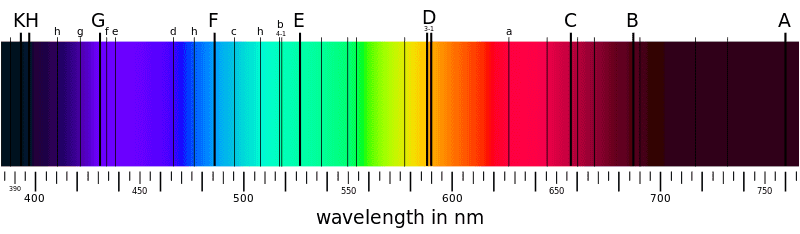
Fraunhofer_lines_From_Wikipedia.png


Does those black lines on the sun light spectrum show that the sunlight that reach the Earth doesn't contain all colors?
 
Science news on Phys.org
Can you describe your understanding of what is the difference between 'all wavelengths' and 'all colours'?
 
But if all visible wavelengths are not contained in sunlight, doesn't it mean also that all colors are not contained in that sunlight?
 
You haven't answered my question. I'm not trying to be clever here, nor mean - I'm just asking you to try and define what it means to see all colours. What it means to perceive light as white?
Is 650 nm a colour? Is a combination of two discrete wavelengths a colour?
 
Karagoz said:
Does those black lines on the sun light spectrum show that the sunlight that reach the Earth doesn't contain all colors?

I'll assume here that OP is asking whether sunlight contains all wavelengths in the visible spectrum (realizing there is a technical difference between wavelengths and colors). The black lines are indeed wavelengths that are missing from the solar spectrum. Substances in the sun are absorbing those wavelengths from the continuous spectrum of light generated in the sun.
 
  • Like
Likes   Reactions: sophiecentaur
pixel said:
The black lines are indeed wavelengths that are missing from the solar spectrum.
There are not, though (in general). Absorption lines do not mean that that wavelength was entirely removed - there's just less of it than we'd normally expect.
 
  • Like
Likes   Reactions: sophiecentaur and Charles Link
The atomic absorption lines are narrow enough in ## \Delta \lambda ## that they do not block what could be considered an entire color. The wavelength of 650 nm (that might be blocked) is essentially the same color as the wavelengths 651-655 nm. The question the OP is asking is really splitting hairs. In making the statement "sunlight contains all the colors of the visible spectrum", I don't think any qualifying statements or disclaimers need to be included. And even at these absorption wavelengths, there is still some light at those wavelengths. It is simply dimmer than the adjacent wavelengths. ## \\ ## And just an item of interest: What are two very prominent absorption lines in the spectrum right at ## \lambda =589.0\, nm ## and ## \lambda =589.6 \, nm ## are no doubt the Na =sodium absorption lines. A sodium arc lamp radiates very strongly at these wavelengths. A couple of the other absorption lines would be due to electronic transitions in the hydrogen atom. These include ## \lambda=410.1, 434.0, 486.1, ## and ## 656.2 \, nm ##. Some additional googling gives the results that these are known as the Fraunhofer absorption lines in the solar spectrum, and a complete table of these lines with the associated atom was found in one article.
 
Last edited:
  • Like
Likes   Reactions: sophiecentaur
Bandersnatch said:
There are not, though (in general). Absorption lines do not mean that that wavelength was entirely removed - there's just less of it than we'd normally expect.

Right, and the form of the absorption line depends on the resolution of the recording instrument. So even if all of a particular wavelength were removed, it might not appear that way in the recording as light from nearby wavelengths will encroach.
 

Similar threads

  • · Replies 40 ·
2
Replies
40
Views
4K
  • · Replies 4 ·
Replies
4
Views
2K
  • · Replies 1 ·
Replies
1
Views
2K
  • · Replies 207 ·
7
Replies
207
Views
13K
  • · Replies 5 ·
Replies
5
Views
2K
  • · Replies 22 ·
Replies
22
Views
3K
  • · Replies 10 ·
Replies
10
Views
4K
  • · Replies 7 ·
Replies
7
Views
1K
  • · Replies 4 ·
Replies
4
Views
6K
  • · Replies 3 ·
Replies
3
Views
1K