Superconductivity: Current and Magnetic Field Limitations

Click For Summary
SUMMARY

This discussion centers on the limitations of superconductivity related to current density (J) and magnetic field (H). When the critical current density (Jc) is exceeded, the formation of Cooper pairs is disrupted, leading to the loss of superconductivity. The BCS theory explains that superconductors must be maintained below a critical temperature (Tc) to function, with conventional superconductors operating below approximately 10 K and high-temperature superconductors up to about 100 K. The relationship between Jc and Hc indicates that increasing Tc is essential for enhancing both Jc and Hc.

PREREQUISITES
  • Understanding of BCS theory and Cooper pairs
  • Knowledge of critical temperature (Tc) and its significance in superconductivity
  • Familiarity with concepts of critical current density (Jc) and critical magnetic field (Hc)
  • Basic principles of superconductivity and thermal energy effects
NEXT STEPS
  • Research the BCS theory in detail, focusing on Cooper pair formation
  • Study the properties and applications of high-temperature superconductors
  • Explore methods to experimentally determine critical temperature (Tc) and critical current density (Jc)
  • Investigate advancements in superconducting materials and their implications for technology
USEFUL FOR

Physicists, materials scientists, and engineers interested in superconductivity, as well as researchers focused on developing advanced superconducting materials and applications.

VictorMedvil
Messages
41
Reaction score
4
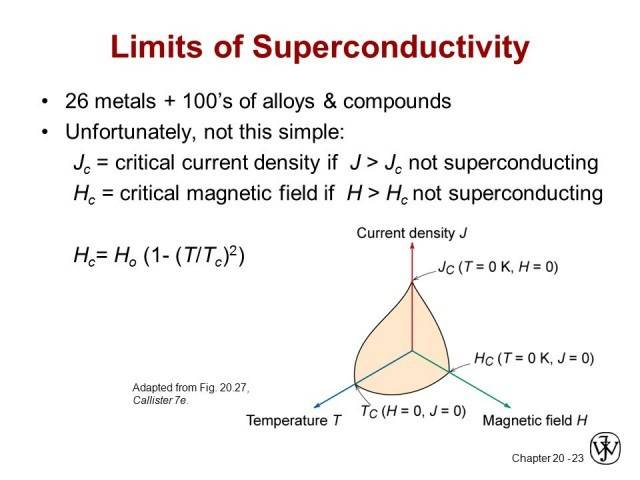
Why when a certain current limit is breached is superconductivity destroyed in a material, what atomically causes this effect when J > Jc? Secondary question what causes H0's value to be higher or lower atomically and chemically for a given material?

Limits-of-Superconductivity.jpg
 
Last edited:
Physics news on Phys.org
It's the same effect, basically. The current inside the superconductor produces a magnetic field that needs to be canceled (which effectively means the current flows on the surface, approximately), that only works up to some point.
 
  • Like
Likes   Reactions: VictorMedvil
mfb said:
It's the same effect, basically. The current inside the superconductor produces a magnetic field that needs to be canceled (which effectively means the current flows on the surface, approximately), that only works up to some point.
But why? I understand that part of it.
 
According to the BCS theory, superconducting phenomena occur when two electrons couple to form a Cooper pair (http://hyperphysics.phy-astr.gsu.edu/hbase/Solids/coop.html).

Kevin A. Delin and Terry P. Orlando in Chapter 122 „Superconductivity“ in „The Engineering Handbook“ (ed. Richard C. Dorf):

“If we prevent the Cooper pairs from forming by ensuring that all the electrons are at an energy greater than the binding energy, we can destroy the superconducting phenomenon. This can be accomplished, for example, with thermal energy. In fact, according to the BCS theory, the critical temperature, ##T_c##, associated with this energy is

$$\frac {2\Delta} {k_BT_c} \approx 3.5$$

where ##k_B## is Boltzmann’s constant. For low critical temperature (conventional) superconductors, ##2Δ## is typically on the order of ##1 meV##, and we see that these materials must be kept below temperatures of about ##10 K## to exhibit their unique behavior. Superconductors with high critical temperature, in contrast, will superconduct up to temperatures of about ##100 K##, which is attractive from a practical view because the materials can be cooled cheaply using liquid nitrogen. A second way of increasing the energy of the electrons is electrically driving them. In other words, if the critical current density, ##J_c##, of a superconductor is exceeded, the electrons have sufficient kinetic energy to prevent the formation of Cooper pairs. The necessary kinetic energy can also be generated through the induced currents created by an external magnetic field. As a result, if a superconductor is placed in a magnetic field larger than its critical field, ##H_c##, it will return to its normal metallic state. To summarize, superconductors must be maintained under the appropriate temperature, electrical current density, and magnetic field conditions to exhibit its special properties.”
 
  • Informative
Likes   Reactions: VictorMedvil
Lord Jestocost said:
According to the BCS theory, superconducting phenomena occur when two electrons couple to form a Cooper pair (http://hyperphysics.phy-astr.gsu.edu/hbase/Solids/coop.html).

Kevin A. Delin and Terry P. Orlando in Chapter 122 „Superconductivity“ in „The Engineering Handbook“ (ed. Richard C. Dorf):

“If we prevent the Cooper pairs from forming by ensuring that all the electrons are at an energy greater than the binding energy, we can destroy the superconducting phenomenon. This can be accomplished, for example, with thermal energy. In fact, according to the BCS theory, the critical temperature, ##T_c##, associated with this energy is

$$\frac {2\Delta} {k_BT_c} \approx 3.5$$

where ##k_B## is Boltzmann’s constant. For low critical temperature (conventional) superconductors, ##2Δ## is typically on the order of ##1 meV##, and we see that these materials must be kept below temperatures of about ##10 K## to exhibit their unique behavior. Superconductors with high critical temperature, in contrast, will superconduct up to temperatures of about ##100 K##, which is attractive from a practical view because the materials can be cooled cheaply using liquid nitrogen. A second way of increasing the energy of the electrons is electrically driving them. In other words, if the critical current density, ##J_c##, of a superconductor is exceeded, the electrons have sufficient kinetic energy to prevent the formation of Cooper pairs. The necessary kinetic energy can also be generated through the induced currents created by an external magnetic field. As a result, if a superconductor is placed in a magnetic field larger than its critical field, ##H_c##, it will return to its normal metallic state. To summarize, superconductors must be maintained under the appropriate temperature, electrical current density, and magnetic field conditions to exhibit its special properties.”

So the only way to increase Jc and Hc is to increase Tc, thanks for answering this question Lord Jestocost.
 

Similar threads

  • · Replies 4 ·
Replies
4
Views
2K
  • · Replies 7 ·
Replies
7
Views
3K
  • · Replies 1 ·
Replies
1
Views
984
  • · Replies 8 ·
Replies
8
Views
2K
  • · Replies 1 ·
Replies
1
Views
5K
  • · Replies 7 ·
Replies
7
Views
3K
  • · Replies 2 ·
Replies
2
Views
1K
  • · Replies 5 ·
Replies
5
Views
1K
  • · Replies 5 ·
Replies
5
Views
3K
  • · Replies 1 ·
Replies
1
Views
5K