Suspending a Speaker: What is T in each cable

  • Thread starter Thread starter pemby
  • Start date Start date
  • Tags Tags
    Cable Speaker
Click For Summary

Homework Help Overview

The discussion revolves around a physics problem involving the tension in cables suspending a loudspeaker. The original poster presents calculations related to the forces acting on the speaker and attempts to determine the tension in the cables using trigonometric relationships.

Discussion Character

  • Exploratory, Assumption checking, Mathematical reasoning

Approaches and Questions Raised

  • Participants discuss the calculations involving angles in degrees versus radians, questioning the implications of these conversions on the final results. There are attempts to clarify the correct use of trigonometric functions in the context of the problem.

Discussion Status

Some participants have provided guidance on checking calculations and the importance of ensuring the correct angle measurement. There is an acknowledgment of a potential misunderstanding regarding the angle's representation, but no explicit consensus has been reached on the approach to the problem.

Contextual Notes

Participants note the original poster's confusion regarding the error message from Masteringphysics and the implications of using radians instead of degrees. The problem setup includes specific values for weight and angles, but further details on the overall context are not provided.

pemby
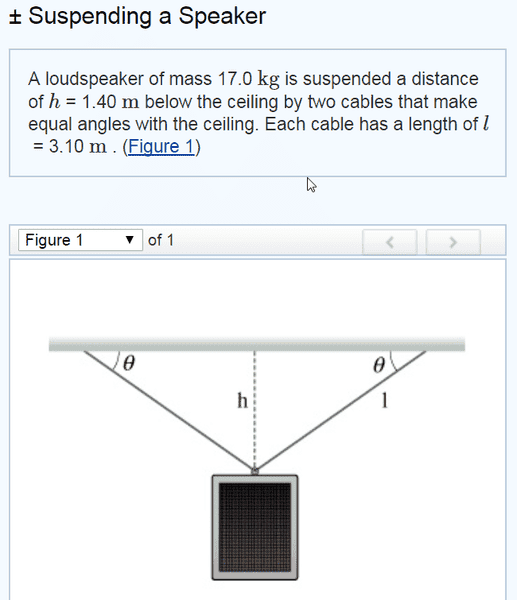
1. The problem statement, all variables, and given/known data
ip6TZvn.png

Homework Equations


Assuming standard coordinates, Net forces in the x plane are 0, by

Clxg7wc.png


The Attempt at a Solution


I have worked out that

[tex]\arcsin { \left( \frac { 1.4 }{ 3.1 } \right) } =\quad 26.8{ 5 }°\\ loud\quad speaker\quad =\quad wg\quad =\quad 166.77\quad N\\ 2T\sin { \left( 26.8{ 5 }° \right) \quad =\quad 166.77 } N\\ T\quad =\quad 84.2824[/tex]

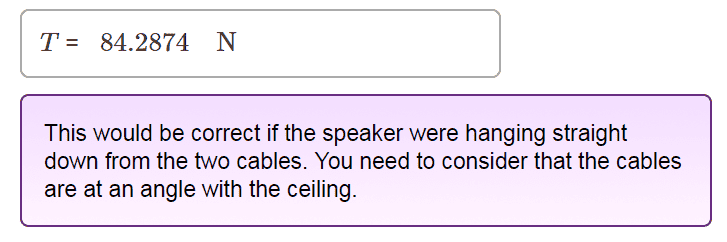
Masteringphysics returning with an incorrect solution response and is giving me this piece of information.
xI11CSA.png


I do not understand what this error implies.
I have tried;

[tex]\\ T\sin { \left( 26.8{ 5 }° \right) \quad =\quad 166.77 } N\\ \\ \\ T\sin { \left( \frac { 1 }{ 2 } 26.8{ 5 }° \right) \quad =\quad 166.77 } N\\ \\ T2\sin { \left( 26.8{ 5 }° \right) \quad =\quad \frac { 166.77\quad N }{ 2 } }[/tex]
 

Attachments

  • ip6TZvn.png
    ip6TZvn.png
    24 KB · Views: 1,026
  • Clxg7wc.png
    Clxg7wc.png
    4.7 KB · Views: 880
  • xI11CSA.png
    xI11CSA.png
    14.6 KB · Views: 518
Physics news on Phys.org
Radians v. degrees.
 
Sorry, can you expand a bit more? I understand the difference but not in the context of this question.
 
pemby said:
sin(26.85°)
What value did you get for that?
 
haruspex said:
What value did you get for that?
0.438371146789077417452734540658265739062755719988552114431
 
pemby said:
0.438371146789077417452734540658265739062755719988552114431
Then I do not see how you could have got that final answer. You had
pemby said:
2Tsin(26.85°)=166.77N
Maybe you halved twice?
 
Thanks. it was reading my degrees as radians. I tricked my self by not double checking!
 
pemby said:
Thanks. it was reading my degrees as radians. I tricked my self by not double checking!
OK.

Btw, you can often avoid figuring out the angle. In the present case, you wanted sin(θ), which is h/l, so the accurate answer is 17g*3.1/(2*1.4).
 

Similar threads

  • · Replies 14 ·
Replies
14
Views
3K
Replies
46
Views
5K
  • · Replies 11 ·
Replies
11
Views
2K
  • · Replies 3 ·
Replies
3
Views
2K
  • · Replies 31 ·
2
Replies
31
Views
3K
  • · Replies 1 ·
Replies
1
Views
2K
  • · Replies 1 ·
Replies
1
Views
4K
  • · Replies 42 ·
2
Replies
42
Views
11K
  • · Replies 7 ·
Replies
7
Views
2K
  • · Replies 15 ·
Replies
15
Views
1K