Syringe/Stepper Motor Pump Design

  • Context: Plumbing 
  • Thread starter Thread starter Frank-95
  • Start date Start date
  • Tags Tags
    Design Motor Pump
Click For Summary
SUMMARY

The discussion centers on the design of a syringe pump utilizing a NEMA 11 stepper motor with a maximum torque of 6 Ncm and an M5 threaded rod with a pitch of 0.8 mm. The user aims to achieve an output pressure of 0.5 bar and a flow rate of 233 μl/s, utilizing the Hagen-Poiseuille formula to calculate necessary pressures and flow dynamics. The conversation emphasizes the importance of selecting an appropriate spray nozzle based on its operating pressure and flow rate specifications, as well as understanding the relationship between flow rate and pressure in positive displacement pumps.

PREREQUISITES
  • Understanding of syringe pump mechanics and design principles
  • Familiarity with fluid dynamics, specifically the Hagen-Poiseuille equation
  • Knowledge of stepper motor specifications and control
  • Experience with spray nozzle performance characteristics and selection
NEXT STEPS
  • Research the application of the Hagen-Poiseuille formula in fluid systems
  • Learn about the characteristics and selection criteria for spray nozzles
  • Explore stepper motor control techniques for precise flow rate adjustments
  • Investigate the impact of pressure on spray patterns and flow uniformity
USEFUL FOR

Engineers, hobbyists, and researchers involved in fluid dynamics, syringe pump design, and spray nozzle selection will benefit from this discussion.

Frank-95
Messages
51
Reaction score
1
TL;DR
I need to calculate the output pressure of a syringe pump driven by a stepper motor, given the step-rate of the motor itself, and the length of the tube connected to the syringe.
Hello.

I've built this syringe pump. The chosen motor is a NEMA 11 with a maximum torque of 6 Ncm.
The thread rod is an M5 with a pitch of 0.8 mm.
The whole system will consist also of a long tube (1 m length, 3.175 mm external diameter, 1.5875 internal diameter), at the end of which I'll need to place a spray nozzle which I have not bought yet.

I'm stuck at this point: given the syringe diameter, the tube length and diameter, the pitch of the thread, and the motor steprate, how do I calculate needed steprate to have a certain pressure?

The following image is taken from this thread, I didn't make it.
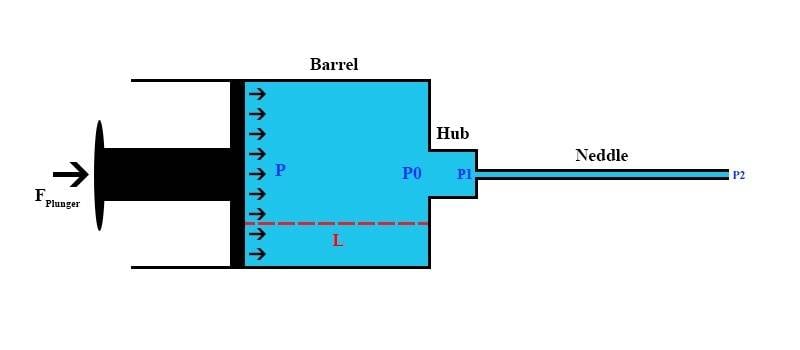
syringeillustration-jpg.jpg


Last attempt was to use Hagen-Poiseuille formula for every section of the device. The long tube, the syringe tip and the syringe body.

So my P2 is the pressure I need (0,5 bar) plus atmospheric pressure, am I right? Then after I use that formula and I can say that losses along the syringe body are negligible so that P ≈ P0 ≈ P1. Now that I have calculated the necessary pressure at the plunger to obtain the needed output pressure and flow rate, which is the next step?

I thought of use these calculated pressures inside Bernoulli's principle, in order to get the linear velocity at the plunger and so calculating the steprate from that one, which is straightforward. Does it make any sense?

EDIT:
What I need is an output pressure of 0,5 bar and a flow rate of 233 μl/s
 
Last edited:
Physics news on Phys.org
Frank-95 said:
So my P2 is the pressure I need (0,5 bar) plus atmospheric pressure, am I right?
How did you arrive at that number? I don't see that you've told us anywhere what the desired performance of this system is. In particular, the desired flow rate and associated pressure drop at the nozzle.

You seem to be approaching the problem backwards.
 
It is what I need it is not calculated.

I edited the first post. I still have to choose the spray nozzle though, but it will likely be a nozzle that can operate at those values. Do you need the complete numerical application of Hagen-Pouseuille formula?

You seem to be approaching the problem backwards.

Yes forgive my inaccurate thread title. It should actually be the contrary, calculating step-rate from pressure. I've been trying both ways during my attempts.
 
Frank-95 said:
It is what I need it is not calculated.

I edited the first post. I still have to choose the spray nozzle though, but it will likely be a nozzle that can operate at those values. Do you need the complete numerical application of Hagen-Pouseuille formula?

Yes forgive my inaccurate thread title. It should actually be the contrary, calculating step-rate from pressure. I've been trying both ways during my attempts.
No, this problems is largely flow driven, not pressure driven because water (I assume water?) is incompressible. As you were told in the previous thread, this is a pretty simple geometry problem, matching the flow rate to the volume reduction of the syring and converting to the linear speed of the plunger.
 
Yes we are talking about acqueous solutions.

Okay, that was the first thing I did a lot of time ago:

ω = ( Q ⋅ 360°) / ( π r^2 p ∂°)

Where omega is the step rate [step/s], Q the flow rate [m3/s], r the syringe body diameter [m], p the pitch of the threaded rod [m/rev], ∂° the angle encompassed in a single step (given by the motor datasheet), and 360° obviously the angles per revolution [°/rev] ("per revolution" as "measure unit" was used for better readability of the formula and easier sums.

So I have everything I need as far as the syringe and tube is concerned. The problem is that spray nozzle specifications are given in terms of input pressure and output flow. So I really don't know how to choose the spray if I don't know the pressure. Moreover there esist devices like the one I'm making and they all provide the pressure out of the spray head.
 
Frank-95 said:
The problem is that spray nozzle specifications are given in terms of input pressure and output flow. So I really don't know how to choose the spray if I don't know the pressure.
In positive displacement pumps with incompressible fluids, the pressure will be whatever the system demands. There is nothing to calculate...

...Except as it relates to motor torque, which you haven't asked about yet. But one thing at a time.
 
russ_watters said:
In positive displacement pumps with incompressible fluids, the pressure will be whatever the system demands. There is nothing to calculate...

...Except as it relates to motor torque, which you haven't asked about yet. But one thing at a time.

Okay, so if I had to choose a spray nozzle what features should I look for? As far as I know spray nozzle are provided with operating pressure range, and minimum capacity, is that right?
Let's consider this one as example. It says:

0.19 - 46 L/min @ 0.7bar
Min. 0.4 bar

It means that it cannot output less than 0.19 L/min, if I've understood correctly. So if I pushed less than that with the motor by using the formula in the above post, wouldn't it spray at all?
 
Frank-95 said:
Okay, so if I had to choose a spray nozzle what features should I look for? As far as I know spray nozzle are provided with operating pressure range, and minimum capacity, is that right?
Let's consider this one as example. It says:

0.19 - 46 L/min @ 0.7bar
Min. 0.4 bar
That link includes an entire performance table. Decide what flow you want, and at what pressure, then look up the nozzle size associated with it. The pressure is probably not very important, so 0.4 bar is probably fine...though note, the spray angle changes with pressure.
It means that it cannot output less than 0.19 L/min, if I've understood correctly. So if I pushed less than that with the motor by using the formula in the above post, wouldn't it spray at all?
No, that's just a minimum rating. what probably happens below the minimum flow is the spray pattern becomes non-uniform.
 
russ_watters said:
That link includes an entire performance table. Decide what flow you want, and at what pressure, then look up the nozzle size associated with it. The pressure is probably not very important, so 0.4 bar is probably fine...though note, the spray angle changes with pressure.

Okay, let's suppose that I need I choose any of them, because the flow rate is what I need, 0.19 L/min for example, the one with 1/8'' thread size. This means that if I pushed with the motor a certain amount of water (like 100 μl) at 0.19 L/min, then the pressure at the spray will be 0.7 bar as written in the table?

Just to be sure. Thank you very much
 
  • #10
Frank-95 said:
Okay, let's suppose that I need I choose any of them, because the flow rate is what I need, 0.19 L/min for example, the one with 1/8'' thread size. This means that if I pushed with the motor a certain amount of water (like 100 μl) at 0.19 L/min, then the pressure at the spray will be 0.7 bar as written in the table?
Yes; the pressure just upstream of the nozzle.
 

Similar threads

Replies
2
Views
1K
  • · Replies 9 ·
Replies
9
Views
2K
  • · Replies 7 ·
Replies
7
Views
2K
  • · Replies 3 ·
Replies
3
Views
2K
  • · Replies 6 ·
Replies
6
Views
3K
  • · Replies 5 ·
Replies
5
Views
17K
  • · Replies 6 ·
Replies
6
Views
7K
  • · Replies 5 ·
Replies
5
Views
15K
Replies
2
Views
4K
  • · Replies 8 ·
Replies
8
Views
4K