Linear force of a syringe pump plunger

Click For Summary

Discussion Overview

The discussion revolves around calculating the torque or linear force required on a syringe plunger to overcome a backpressure of 20,000 psi at the nozzle. Participants explore the implications of high-pressure applications, particularly in contexts like hydraulic systems and high-performance liquid chromatography (HPLC).

Discussion Character

  • Technical explanation
  • Debate/contested
  • Mathematical reasoning

Main Points Raised

  • One participant seeks clarification on the necessary force to overcome a backpressure of 20,000 psi, noting the ambiguity from syringe pump manufacturers.
  • Another participant questions the pressure inside the syringe if the plunger does not move, suggesting it would be atmospheric pressure until flow begins.
  • Concerns are raised about the dangers associated with operating at such high pressures, with a participant noting that a pinhole leak could cause severe injury.
  • A calculation is presented by a participant indicating that the force required would be approximately 2,515 pounds, translating to about 1.14 tonnes of force, based on the area of the plunger.
  • One participant expresses confusion regarding the term 'ton' and clarifies their understanding of the force measurement.

Areas of Agreement / Disagreement

Participants express differing views on the calculations and implications of the required force. While some calculations suggest a force of over one ton, there is no consensus on the interpretation of these figures or the implications for syringe pump selection.

Contextual Notes

The discussion includes varying assumptions about pressure dynamics in the syringe and the potential risks associated with high-pressure systems. There are unresolved aspects regarding the exact calculations and the definitions of force measurements.

kaadeeka
Messages
9
Reaction score
0
Hi all,

I am looking for the correct calculation of the torque (or linear force) that is needed on a syringe plunger to overcome a backpressure at the nozzle of 20,000 psi.

I have to decide which syringe pump I will be using for my application, but their is a lot of choice and mainly I need enough linear force to overcome 20,000 psi back pressure.

The plunger has a diameter of 0.4 inch , the nozzle has an internal diameter of 0.02 inch. Let us say that the syrine is filled with water and the backpressure is also coming from water that is restricted by a back pressure regulator of 20,000 psi (not the real case, but to keep it simple).

In attachment I have put a drawing of my question.
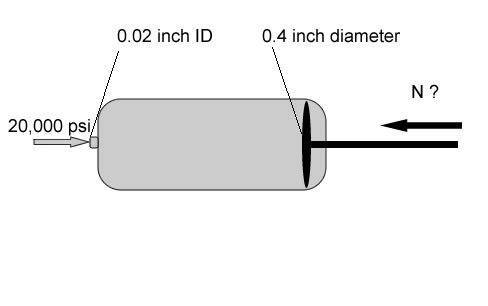
pressure quest.jpg


I hope someone can help. Apparently this is not such an easy question, as all syringe pump manufacturers give me an ambiguous answer.
 
Physics news on Phys.org
You have 20000PSI at the hole ... if the plunger didn't move, what would be the pressure inside the syringe?
 
20,000 psi is quite a high pressure. Most hydraulic systems operate below 3,000 psi.
Water jet cutting and some common rail diesel injection systems use 20,000 psi.
Those pressures are very dangerous because a pinhole leak in a fitting can amputate a finger before you realize what is happening.

The answer to your question will come out at a little over a one ton force.
Take care.
 
Simon Bridge said:
You have 20000PSI at the hole ... if the plunger didn't move, what would be the pressure inside the syringe?

Pressure would be atmospheric, because the pressure is building up the moment the syringe starts flowing. The syringe has to be able to flow so fast that the whole system reaches a backpressure of 20,000 psi.

I don't know if you are familiar with HPLC, but this is exactly what I am planning to do with the syringe pump.

It means that the syringe pump will be connected to a 'column' filled with small particles of 2 μm. This will give a high back pressure if the flow is coming close to 1 ml/min. The syringe pump has to be able to go as high as 20,000 psi.
 
Baluncore said:
20,000 psi is quite a high pressure. Most hydraulic systems operate below 3,000 psi.
Water jet cutting and some common rail diesel injection systems use 20,000 psi.
Those pressures are very dangerous because a pinhole leak in a fitting can amputate a finger before you realize what is happening.

The answer to your question will come out at a little over a one ton force.
Take care.

What all respect, but I don't think this is right...
 
The pressure you specify is in psi, that is, pounds per square inch. No matter what the section of the vessel or tube is, the pressure will be 20,000 psi.

If the pressure connected to the one side of the piston is 20,000 psi and the other side is atmospheric then the force on the piston will be 20,000 multiplied by the area of the piston.

Diameter = 0.4” therefore radius = 0.2”
Area = Pi * r * r = 0.126 square inches.
Force = 0.126 * 20,000 = 2515. pounds force.
2515 pounds force = 2515 / 2.2046 kg force = 1140 kg force = 1.14 tonne force.
1140 kg force = 1140 * 9.807 Newton = 11180 N.
 
yep, I just figured it out myself. I was confused with the term 'ton', which sounded as 'really really a lot', but is actually just 1000 kg ... :-)
 

Similar threads

  • · Replies 7 ·
Replies
7
Views
3K
  • · Replies 5 ·
Replies
5
Views
15K
Replies
2
Views
1K
  • · Replies 10 ·
Replies
10
Views
19K
  • · Replies 3 ·
Replies
3
Views
2K
  • · Replies 32 ·
2
Replies
32
Views
12K
  • · Replies 8 ·
Replies
8
Views
3K
  • · Replies 9 ·
Replies
9
Views
7K
  • · Replies 22 ·
Replies
22
Views
3K
  • · Replies 7 ·
Replies
7
Views
2K