Taking the components of a system containing multiple vectors

Click For Summary

Homework Help Overview

The discussion revolves around a problem involving the motion of a mass connected to a string passing over pulleys, with specific focus on the relationship between the velocities of different components of the system. The subject area includes kinematics and vector analysis.

Discussion Character

  • Exploratory, Assumption checking, Conceptual clarification

Approaches and Questions Raised

  • Participants explore the relationship between the velocities of the mass and the ends of the string, questioning the validity of different methods for resolving vector components. There are attempts to clarify the roles of vertical and horizontal components of velocity in the context of the problem.

Discussion Status

The discussion is ongoing, with participants providing insights and questioning assumptions about the motion of the string and the mass. Some guidance has been offered regarding the interpretation of vector components, but there is no clear consensus on the correct approach to the problem.

Contextual Notes

Participants note potential confusion arising from the diagrams used in the problem, as well as the implications of the string's length remaining constant throughout the motion. There are also references to the need for careful consideration of the geometry involved in the setup.

Hijaz Aslam
Messages
66
Reaction score
1
Q.In the arrangement shown in fig. the ends P and Q of an inextensible string move downwards with uniform speed u. Pulleys A and B are fixed. The mass M moves upwards with a speed.
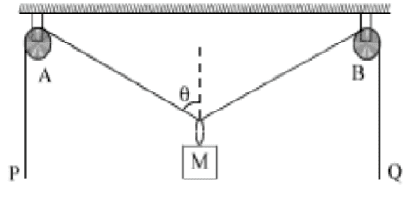
J1hmGOg.png


ANSWER PROVIDED BY MY TEXT

MrRRkou.png


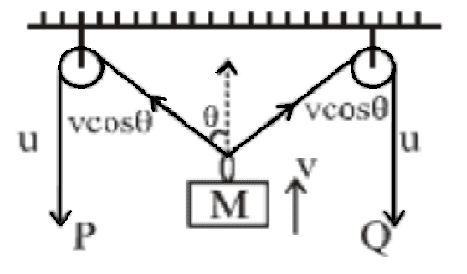
In the diagram ##vcos\theta=u## therefore ##v=u/cos\theta##

HOW I TRIED TO DO THE PROBLEM:
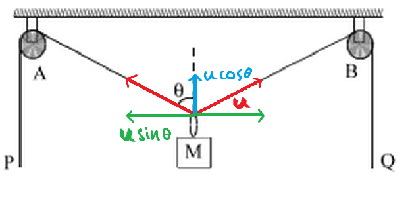
4jvsyA6.png


Here both the ##usin\theta## cancel out but the component ##ucos\theta## of both the vectors u add up. Therefore ##2ucos\theta=v## or ##v=2ucos\theta##

But this is a completely different answer regarding the former one, and the latter answer is marked wrong and the former correct. Why can't we add up the vectors like the latter case?


Last edited:
Physics news on Phys.org
The first is a velocity diagram and second is a force diagram.

Consider the first diagram... Suppose you add a car moving horizontally under the mass. To show the relative velocity between mass and car you would draw a vector arrow between the two. Adding that arrow to the diagram doesn't change the velocity of the mass or car does it?
 
CWatters - Thanks for your reply.
Does it mean that in this case ##ucos\theta## is just the vertical component of the velocity u and has nothing to do with or doesn't contribute anything to v?

And, what about ##vsin\theta## ? Which entity provides this velocity? Where is it? And what is happening to it?

It will be really helpful if you can provide an explanation. Thanks
 
Last edited:
  • Like
Likes   Reactions: manas237
Hijaz Aslam said:
CWatters - Thanks for your reply.
Does it mean that in this case ##ucos\theta## is just the vertical component of the velocity u and has nothing to do with or doesn't contribute anything to v?

Which case?

ucos(theta) only makes sense if you are talking about the force diagram. So it's got nothing to do with velocities.

I think you are getting confused because both cases appear to use similar trigonometry but in fact they are quite different. First thing to note is that the "right angled triangle" is not the same in the two cases...

MrRRkou.png
4jvsyA6.png


Looking at the left hand (velocity drawing)...

VCos(theta) is the component of V acting in the direction of the rope (so it is the velocity of the rope = u)
VSin(theta) is the component of V acting at right angles to the rope.

Looking at the right hand drawing (force diagram)...

UCos(theta) is the vertical component of the force U.
USin(theta) is the horizontal component of the force U.
 
I think their diagram is confusing too. The points of the rope do not move with that velocity. It is obvious for the point in the middle of the rope which has no horizontal component of velocity. Even though the result seems to be OK, I cannot see how to justify the "method".

If the ends move down by u*dt, the rope in the middle should get shorter by the 2 u*dt (or each half by u*dt).
You have to write a relationship between the shortening of the rope in the middle and the vertical displacement of the middle point. This will provide the relationship between the two velocities.
 
Why can't we take components of velocity here?
 
manas237 said:
Why can't we take components of velocity here?
You can; that is the textbook method, and the method described in post #4.
The tricky part is realising that you need to take the component of v in the direction towards the pulley, not the component of u (as speed of the angled sections of strings) in the direction of the movement of the mass.
 
  • Like
Likes   Reactions: manas237
I am not able to understand why the method that the questioner has used is wrong please explain
 
Prasad W said:
I am not able to understand why the method that the questioner has used is wrong please explain
Since the final motion of the body is vertically upwards,the magnitude of velocity at that direction must be it's net magnitude.
This means that the velocity of the strings must be components of that velocity.
 
  • Like
Likes   Reactions: CWatters
  • #10
Prasad W said:
I am not able to understand why the method that the questioner has used is wrong please explain
The second method has two independent flaws.
First, it supposes that the piece of string immediately adjacent to the mass is moving directly towards the pulley (at speed u). As has been noted, it is moving vertically upwards at the same speed as the mass.
Its total speed must be more than u. It is getting closer to the pulley at rate u, but it also has a tangential velocity so as to result in a net upward velocity. Thus v> u.

The second error is adding the two velocities, for P and Q, thus calculated. By symmetry, the value of v calculated to make it all work on one side also works for the other side.
 
  • Like
Likes   Reactions: CWatters and manas237
  • #11
Can someone explain why it u/cos and not ucos. Please.
 
  • #12
Kaushik said:
Can someone explain why it u/cos and not ucos. Please.
If you tell me why you think it should be u cos, I will endeavour to point out your error.
 
  • Like
Likes   Reactions: Kaushik
  • #13
Yeah sure. According to my perception the string that is connected to the block is also moving with velocity u. But as the block only moves up, it should move with velocity ucosθ as it is the vertical component of u.
 
  • #14
haruspex said:
If you tell me why you think it should be u cos, I will endeavour to point out your error.
Yeah sure. According to my perception the string that is connected to the block is also moving with velocity u. But as the block only moves up, it should move with velocity ucosθ as it is the vertical component of u.
 
  • #15
If the point of the rope that is connected to the mass has speed ##u## and a vertical component ##u_y=u \cos\theta##, then it must have a non-zero horizontal component ##u_x=u \sin\theta## because it should be true that ##u=\sqrt{u_x^2+u_y^2}.~## Is the horizontal component of the velocity at that point non-zero?
 
  • #16
kuruman said:
If the point of the rope that is connected to the mass has speed ##u## and a vertical component ##u_y=u \cos\theta##, then it must have a non-zero horizontal component ##u_x=u \sin\theta## because it should be true that ##u=\sqrt{u_x^2+u_y^2}.~## Is the horizontal component of the velocity at that point non-zero?
But the point where the block is connected has velocity 'u', isn't ? If not then the strings length will change.
 
  • #17
Kaushik said:
But the point where the block is connected has velocity 'u', isn't ? If not then the strings length will change.
If the vertical piece of the rope increases by a certain length ##L##, does the angled part of the rope decrease by the same amount? Make a drawing and calculate the changes in length of the two pieces.
 
  • #18
kuruman said:
If the vertical piece of the rope increases by a certain length ##L##, does the angled part of the rope decrease by the same amount? Make a drawing and calculate the changes in length of the two pieces.
According to my perception, Yes it does increase by same amount.
 
  • #19
kuruman said:
If the vertical piece of the rope increases by a certain length ##L##, does the angled part of the rope decrease by the same amount? Make a drawing and calculate the changes in length of the two pieces.
246333

What am i doing wrong? why am i getting u = u/cosø?
 
  • #20
Your drawing shows a right triangle of right sides ##x_1## and ##c##. OK. Then you say ##l=x_1+\frac{x_1}{\cos\theta}##. This defines ##l## as the sum of one right side and the hypotenuse. Why is that relevant? I don't see how you got the last circled equation from the previous one.

Write the Pythagorean relation for that triangle. Then find a relation between the rate of change of the hypotenuse ##h## with respect to time and the rate of change of right side ##x_1## with respect to time. The former is the speed you're looking for and the latter is the speed ##u##. Note that right side ##c## does not change as the mass rises.
 
  • #21
Kaushik said:
What am i doing wrong? why am i getting u = u/cosø?
You are going to need to fill in more reasoning behind the equation you have drawn. The length of the string (##l##) remains constant. A good way to approach the problem is to use that fact.

Over a small increment of time (##dt##), the length of each vertical section will increase by ##u\ dt##. To preserve the total string length, the result of the upward motion by ##v\ dt## must reduce the length of each diagonal section by ##u\ dt##.

A laborious way to proceed would be to compute the current diagonal string length, subtract the delta (##u\ dt##) and use the Pythagorean theorem in reverse to find how much vertical distance must be covered so that the new diagonal string length matches. After simplifying the formula, I expect that one could extract something approximating a ##\cos \theta## term.

A more direct way to proceed would be to note that the upward motion at velocity v makes progress along the diagonal at a reduced rate corresponding to ##\cos \theta##

A more formal way of seeing that would be to split the upward motion at velocity v into two components. One component is in the direction of the pulley and has magnitude ##v \cos \theta##. It accounts for forward progress along the diagonal. The other component is at right angles to the first and has magnitude ##v \sin \theta##. It makes no forward progress. Instead, it merely succeeds in rotating the diagonal.
 
  • #22
kuruman said:
Your drawing shows a right triangle of right sides ##x_1## and ##c##. OK. Then you say ##l=x_1+\frac{x_1}{\cos\theta}##. This defines ##l## as the sum of one right side and the hypotenuse. Why is that relevant? I don't see how you got the last circled equation from the previous one.

Write the Pythagorean relation for that triangle. Then find a relation between the rate of change of the hypotenuse ##h## with respect to time and the rate of change of right side ##x_1## with respect to time. The former is the speed you're looking for and the latter is the speed ##u##. Note that right side ##c## does not change as the mass rises.
I got the circled equation by differentiating wrt time.
 
  • #23
Kaushik said:
I got the circled equation by differentiating wrt time.
But ##\theta## also changes with time. Furthermore, why should the sum of ##x_1## and the hypotenuse not change? As the mass rises, that sum decreases.
 
  • #24
kuruman said:
But ##\theta## also changes with time. Furthermore, why should the sum of ##x_1## and the hypotenuse not change? As the mass rises, that sum decreases.
The length of the string that is inclined at an angle θ does change. I wrote length(of the string inclined) = x1/cosθ
So as the body M moves up x1 will reduce due to which x1/cosθ will also reduce.

So you are saying theta (θ) also changes wrt time.
 
  • #25
jbriggs444 said:
You are going to need to fill in more reasoning behind the equation you have drawn. The length of the string (##l##) remains constant. A good way to approach the problem is to use that fact.

Over a small increment of time (##dt##), the length of each vertical section will increase by ##u\ dt##. To preserve the total string length, the result of the upward motion by ##v\ dt## must reduce the length of each diagonal section by ##u\ dt##.

A laborious way to proceed would be to compute the current diagonal string length, subtract the delta (##u\ dt##) and use the Pythagorean theorem in reverse to find how much vertical distance must be covered so that the new diagonal string length matches. After simplifying the formula, I expect that one could extract something approximating a ##\cos \theta## term.

A more direct way to proceed would be to note that the upward motion at velocity v makes progress along the diagonal at a reduced rate corresponding to ##\cos \theta##

A more formal way of seeing that would be to split the upward motion at velocity v into two components. One component is in the direction of the pulley and has magnitude ##v \cos \theta##. It accounts for forward progress along the diagonal. The other component is at right angles to the first and has magnitude ##v \sin \theta##. It makes no forward progress. Instead, it merely succeeds in rotating the diagonal.
My question is why do we consider the velocity along the inclined string as ##vcosθ## and not ##u##? Shouldn't it be ##u##.
 
  • #26
Kaushik said:
My question is why do we consider the velocity along the inclined string as ##vcosθ## and not ##u##? Shouldn't it be ##u##.
It should be both. That yields an equation.
 
  • Like
Likes   Reactions: Kaushik
  • #27
Kaushik said:
The length of the string that is inclined at an angle θ does change. I wrote length(of the string inclined) = x1/cosθ
So as the body M moves up x1 will reduce due to which x1/cosθ will also reduce.

So you are saying theta (θ) also changes wrt time.
I think I see your reasoning now.

Yes, if the body moves upward at rate v, ##x_1## will reduce at rate v. If ##\theta## were held constant, that would result in a diagonal velocity of ##\frac{v}{\cos \theta}##.

As you note, ##\theta## is not being held constant.
 
  • Like
Likes   Reactions: Kaushik
  • #28
Look at your drawing. The Pythagorean theorem says
##h^2=x_1^2+c^2## where ##h## is the hypotenuse.
Take differentials:
##d(h^2)=d(x_1^2)+d(c^2)##
Find what each differential is equal to.
Divide both sides by ##dt##. There will be a ##dh/dt## term, which is the speed of a point on the angled rope and a ##dx_1/dt## term which is the speed of the vertical rope also known as ##u##.
Use trig to introduce angle ##\theta##.
 
  • Like
Likes   Reactions: Kaushik
  • #29
kuruman said:
Look at your drawing. The Pythagorean theorem says
##h^2=x_1^2+c^2## where ##h## is the hypotenuse.
Take differentials:
##d(h^2)=d(x_1^2)+d(c^2)##
Find what each differential is equal to.
Divide both sides by ##dt##. There will be a ##dh/dt## term, which is the speed of a point on the angled rope and a ##dx_1/dt## term which is the speed of the vertical rope also known as ##u##.
Use trig to introduce angle ##\theta##.
After differentiating the given equation wrt time, we will get ## V_h = U + 0 ## as ## \frac{d(c^2)}{dt} = 0 ##
I am actually getting confused in using the trig. Like there are two right angles which can be formed. One in which the velocity along the inclined is hypotenuse and the other in which the vertical is the hypotenuse. Which one to use and why?

Thanks.
 
  • #30
Kaushik said:
After differentiating the given equation wrt time, we will get ## V_h = U + 0 ## as ## \frac{d(c^2)}{dt} = 0 ##
I am actually getting confused in using the trig. Like there are two right angles which can be formed. One in which the velocity along the inclined is hypotenuse and the other in which the vertical is the hypotenuse. Which one to use and why?

Thanks.
Please show me your work step by step following my outline. First step, how did you rewrite the equation
##d(h^2)=d(x_1^2)+d(c^2)##? You can take the time derivative directly, but don't forget the chain rule.
 

Similar threads

  • · Replies 5 ·
Replies
5
Views
3K
  • · Replies 6 ·
Replies
6
Views
2K
  • · Replies 4 ·
Replies
4
Views
2K
  • · Replies 5 ·
Replies
5
Views
3K
  • · Replies 68 ·
3
Replies
68
Views
14K
  • · Replies 4 ·
Replies
4
Views
3K
  • · Replies 31 ·
2
Replies
31
Views
5K
  • · Replies 1 ·
Replies
1
Views
4K
  • · Replies 8 ·
Replies
8
Views
2K
  • · Replies 6 ·
Replies
6
Views
3K