Tank Change in Flow Process Modeling

Click For Summary

Discussion Overview

The discussion revolves around modeling the flow process between two interconnected cylindrical tanks, focusing on determining the change in height of fluid in the second tank when a valve is open. Participants are addressing a homework problem that involves both mathematical modeling and the calculation of a time constant for the system.

Discussion Character

  • Homework-related
  • Mathematical reasoning
  • Technical explanation

Main Points Raised

  • One participant expresses uncertainty about their approach to modeling the flow process and seeks guidance on whether their submission is correct.
  • Another participant suggests that the final differential equation may not be necessary and proposes using two algebraic equations to solve for the heights in the tanks.
  • There is a discussion about whether to differentiate the equations or to keep them in their algebraic form, with a later reply insisting on solving the equations for the change in height.
  • A participant indicates they have solved the equations but are unsure about determining the time constant, questioning if it involves rearranging the model equation.
  • Another participant points out that an equation for the time constant has already been provided earlier in the discussion.

Areas of Agreement / Disagreement

Participants do not reach a consensus on the best approach to model the problem, with differing opinions on whether to differentiate the equations or keep them algebraic. The discussion remains unresolved regarding the most effective method to determine the time constant.

Contextual Notes

Participants reference specific equations and variables related to the flow process, but there are no explicit definitions or assumptions provided for all terms, which may limit clarity in the discussion.

PaxFinnica96
Messages
14
Reaction score
0
Hi All,
I'm really struggling with the below question - I'm not sure if I've taken the correct approach to determining the model as there may be an easier way to do this?

Any help in much appreciated, please let me know if I have submitted this template correctly as this if my first time!
Cheers

1. Homework Statement


a. FIGURE 2 shows two cylindrical tanks interconnected with a pipe which has a valve that creates a constant resistance to flow of Rf when fully open. The height of liquid (of density ρ) in the first tank is hin and the second tank hout. The cross-sectional area of the first tank is Ain m2 and the second tank Aout m2.
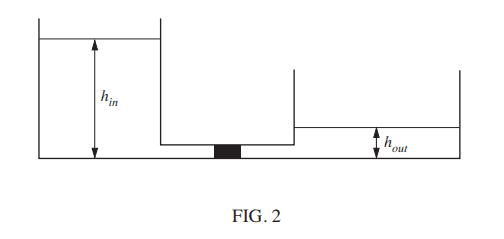
upload_2019-2-21_8-34-56.png


Produce a mathematical model of the process to determine the change in height of fluid in the second tank when the valve is open.

b. Determine the time constant for the system.


Homework Equations


The flow rate of liquid through the valve is given by:[/B]

Q = 1/Rf (Pin - Pout)

Where; Q = flow rate in m^3 s^-1

Pin = pressure due to height of liquid in first tank (Pa)

Pout = pressure due to height of liquid in second tank (Pa)

The Attempt at a Solution


a[/B]
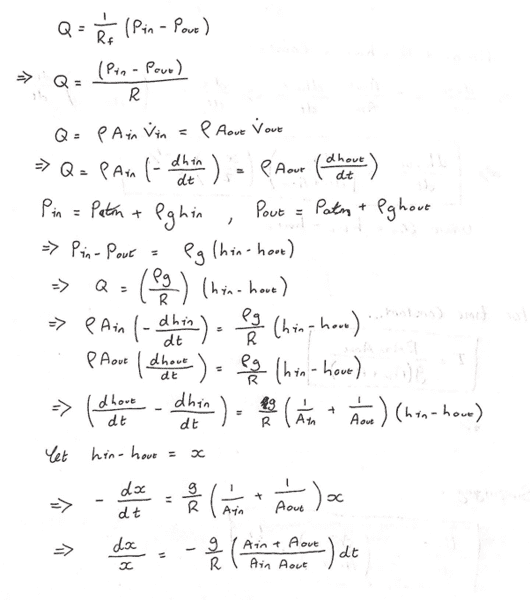
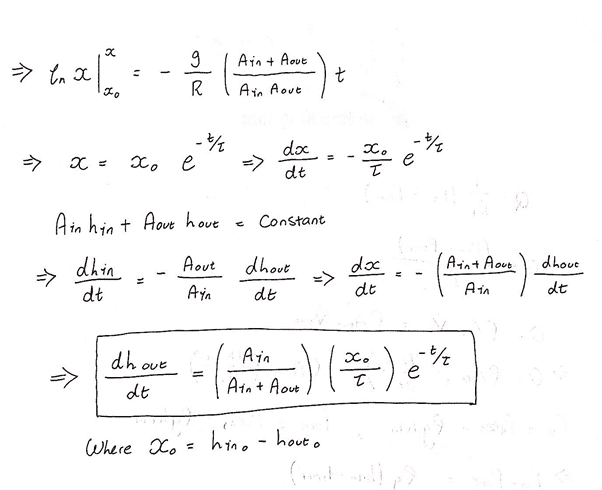
upload_2019-2-21_8-36-47.png
upload_2019-2-21_8-37-8.png

b
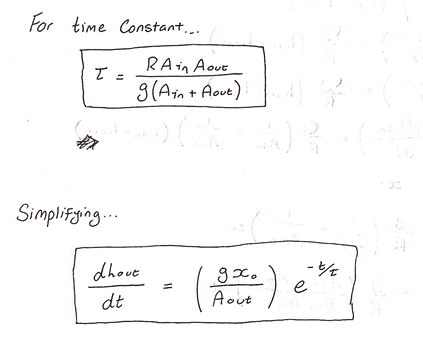
upload_2019-2-21_8-37-52.png

Giving a time constant of 63.2% for the system.
 

Attachments

  • upload_2019-2-21_8-34-56.png
    upload_2019-2-21_8-34-56.png
    1.5 KB · Views: 598
  • upload_2019-2-21_8-36-47.png
    upload_2019-2-21_8-36-47.png
    27.3 KB · Views: 520
  • upload_2019-2-21_8-37-8.png
    upload_2019-2-21_8-37-8.png
    19.7 KB · Views: 578
  • upload_2019-2-21_8-37-52.png
    upload_2019-2-21_8-37-52.png
    9.3 KB · Views: 572
Physics news on Phys.org
You don't need the final differential equation to determine ##h_{out}##. You have two algebraic equations in two unknowns:
$$A_{in}h_{in}+A_{out}h_{out}=A_{in}h_{in,0}+A_{out}h_{out,0}$$
and $$h_{in}-h_{out}=(h_{in,0}-h_{out,0})e^{-t/\tau}$$
 
So instead of differentiating at the end I should just leave the equations as they are like below?

222195-b54ffaec0afbba6d5453a104228544fb.jpg
 

Attachments

  • 1234.jpg
    1234.jpg
    33.3 KB · Views: 421
  • 222195-b54ffaec0afbba6d5453a104228544fb.jpg
    222195-b54ffaec0afbba6d5453a104228544fb.jpg
    1.3 KB · Views: 660
PaxFinnica96 said:
So instead of differentiating at the end I should just leave the equations as they are like below?

View attachment 239115
No. You solve the two equations in two unknowns for the change in height in the second tank.
 
Chestermiller said:
No. You solve the two equations in two unknowns for the change in height in the second tank.

Ok, that's great I think I've managed to solve the two equations and demonstrate the proof but I'm still struggling with how best to determine the time constant - would it just be a simple matter of rearranging the model equation (the one I've just solved from the two above equations) for tau?
 
PaxFinnica96 said:
Ok, that's great I think I've managed to solve the two equations and demonstrate the proof but I'm still struggling with how best to determine the time constant - would it just be a simple matter of rearranging the model equation (the one I've just solved from the two above equations) for tau?
You already provided an equation for tau.
 

Similar threads

  • · Replies 6 ·
Replies
6
Views
4K
  • · Replies 14 ·
Replies
14
Views
3K
  • · Replies 1 ·
Replies
1
Views
2K
  • · Replies 14 ·
Replies
14
Views
2K
  • · Replies 3 ·
Replies
3
Views
3K
Replies
8
Views
6K
  • · Replies 7 ·
Replies
7
Views
7K
Replies
1
Views
3K
  • · Replies 4 ·
Replies
4
Views
3K
Replies
12
Views
2K