Temperature of a Solar panel in space

Click For Summary

Discussion Overview

The discussion revolves around the thermal dynamics of solar panels in space, specifically examining the temperature changes of two marble slabs, one equipped with a photovoltaic solar panel and a resistive load. Participants explore the implications of power transfer and energy conversion on the temperature of the slabs, considering equilibrium conditions and the effects of energy absorption and dissipation.

Discussion Character

  • Exploratory
  • Technical explanation
  • Conceptual clarification
  • Debate/contested

Main Points Raised

  • Some participants propose that when the photovoltaic cell is connected to the load, the power consumed by the load slab increases its temperature, while the photovoltaic slab experiences a decrease in temperature due to reduced net power received.
  • Others argue that the photovoltaic cell operates in a way that it limits its temperature increase by converting some absorbed solar energy into work, which would otherwise contribute to heating.
  • A later reply introduces the idea that the absorptivity and emissivity of the marble slabs could complicate the analysis, suggesting that painting the sunward side black could alter the radiative equilibrium temperature.
  • Participants discuss the relationship between entropy and energy conversion, noting that sunlight (low entropy) is converted into heat (high entropy) and that converting some energy into work reduces the energy available to heat the panel.

Areas of Agreement / Disagreement

While there is some agreement on the basic thermal dynamics of the slabs, participants express differing views on the implications of the photovoltaic cell's operation and the effects of material properties on temperature changes. The discussion remains unresolved regarding the overall impact of these factors.

Contextual Notes

Participants acknowledge limitations related to the assumptions of absorptivity and emissivity of the materials involved, as well as the efficiency of the solar cells, which complicate the analysis of temperature changes.

nithinyes
Messages
15
Reaction score
0
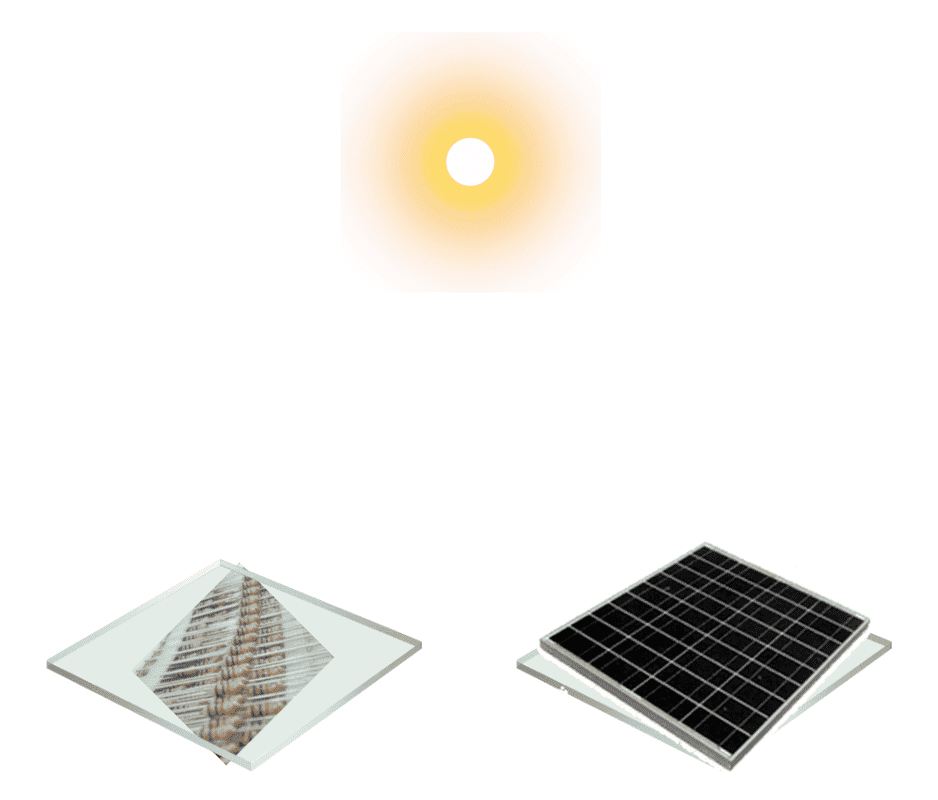
Consider two 1 square meter marble slabs each of mass 1 kg floating in space facing the sun such that light from the sun incident perpendicularly on the flat faces.

us9a2bigwft51.png
At equilibrium, power received from the sun 'PS' equals the power being lost in the form of radiation 'PR'.

PS = PR (at equilibrium)

For simplicity, assume the equilibrium temperature TE = 300K.

Let us now install a photovoltaic solar panel on the right slab and resistive load on the left slab.

Assume the mass of the photovoltaic panel and resistive load be 1 kg each.

Connect the panel and load using wires and a switch of negligible mass.
4r56nn1iwft51.png
Let the new equilibrium temperature also be 300 K.

At time t = 0, the pv cell is connected to the load by closing the switch. Let the power being transmitted from pv slab to load slab be 'PPV' and all this power is consumed by the load slab.

So the net power received by load slab is PS + PPV and the net power received by pv slab is PS - PPV.

Since PS + PPV > PS - PPV,

So what happens to the temperature of the slabs?
 
Last edited by a moderator:
Science news on Phys.org
nithinyes said:
So what happens to the temperature of the slabs?
You first: what do you think happens, and why?
 
  • Like
Likes   Reactions: davenn and phinds
russ_watters said:
You first: what do you think happens, and why?
I think that the power consumed at the load converts into heat and so the temperature of load slab increases.

Coming to pv slab, net power received is reduced due to diversion of some solar power to load power and so the temperature of pv slab decreases.

Am I correct?
 
nithinyes said:
I think that the power consumed at the load converts into heat and so the temperature of load slab increases.

Coming to pv slab, net power received is reduced due to diversion of some solar power to load power and so the temperature of pv slab decreases.

Am I correct?
Yup!
 
russ_watters said:
Yup!
If so, Can we say that photovoltaic cell is a device which reduces its temperature and does useful work on surroundings when it is operating?
 
nithinyes said:
If so, Can we say that photovoltaic cell is a device which reduces its temperature and does useful work on surroundings when it is operating?

Yes, but in order to avoid misconception it is better to say that it limits the increase of its temperature by doing work that would otherwise converted into heat.
 
DrStupid said:
Yes, but in order to avoid misconception it is better to say that it limits the increase of its temperature by doing work that would otherwise converted into heat.
Can you please explain it a little elaborately in terms of entropy?
 
nithinyes said:
Can you please explain it a little elaborately in terms of entropy?

Sunlight (with low entropy) is absorbed by the solar panel and converted into heat (with high entropy). If a part of the absorbed energy is converted into work (without entropy) there is less energy left to heat the panel.
 
  • Like
Likes   Reactions: etotheipi, nithinyes and vanhees71
DrStupid said:
Sunlight (with low entropy) is absorbed by the solar panel and converted into heat (with high entropy). If a part of the absorbed energy is converted into work (without entropy) there is less energy left to heat the panel.
Thank you
 
  • #10
nithinyes said:
I think that the power consumed at the load converts into heat and so the temperature of load slab increases.

Coming to pv slab, net power received is reduced due to diversion of some solar power to load power and so the temperature of pv slab decreases.

Am I correct?
Because this is an intermediate level post I would like, for completeness, to include one complication.. The slab is made of marble which is presumably not very absorbtive (or therefore emissive). Panting (only) the sunward side of the slab black would increase its radiative equilibrium temperature. The solar cells are black and not 100% efficient and so the true answer is unknown because of these competing factors.
But the rest of the analysis is fine.
 
  • Like
Likes   Reactions: nithinyes and Dullard

Similar threads

Replies
7
Views
2K
  • · Replies 11 ·
Replies
11
Views
2K
  • · Replies 2 ·
Replies
2
Views
2K
  • · Replies 31 ·
2
Replies
31
Views
5K
  • · Replies 30 ·
2
Replies
30
Views
4K
Replies
28
Views
4K
  • · Replies 9 ·
Replies
9
Views
3K
  • · Replies 152 ·
6
Replies
152
Views
11K
  • · Replies 1 ·
Replies
1
Views
3K
  • · Replies 1 ·
Replies
1
Views
2K