Undergrad The 1.22 factor in the angular resolution

Click For Summary
The discussion centers on the calculation of angular resolution, primarily using the formula θ=1.22(λ/D), which relates to the Airy disk's intensity function. An alternative approach suggests defining angular resolution at θ≈0.94(λ/D), based on when the central peak of the combined intensity of two sources divides into two distinct peaks. The conversation also touches on the practical limitations of CCD technology in capturing these details, highlighting the need for significantly more pixels to achieve better resolution. Additionally, different criteria for angular resolution, such as the Sparrow criterion and Dawes' limit, are mentioned as alternatives to the Rayleigh criterion. Ultimately, the discussion emphasizes the complexity and varying definitions of angular resolution in imaging systems.
greypilgrim
Messages
581
Reaction score
44
Hi.

The angular resolution is calculated through
$$\theta=1.22\frac{\lambda}{D}\enspace.$$

It's the first zero of the intensity function (in small-angle approximation) of the Airy disk:
$$I\left(\alpha\right)=I_0\left(\frac{2J_1\left(\pi\cdot\alpha\cdot\frac{D}{\lambda}\right)}{\pi\cdot\alpha\cdot\frac{D}{\lambda}}\right)^2$$

So if the angle between two light sources is ##\theta##, the central maximum of one source coincides with the first minimum of the other and vice versa.

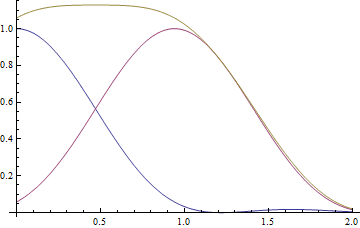
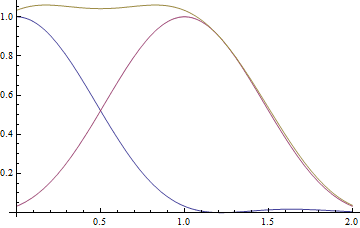
Though this makes sense, I tried a different approach and tried to find the smallest ##\theta## where the central peak of
$$I\left(\alpha\right)+I\left(\alpha-\theta\right)$$
divides into two. This happens way earlier, at about ##\theta\approx0.94\frac{\lambda}{D}##:
##\theta=0.90\frac{\lambda}{D}:##
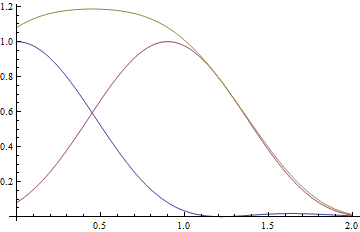
90.png

##\theta=0.94\frac{\lambda}{D}:##
94.png

##\theta=1.00\frac{\lambda}{D}:##
100.png


Wouldn't it make more sense to define ##\theta\approx0.94\frac{\lambda}{D}## as angular resolution?
 

Attachments

  • 90.png
    90.png
    3.6 KB · Views: 1,052
  • 100.png
    100.png
    3.7 KB · Views: 1,026
  • 94.png
    94.png
    3.5 KB · Views: 1,030
Physics news on Phys.org
It's a rule of thumb, to an extent.

But note that your graph is sampling hundreds of points across the diameter of one Airy disc. In other words, a CCD with the capability of your graph would need tens of thousands times more pixels than the one you'd normally fit to the instrument producing the Airy discs. That'll be a penny or two in R&D costs, and the resolution gain is tiny. Easier to build a bigger telescope. With adaptive optics.

You might like to try again with CCD elements that integrate over some finite area and not knowing where the discs are centred. The Nyquist criterion tells you that you'll get a decent performance gain until the detector pitch is about half the width of the Airy disc, and then diminishing returns will well and truly set in.
 
Last edited:
Ibix said:
It's a rule of thumb, to an extent.
So why not just take
$$\theta=\frac{\lambda}{D}\enspace?$$
 
greypilgrim said:
Hi.

The angular resolution is calculated through
$$\theta=1.22\frac{\lambda}{D}\enspace.$$

It's the first zero of the intensity function (in small-angle approximation) of the Airy disk:
$$I\left(\alpha\right)=I_0\left(\frac{2J_1\left(\pi\cdot\alpha\cdot\frac{D}{\lambda}\right)}{\pi\cdot\alpha\cdot\frac{D}{\lambda}}\right)^2$$

So if the angle between two light sources is ##\theta##, the central maximum of one source coincides with the first minimum of the other and vice versa.

Though this makes sense, I tried a different approach <snip>

There are different approaches to defining 'angular resolution'- the Rayleigh criterion was simply the first. The Sparrow criterion uses a different metric (the central dip is 5%, not (IIRC) 20%). The Nyquist limit is more appropriate for sampled imaging systems. Your approach simply defines yet another criterion.
 
  • Like
Likes vanhees71, Charles Link and Ibix
Andy Resnick said:
The Sparrow criterion uses a different metric (the central dip is 5%, not (IIRC) 20%).
Having read up on the topic a little, I think the Sparrow criterion is exactly the idea I had (appearance of a central dip). Based on a 5 % central dip, it seems to be called Dawes' limit.
 
  • Like
Likes Charles Link
Topic about reference frames, center of rotation, postion of origin etc Comoving ref. frame is frame that is attached to moving object, does that mean, in that frame translation and rotation of object is zero, because origin and axes(x,y,z) are fixed to object? Is it same if you place origin of frame at object center of mass or at object tail? What type of comoving frame exist? What is lab frame? If we talk about center of rotation do we always need to specified from what frame we observe?

Similar threads

  • · Replies 1 ·
Replies
1
Views
1K
  • · Replies 5 ·
Replies
5
Views
2K
  • · Replies 6 ·
Replies
6
Views
2K
  • · Replies 1 ·
Replies
1
Views
501
  • · Replies 1 ·
Replies
1
Views
1K
Replies
46
Views
4K
  • · Replies 3 ·
Replies
3
Views
3K
  • · Replies 11 ·
Replies
11
Views
3K
  • · Replies 3 ·
Replies
3
Views
2K
  • · Replies 5 ·
Replies
5
Views
3K