The classic 'stone at the end of a thread problem'

  • Context: Graduate 
  • Thread starter Thread starter WorldOfPhysics
  • Start date Start date
  • Tags Tags
    Circular motion Thread
Click For Summary

Discussion Overview

The discussion revolves around the dynamics of a stone attached to a string being rotated at high speeds, particularly analyzing the system from a rotating frame. Participants explore the behavior of the string and the forces acting on the stone, considering both theoretical and practical implications.

Discussion Character

  • Exploratory
  • Technical explanation
  • Debate/contested
  • Experimental/applied

Main Points Raised

  • One participant questions the possibility of the string becoming horizontal, suggesting it will asymptotically approach that state as angular velocity increases.
  • Another participant critiques the diagram presented in the initial post, arguing that the tension force is misrepresented and should include an upward component that balances the gravitational force.
  • A practical example is shared involving a boat moored with a rope, illustrating the effects of tension and angle in a real-world scenario, particularly during turbulence in a lock.
  • It is proposed that in an ideal scenario, tension in the string is inversely proportional to the sine of the angle with the horizontal, indicating that as the angle approaches zero, tension becomes infinitely large.
  • Participants discuss the implications of small forces on tension in ropes, referencing practical applications in boating where minor adjustments can lead to significant increases in tension.

Areas of Agreement / Disagreement

Participants express differing views on the behavior of the string and the forces involved, with no consensus reached on whether the string can become horizontal or the accuracy of the initial diagram. Multiple competing perspectives remain throughout the discussion.

Contextual Notes

Some assumptions regarding the ideal conditions of the system are not fully explored, and the mathematical relationships presented depend on specific definitions of angles and forces that may not be universally agreed upon.

WorldOfPhysics
Messages
11
Reaction score
0
Dear experts,

when a a stone at the end of the string is rotated with a high speed so that the string is suspended making zero degrees with the plane of the ground, how do we analyze the system from the rotating frame.
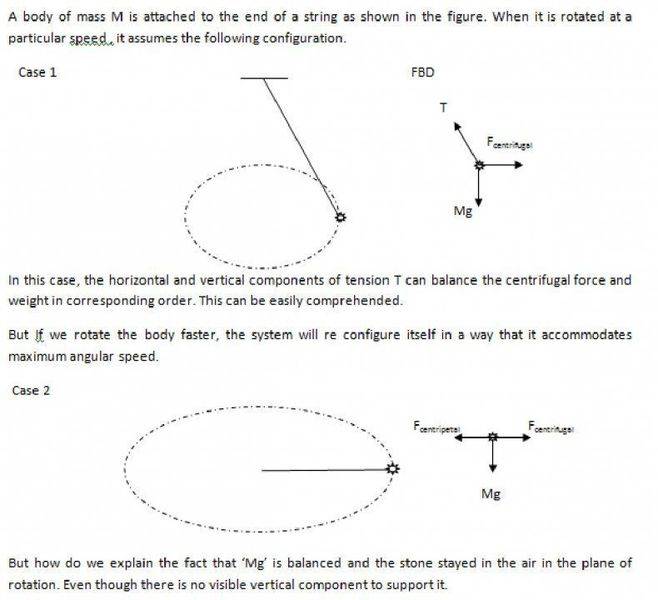
query.jpg
 
Last edited:
Physics news on Phys.org
I don't think the string will ever become horizontal. It will asymptotically tend towards horizontal as angular velocity increases.
So the case you are being asked to explain requires no explanation because it doesn't happen.
 
  • Like
Likes   Reactions: CWatters and russ_watters
I agree with andrewkirk.

The figure in Case 2 (in post #1) is drawn incorrectly. The correct figure should have the label "T" or tension force for the left-pointing arrow, which should point slightly upward and to the left. Then, the magnitude of the downward force Mg should be much smaller than shown -- equal, in fact to the small upward component of the tension force.

Aternatively, Mg could keep the same magnitude, but the centripetal and tension forces would be drawn much larger than shown in Case 2 -- again with the upward component of tension equal to Mg.
 
We had a very real world experience of this effect last week when we hired a boat...

The boat had a single main mooring line tied permanently near the front. We entered a lock and moored up by running the mooring line around a vertical pole as shown in the first drawing. The problem came when the lock keeper let water into the lock. This caused a lot of turbulence and it proved impossible for the person holding the free end of the rope to keep us against the bank. The reason was the shallow angle on the rope. The closer the boat gets to the bank the harder it is to pull it any closer.

Boat 1.jpg


The answer was to run the rope as shown in the second drawing...

Boat 2.jpg
 
  • Like
Likes   Reactions: andrewkirk
In an ideal case, the tension will be proportional to 1/sin(θ) where θ is the angle between the string and horizontal. As θ approaches 0, the tension will approach Infinity. Your perception of the stone being in the same horizontal plane as the support was, in fact, wrong. i.e. θ was very small and appeared to be zero.
There are many examples where a small sideways force can give a massive increase in tension on a taught rope. This is used very often on boats when a mere human can produce super human force against wind and current. (example mentioned above).
 

Similar threads

Replies
12
Views
4K
  • · Replies 10 ·
Replies
10
Views
3K
  • · Replies 35 ·
2
Replies
35
Views
9K
  • · Replies 1 ·
Replies
1
Views
2K
  • · Replies 5 ·
Replies
5
Views
2K
  • · Replies 8 ·
Replies
8
Views
3K
  • · Replies 23 ·
Replies
23
Views
5K
  • · Replies 2 ·
Replies
2
Views
3K
  • · Replies 21 ·
Replies
21
Views
4K
  • · Replies 15 ·
Replies
15
Views
4K