The Lagrangian a function of 'v' only and proving v is constant

Click For Summary

Discussion Overview

The discussion revolves around the implications of the Lagrangian being a function of the magnitude of velocity only, specifically in the context of proving that velocity is constant. Participants explore the relationship between the Lagrangian, its derivatives, and the conditions under which velocity can be considered constant, referencing concepts from classical mechanics as presented in the Landau/Lifshitz text.

Discussion Character

  • Exploratory
  • Technical explanation
  • Debate/contested

Main Points Raised

  • One participant notes that in an inertial frame, the Lagrangian depends only on the magnitude of velocity (v²) and questions how to prove that velocity is constant.
  • Another participant explains that while the Lagrangian is a function of speed, its derivative with respect to the components of velocity is not constant, providing a mathematical expression for this relationship.
  • A participant expresses confusion about how the derivative being a different type of function does not imply that velocity is constant, seeking further clarification or literature recommendations.
  • Another response asserts that the derivative is constant for all components and suggests that if v² is constant, then the derivative of the Lagrangian with respect to velocity must also be constant.
  • It is mentioned that the typical form of the Lagrangian includes a kinetic term, which leads to a specific value for the derivative of the Lagrangian.

Areas of Agreement / Disagreement

Participants express differing views on the implications of the Lagrangian's dependence on velocity and whether this leads to a definitive conclusion about the constancy of velocity. The discussion remains unresolved, with no consensus on the proof of velocity being constant.

Contextual Notes

There are unresolved assumptions regarding the conditions under which the Lagrangian is considered, and the implications of its derivatives are not fully clarified. The discussion also reflects varying levels of understanding of the mathematical relationships involved.

Ren Figueroa
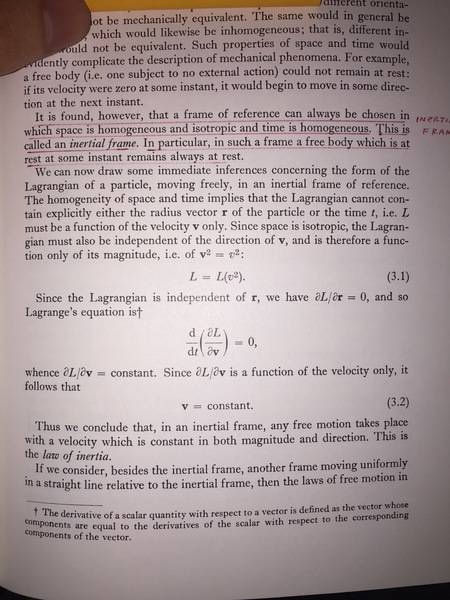
Hi everyone. So I'm going through Landau/Lifshitz book on Mechanics and I read through a topic on inertial frames. So, because we are in an inertial frame, the Lagrangian ends up only being a function of the magnitude of the velocity only (v2) Now my question to you is, how does one prove that the velocity is constant like in (3.2)? When I first went through it, I thought it was obvious because it makes sense that the partial derivative of the Lagrangian with respect to velocity has to be a constant in order for the derivative with respect to time to equal zero. But a professor, who is mentoring me, brought it to my attention that this is not as obvious as it looks and once he explained to me why it wasn't obvious, I started to think so too.
Actually, when I think about it, if the Lagrangian is only a function of the magnitude of velocity, then the derivative with respect to time automatically should be zero. But, this doesn't automatically prove that velocity is constant. (At least it doesn't to me) I am curious to know anyone else's explanation/feedback on this subject. Thanks!
(Also, I am not sure if this is a graduate level text or undergraduate but I have already read undergraduate texts by Morin and Taylor. I put the thread under "graduate level" based on what I found on other forums but if it is actually and undergrad text then I apologize!)
I5q0K_reCjlH2qP1Hb3Zk9CmJ-a6XXg-kX_hTsips4C0J-KGStm_BYR1MfI0LHQXLharrYy9elTV7SrGv=w1308-h1742-no.jpg
 
Physics news on Phys.org
While the Lagrangian is a function of the speed only, its derivative with respect to the components of ##\vec v## are not. Generally, if ##L = L(v^2)##, then
$$
\frac{\partial L}{\partial v^i} = L'(v^2) \frac{\partial(v^2)}{dv^i} = 2v^i L'(v^2).
$$
 
Orodruin said:
While the Lagrangian is a function of the speed only, its derivative with respect to the components of ##\vec v## are not. Generally, if ##L = L(v^2)##, then
$$
\frac{\partial L}{\partial v^i} = L'(v^2) \frac{\partial(v^2)}{dv^i} = 2v^i L'(v^2).
$$
Hi. Thanks for the response. I understood that the derivative is a different type of function, but it doesn't convince me that v is constant. Do you have another explanation to help me through this? Or maybe some recommended literature?
 
Ren Figueroa said:
Hi. Thanks for the response. I understood that the derivative is a different type of function, but it doesn't convince me that v is constant. Do you have another explanation to help me through this? Or maybe some recommended literature?
Which part do you not understand? Whatever that derivative is is constant and it holds for all components. If you are worried about the ##L'## factor you can easily show that ##v^2## also is constant and therefore so is ##L'(v^2)##.

Normally, the Lagrangian contains the kinetic term ##mv^2/2##, making ##L' = m/2##.
 

Similar threads

  • · Replies 25 ·
Replies
25
Views
3K
  • · Replies 24 ·
Replies
24
Views
2K
  • · Replies 3 ·
Replies
3
Views
2K
  • · Replies 1 ·
Replies
1
Views
2K
  • · Replies 4 ·
Replies
4
Views
2K
  • · Replies 4 ·
Replies
4
Views
2K
  • · Replies 48 ·
2
Replies
48
Views
3K
  • · Replies 5 ·
Replies
5
Views
2K
  • · Replies 14 ·
Replies
14
Views
8K
  • · Replies 8 ·
Replies
8
Views
4K