The Number e .... Sohrab Proposition 2.3.15 ....

  • Context: MHB 
  • Thread starter Thread starter Math Amateur
  • Start date Start date
Click For Summary
SUMMARY

The discussion centers on Proposition 2.3.15 from Houshang H. Sohrab's "Basic Real Analysis" (Second Edition), specifically the proof that $$1 / n! \leq 1 / (2 \cdot 3^{n - 2})$$ for all $$n \geq 3$$. The proof is established by recognizing that the factorial $$n!$$ is the product of $$n$$ factors, where each factor after 2 is at least 3. This leads to the conclusion that $$n! \geq 2 \cdot 3^{n - 2}$$, allowing the inequality to be validated by taking the inverse.

PREREQUISITES
  • Understanding of factorial notation and properties
  • Basic knowledge of inequalities in real analysis
  • Familiarity with sequences and series of real numbers
  • Proficiency in mathematical proofs and logical reasoning
NEXT STEPS
  • Study the properties of factorials in combinatorial contexts
  • Explore advanced inequalities in real analysis
  • Learn about convergence of sequences and series
  • Review proof techniques in mathematical analysis
USEFUL FOR

Students of real analysis, mathematicians focusing on sequences and series, and anyone interested in understanding mathematical proofs and inequalities.

Math Amateur
Gold Member
MHB
Messages
3,920
Reaction score
48
I am reading Houshang H. Sohrab's book: "Basic Real Analysis" (Second Edition).

I am focused on Chapter 2: Sequences and Series of Real Numbers ... ...

I need help with an aspect of the proof of Proposition 2.3.15 ...

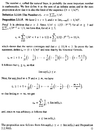
Proposition 2.3.15 and its proof read as follows:
View attachment 9052
In the above proof by Sohrab we read the following:

" ... ...Since $$1 / n! \leq 1 / (2 \cdot 3^{ n - 2 } )$$ for all $$n \geq 3$$ ... ... "My question is ... how do we know this is true ... ?

Can someone please demonstrate how to prove that $$1 / n! \leq 1 / (2 \cdot 3^{ n - 2 } )$$ for all $$n \geq 3$$ ... ...

Help will be much appreciated ...

Peter
 

Attachments

  • Sohrab - Proposition 2.3.15 ... .png
    Sohrab - Proposition 2.3.15 ... .png
    26.9 KB · Views: 127
Physics news on Phys.org
Hi Peter,

$n!=1\cdot2\cdot3\cdots n$ is the product of $n$ factors. As each of the $n-2$ factors after $2$ is at least equal to $3$, we have:
$$
n!\ge1\cdot2\cdot3^{n-2}=2\cdot3^{n-2}
$$
and the result follows by taking the inverse.
 
castor28 said:
Hi Peter,

$n!=1\cdot2\cdot3\cdots n$ is the product of $n$ factors. As each of the $n-2$ factors after $2$ is at least equal to $3$, we have:
$$
n!\ge1\cdot2\cdot3^{n-2}=2\cdot3^{n-2}
$$
and the result follows by taking the inverse.

Hmmm ... easy when you see how ... :) ...

Thanks for the help castor28 ...

Peter
 

Similar threads

  • · Replies 2 ·
Replies
2
Views
2K
Replies
4
Views
2K
Replies
2
Views
2K
Replies
2
Views
2K
  • · Replies 4 ·
Replies
4
Views
2K
Replies
5
Views
2K
  • · Replies 3 ·
Replies
3
Views
2K
  • · Replies 6 ·
Replies
6
Views
2K
  • · Replies 2 ·
Replies
2
Views
2K
Replies
2
Views
2K