Undergrad The Riemann and Darboux Integrals .... Browder, Theorem 5.10 .... ....

Click For Summary
SUMMARY

The forum discussion centers on understanding the proof of Theorem 5.10 from Andrew Browder's "Mathematical Analysis: An Introduction," specifically regarding the necessity of the condition for the existence of the Riemann integral. Participants discuss the rigorous demonstration required to show that if the integral exists, then for every ε > 0, there exists a partition π of [a, b] such that the difference between the upper and lower sums, denoted as &overline;S(f, π) - &underline;S(f, π), is less than ε. The conversation highlights the importance of utilizing the definitions and properties of Riemann sums to construct a valid proof.

PREREQUISITES
  • Understanding of Riemann integration concepts
  • Familiarity with the definitions of upper and lower sums
  • Knowledge of the triangle inequality in mathematical proofs
  • Ability to work with ε-δ definitions in analysis
NEXT STEPS
  • Study the definitions and properties of Riemann sums in detail
  • Learn how to apply the triangle inequality in proofs involving integrals
  • Review the implications of Theorem 5.10 in Browder's text
  • Explore additional examples of proving the existence of integrals using partitions
USEFUL FOR

Mathematics students, educators, and anyone interested in deepening their understanding of Riemann integration and its foundational proofs.

Math Amateur
Gold Member
MHB
Messages
3,920
Reaction score
48
TL;DR
I need help to prove a theorem effectively equivalencing Riemann and Darboux integration ...
I am reading Andrew Browder's book: "Mathematical Analysis: An Introduction" ... ...

I am currently reading Chapter 5: The Riemann Integral and am currently focused on Section 5.1 Riemann Sums ... ...

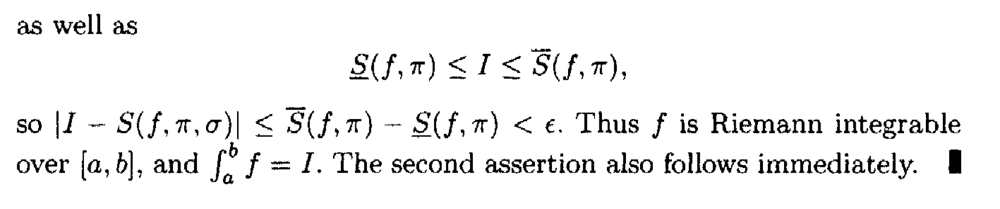
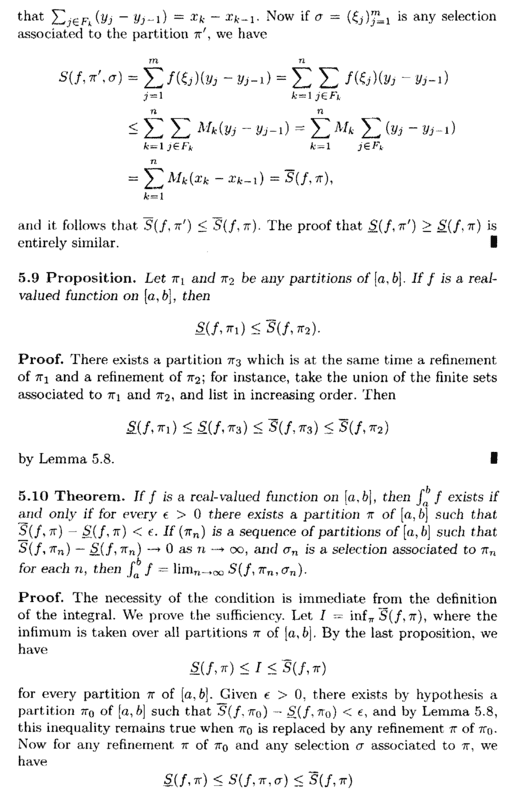
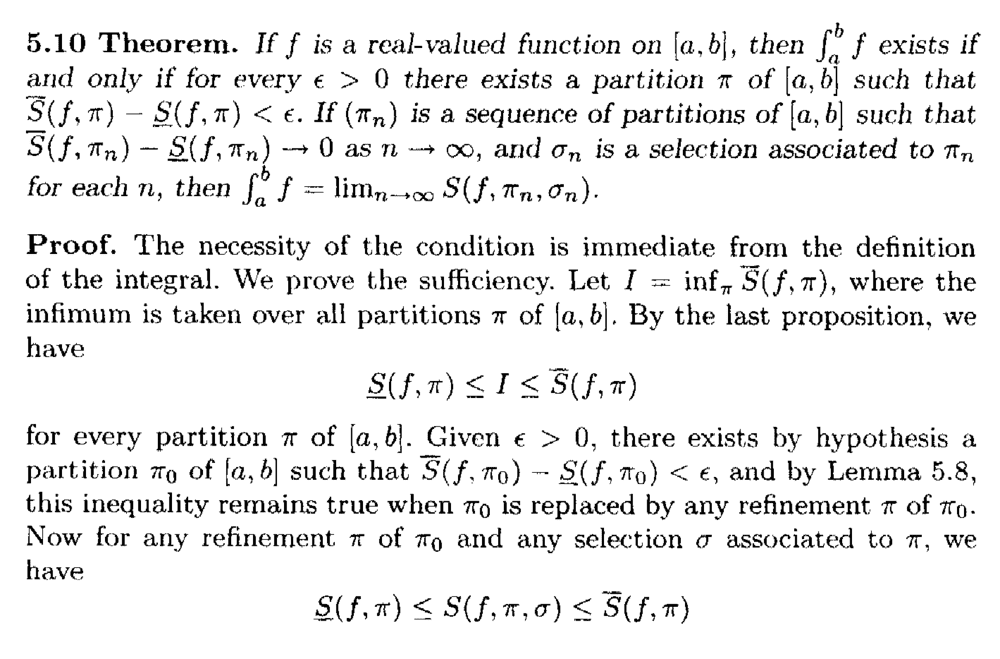
I need some help in understanding the proof of Theorem 5.10 ...Theorem 5.10 and its proof read as follows:
Browder - 1 - Theorem 5.10 ... PART 1 ... .png

Browder - 2 - Theorem 5.10 ... PART 2 ... .png

At the start of the above proof by Browder we read the following:

" ... ... The necessity of the condition is immediate from the definition of the integral ... ... " Can someone please help me to rigorously demonstrate the necessity of the condition ...

-------------------------------------------------------------------------------------------------------------------

Note: I am assuming that proving "the necessity of the condition is proving the following:##\int_a^b f \text{ exists } \Longrightarrow## ... for every ##\epsilon \gt 0 \ \exists \ ## a partition ##\pi## of ##[a, b]## such that ##\overline{S} (f, \pi) - \underline{S} (f, \pi) \lt \epsilon## ... ...

-------------------------------------------------------------------------------------------------------------------

Help will be much appreciated ...

Peter
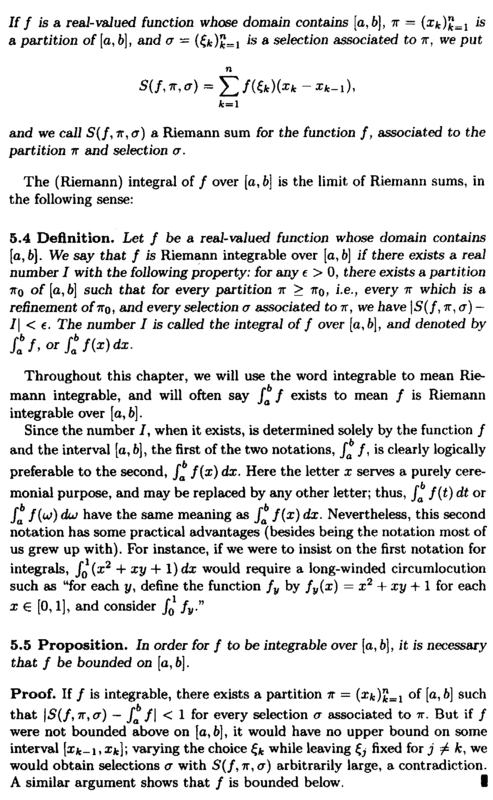
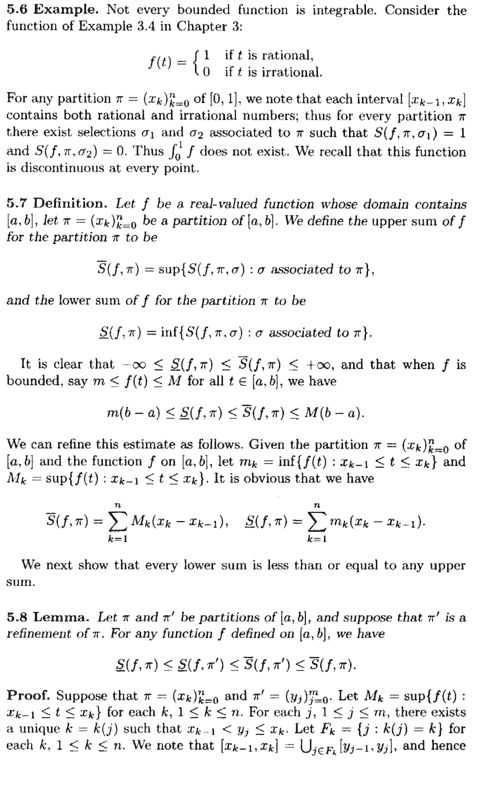
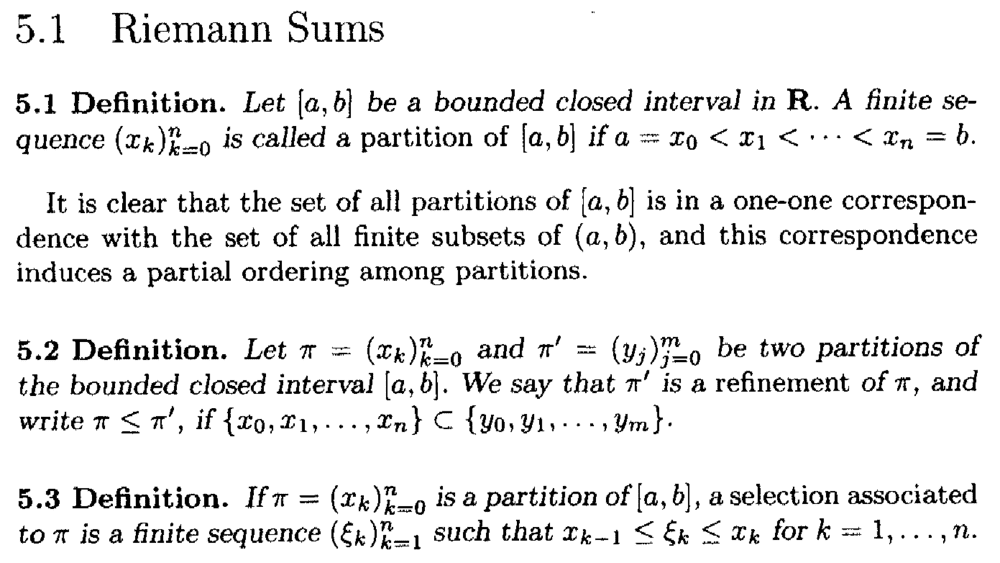
==========================================================================================Note: It may help Physics Forum readers of the above post to have access to Browder's notation, definitions and theorems on Riemann integration preliminary to Theorem 5.10 ... hence I am providing access to the same ... as follows:
Browder - 1 - Start of 5.1 - Relevant Defns & Propns ... PART 1 ... .png

Browder - 2 - Start of 5.1 - Relevant Defns & Propns ... PART 2 ... .png

Browder - 3 - Start of 5.1 - Relevant Defns & Propns ... PART 3 ... .png

Browder - 4 - Start of 5.1 - Relevant Defns & Propns ... PART 4 ... .png
Hope that text helps ...

Peter
 
Physics news on Phys.org
This would be a lot more readable if you just typed out the relevant definitions instead of a lot of images. That being said, here is how you can proceed (possibly I overcomplicated the matter though).

Let ##\epsilon > 0##. Choose ##\pi## as in the definition of integral such that for all corresponding ##\sigma## we have ##|S(f, \pi, \sigma)-I| < \epsilon/4##.

Since ##\overline{S}(f, \pi) = \sup\{S(f, \pi, \sigma): \sigma \mathrm{\ associated \ to \ \pi}\}##, we can select ##\sigma_1## such that ##\overline{S}(f, \pi)- S(f, \pi, \sigma_1)< \epsilon/4##. Similarly, one can choose ##\sigma_2## such that ##S(f, \pi, \sigma_2) - \underline{S}(f, \pi) < \epsilon/4##

Then ##\overline{S}(f, \pi) - \underline{S}(f, \pi) \leq |\overline{S}(f, \pi) - S(f,\pi, \sigma_1)| + |S(f, \pi, \sigma_1)-I| + |I-{S}(f, \pi, \sigma_2)|+ |S(f, \pi, \sigma_2)- \underline{S}(f, \pi, \sigma_2)| < \epsilon##

which is exactly what we want.
 
Last edited by a moderator:
  • Like
Likes Math Amateur
Hi Peter,

a good strategy is always to write down what we have. Here we have that ##I:=\int_a^b f(x)\,dx## exists. Therefore we have to look at definition 5.4. which tells us ##|S(f,\pi,\sigma)-I|<\varepsilon_1\,##. Now we want to show that ##|\underline{S}(f,\pi)-\overline{S}(f,\pi)|<\varepsilon_2\,##.

Whenever we see something like ##|A-B|<\varepsilon ## then then triangle inequality lurks around the corner.
A standard procedure is now ##|A-B|=|A-C + (C-B)| \leq |A-C|+|B-C|## and the approximation of the two resulting summands to get an estimation of the original term.
 
  • Like
Likes Math Amateur
Thanks to fresh_42 and Math_QED for the hints ...

Based on your advice my proof proceeds as follows ...

We wish to prove:

##\int_a^b f \text{ exists } \Longrightarrow##] ... for every ##\epsilon \gt 0 \ \exists \ ## a partition ##\pi## of ##[a, b]## such that ##\overline{S} (f, \pi) - \underline{S} (f, \pi) \lt \epsilon## ... ...Proof:

Let ##\int_a^b f = I ##

Then

##I## exists ##\Longrightarrow## for any ##\frac{ \epsilon }{2} \gt 0 \ \exists \ \pi_0## such that for any ##\pi \geq \pi_0## and every selection ##\sigma## associated with ##\pi## we have ##| s(f, \pi, \sigma ) - I | \lt \frac{ \epsilon }{2}##Now ##| S(f, \pi, \sigma ) - I | \lt \frac{ \epsilon }{2}##

implies that

##- \frac{ \epsilon }{2} \lt S(f, \pi, \sigma ) - I \lt \frac{ \epsilon }{2}##

and so, obviously, we have that

##S(f, \pi, \sigma ) - I \lt \frac{ \epsilon }{2}## ... ... ... ... ... (1)But ##| S(f, \pi, \sigma ) - I | \lt \frac{ \epsilon }{2}##

... also implies that

##- \frac{ \epsilon }{2} \lt I - S(f, \pi, \sigma ) \lt \frac{ \epsilon }{2}##

so, obviously, we have that

##I - S(f, \pi, \sigma ) \lt \frac{ \epsilon }{2}## ... ... ... ... ... (2)

Now we also have that

##\underline{S} (f, \pi) \leq S(f, \pi, \sigma ) \leq \overline{S} (f, \pi)## ... ... ... ... ... (3)Now (1) and (3) imply

##\overline{S} (f, \pi) - I \lt \frac{ \epsilon }{2}## ... ... ... ... ... (4)Similarly (2) and (3) imply

##I - \underline{S} (f, \pi) \lt \frac{ \epsilon }{2}## ... ... ... ... ... (5)Adding (4) and (5) gives

##\overline{S} (f, \pi) - \underline{S} (f, \pi) \lt \epsilon## ... ...
Is that basically correct?

Peter
 
Math Amateur said:
Thanks to fresh_42 and Math_QED for the hints ...

Based on your advice my proof proceeds as follows ...

We wish to prove:

##\int_a^b f \text{ exists } \Longrightarrow##] ... for every ##\epsilon \gt 0 \ \exists \ ## a partition ##\pi## of ##[a, b]## such that ##\overline{S} (f, \pi) - \underline{S} (f, \pi) \lt \epsilon## ... ...Proof:

Let ##\int_a^b f = I ##

Then

##I## exists ##\Longrightarrow## for any ##\frac{ \epsilon }{2} \gt 0 \ \exists \ \pi_0## such that for any ##\pi \geq \pi_0## and every selection ##\sigma## associated with ##\pi## we have ##| s(f, \pi, \sigma ) - I | \lt \frac{ \epsilon }{2}##Now ##| S(f, \pi, \sigma ) - I | \lt \frac{ \epsilon }{2}##

implies that

##- \frac{ \epsilon }{2} \lt S(f, \pi, \sigma ) - I \lt \frac{ \epsilon }{2}##

and so, obviously, we have that

##S(f, \pi, \sigma ) - I \lt \frac{ \epsilon }{2}## ... ... ... ... ... (1)But ##| S(f, \pi, \sigma ) - I | \lt \frac{ \epsilon }{2}##

... also implies that

##- \frac{ \epsilon }{2} \lt I - S(f, \pi, \sigma ) \lt \frac{ \epsilon }{2}##

so, obviously, we have that

##I - S(f, \pi, \sigma ) \lt \frac{ \epsilon }{2}## ... ... ... ... ... (2)

Now we also have that

##\underline{S} (f, \pi) \leq S(f, \pi, \sigma ) \leq \overline{S} (f, \pi)## ... ... ... ... ... (3)Now (1) and (3) imply

##\overline{S} (f, \pi) - I \lt \frac{ \epsilon }{2}## ... ... ... ... ... (4)Similarly (2) and (3) imply

##I - \underline{S} (f, \pi) \lt \frac{ \epsilon }{2}## ... ... ... ... ... (5)Adding (4) and (5) gives

##\overline{S} (f, \pi) - \underline{S} (f, \pi) \lt \epsilon## ... ...
Is that basically correct?

Peter

How do (1) and (3) imply (4)?

Similarly for (2) and (3) implies (5).
 
Hi Math_QED ...

Hmmm ... problem ... just checked ... the implications do not follow ... don't know what I was thinking ... apologies ..

Thanks again for your help ..

Peter
 
Math Amateur said:
Hi Math_QED ...

Hmmm ... problem ... just checked ... the implications do not follow ... don't know what I was thinking ... apologies ..

Thanks again for your help ..

Peter

No problem. A possible proof is in post #2.
 
  • Like
Likes Math Amateur

Similar threads

Replies
2
Views
2K
  • · Replies 2 ·
Replies
2
Views
2K
Replies
2
Views
2K
  • · Replies 4 ·
Replies
4
Views
2K
  • · Replies 14 ·
Replies
14
Views
4K
Replies
2
Views
2K
  • · Replies 2 ·
Replies
2
Views
2K
  • · Replies 2 ·
Replies
2
Views
2K
Replies
2
Views
2K
Replies
2
Views
2K