Thermodynamics - Entropy generation Q

Click For Summary
SUMMARY

The discussion centers on calculating entropy change in a co-current heat exchanger involving oxygen and nitrogen streams. Participants emphasize the need to equate the enthalpy increase of the oxygen stream with the enthalpy decrease of the nitrogen stream to determine the exit temperatures. The entropy change per kilogram for both gases can be calculated using the formula ΔS = Cp * ln(T2/T1), where Cp is the specific heat capacity, and T1 and T2 are the initial and final temperatures, respectively. The negligible pressure drop allows for a simplified analysis focused solely on temperature changes.

PREREQUISITES
  • Understanding of thermodynamic principles, specifically heat exchangers.
  • Familiarity with the concept of entropy and its calculation.
  • Knowledge of specific heat capacities for gases, particularly oxygen and nitrogen.
  • Basic skills in logarithmic functions and their application in thermodynamic equations.
NEXT STEPS
  • Study the calculation of entropy change using the formula ΔS = Cp * ln(T2/T1).
  • Research the specific heat capacities of oxygen and nitrogen at varying temperatures.
  • Explore the principles of co-current and counter-current heat exchangers.
  • Learn about the impact of pressure on thermodynamic properties in gas mixtures.
USEFUL FOR

Students and professionals in thermodynamics, mechanical engineers, and anyone involved in heat exchanger design and analysis will benefit from this discussion.

DrVirz
Messages
24
Reaction score
0
Hi all,

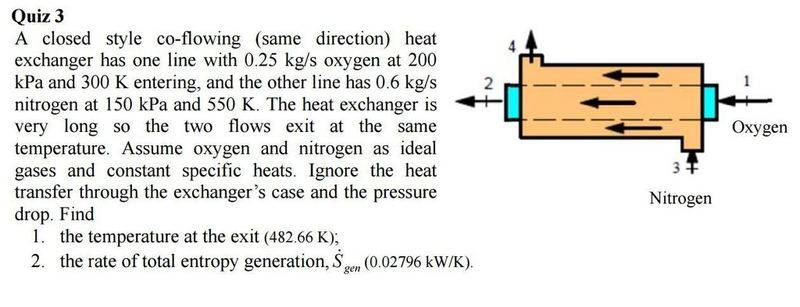
Just doing some thermo study and am stuck on a question. I am not sure where to start this Q as normally I am given a property at the exit..?

Any help is appreciated.
Capture_zps5voqbuaa.jpg


IMG_0001_zpsphzxcinz.jpg
 
Physics news on Phys.org
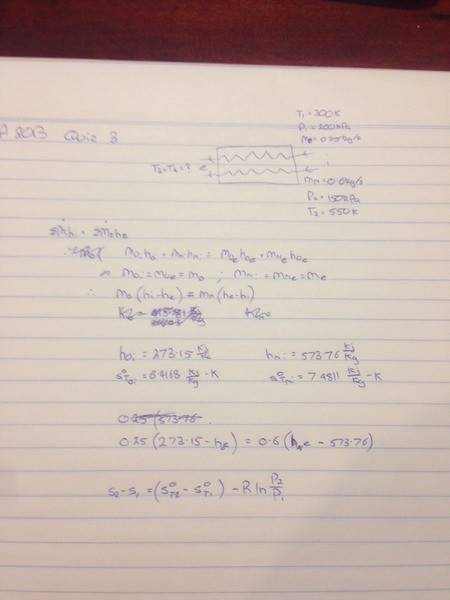
This is a co-current heat exchanger, and both fluids are flowing in the same direction. So, you need to set the enthalpy increase for the oxygen stream equal to the enthalpy decrease for the nitrogen stream. This will give you the exit temperature of both gases. So you know the starting temperature of each gas and the exit temperature of each gas. Do you know how to calculate the entropy change per kg of a gas if you know its initial temperature and its final temperature? (You don't have to take into consideration the effect of pressure on the entropy of each gas, because you are told that the pressure drops of the two gases are negligible). If so, what is the entropy change per kg of the oxygen and of the nitrogen in passing through the heat exchanger?

Chet
 

Similar threads

  • · Replies 3 ·
Replies
3
Views
4K
  • · Replies 11 ·
Replies
11
Views
2K
  • · Replies 34 ·
2
Replies
34
Views
6K
Replies
14
Views
1K
  • · Replies 13 ·
Replies
13
Views
3K
  • · Replies 1 ·
Replies
1
Views
1K
  • · Replies 5 ·
Replies
5
Views
3K
  • · Replies 3 ·
Replies
3
Views
2K
  • · Replies 2 ·
Replies
2
Views
2K
  • · Replies 7 ·
Replies
7
Views
2K