Thinking about the Definition of a Unit of a ring R .... ....

Join the discussion
Ask a follow-up here, or get your own question answered by working scientists, mathematicians and engineers — people, not an autocomplete.
Real named experts · corrections over time · the nuance an AI answer skips
8 replies · 3K views
Math Amateur
Gold Member
MHB
Messages
3,920
Reaction score
48
I have been thinking around the definition of a unit in a ring and trying to fully understand why the definition is the way it is ... ...

Marlow Anderson and Todd Feil, in their book "A First Course in Abstract Algebra: Rings, Groups and Fields (Second Edition), introduce units in a ring with 1 in the following way ... ...
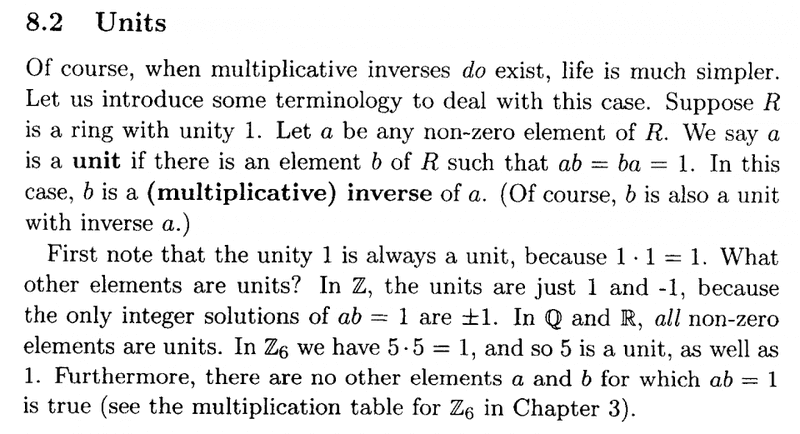
?temp_hash=6f5e57958aebaba9b5362599148c231b.png

So ... an element ##a## of a ring ##R## with ##1## is a unit if there is an element ##b## of ##R## such that
##ab = ba = 1## ... ...So ... if, in the case where ##R## was noncommutative, ##ab = 1## and ##ba \neq 1## then ##a## would not be a unit ... is that right?

Presumably it is not 'useful' to describe ##a## as a 'left unit' in such a case ... that is, presumably one-sided units are not worth defining ... is that right?
Could someone please comment on and perhaps clarify/correct the above ...Hope someone can help ...

Peter
 

Attachments

  • Anderson and Feil - Section 8.2 Units ... ....png
    Anderson and Feil - Section 8.2 Units ... ....png
    45.9 KB · Views: 970
  • Like
Likes   Reactions: Delta2
on Phys.org
Math Amateur said:
So ... if, in the case where ##R## was noncommutative, ##ab = 1## and ##ba \neq 1## then ##a## would not be a unit ... is that right?
I'm not aware of an example and still try to find an argument, why this should be impossible. At least I've found some strange implications.

Let us assume ##ab=1## and ##ba \neq 1##.

Then ##a(ba-1)=0## by associativity and you don't want to have a unit being a zero divisor.
In addition, ##a(ba+b-1)=1=ab## and ##ba+b-1 \neq b## and you don't want to have two different right inverses either.

So although I haven't found a direct contradiction (yet!?), the resulting ring has some really weird properties, at least ##a \in R## has.
 
  • Like
Likes   Reactions: Math Amateur
Thanks for the post fresh_42 ...

But I need some help to see why a(ba-1) = 0 ...

Can you help ...

Peter
 
Math Amateur said:
So ... if, in the case where ##R## was noncommutative, ##ab = 1## and ##ba \neq 1## then ##a## would not be a unit ... is that right?

Yes.

Presumably it is not 'useful' to describe ##a## as a 'left unit' in such a case ... that is, presumably one-sided units are not worth defining ... is that right?
The term "left inverse" is in use. Perhaps that's why we don't hear about "left units".
 
  • Like
Likes   Reactions: Math Amateur
Math Amateur said:
I have been thinking around the definition of a unit in a ring and trying to fully understand why the definition is the way it is ... ...

Marlow Anderson and Todd Feil, in their book "A First Course in Abstract Algebra: Rings, Groups and Fields (Second Edition), introduce units in a ring with 1 in the following way ... ...
?temp_hash=6f5e57958aebaba9b5362599148c231b.png

So ... an element ##a## of a ring ##R## with ##1## is a unit if there is an element ##b## of ##R## such that
##ab = ba = 1## ... ...So ... if, in the case where ##R## was noncommutative, ##ab = 1## and ##ba \neq 1## then ##a## would not be a unit ... is that right?

Presumably it is not 'useful' to describe ##a## as a 'left unit' in such a case ... that is, presumably one-sided units are not worth defining ... is that right?
Could someone please comment on and perhaps clarify/correct the above ...Hope someone can help ...

Peter

I think there are many rings with one sided units.
 
  • Like
Likes   Reactions: Math Amateur
Consider the ring of all operators ##C^\infty \to C^\infty##. What is the inverse of the derivative?
 
  • Like
Likes   Reactions: Math Amateur
fresh_42 said:
Let us assume ##ab=1## and ##ba \neq 1##.

Then ##a(ba-1)=0## by associativity and you don't want to have a unit being a zero divisor.
In addition, ##a(ba+b-1)=1=ab## and ##ba+b-1 \neq b## and you don't want to have two different right inverses either.

Math Amateur said:
But I need some help to see why ##a(ba-1) = 0##...
##a\cdot (ba-1)=a\cdot (b\cdot a)-a\cdot 1=(a\cdot b) \cdot a - a= 1 \cdot a - a = 0## so ##a## is a unit (##ab=1##) and a zero divisor ##a\cdot (ba-1)=0##.

##a(ba+b-1)=a\cdot (ba-1)+a\cdot b=0+1=1=ab## by the above and the definition of ##b##. So ##(ba+b-1)## and ##b## are both right inverse to ##a##. But if they were equal, that is ##ba+b-1=b## then ##ba-1=0## or ##ba=1## which we excluded. Thus they are actually two different right inverses.
 
  • Like
Likes   Reactions: Math Amateur
A classic example occurs in the ring of linear maps on the vector space of infinite tuples of numbers in some field.

The linear map ##R## that shifts the sequence once to the right and puts zero at the beginning of the sequence is inverted by the linear map ##L## that shifts the sequence once to the left and drops off the first number in the sequence. But ##L## is not invertible since it is not injective.

- I will look for some examples that do not involve infinite dimensional space such as this one or the example given above of the derivative operator. I think there are examples for some group rings over certain algebraic extensions of the rationals.
 
Last edited:
  • Like
Likes   Reactions: Math Amateur
Thanks to all who have posted ... it has been most helpful ... I am really grateful for the help ...

Peter