Three dielectric slabs in a capacitor

Click For Summary
The discussion centers on the confusion regarding how three dielectric slabs in a capacitor can be interpreted as three pairs of parallel capacitors, despite having only two physical plates. Participants explain that inserting metal plates at the boundaries of the dielectrics creates equipotential surfaces, allowing for the conceptualization of six plates, which can be treated as three capacitors. There is debate over whether the configuration actually represents three parallel capacitors or if it is more accurately described as three capacitors in series. The importance of understanding electric fields and equipotential surfaces in this context is emphasized, with some suggesting that relying on equivalent circuits may hinder deeper comprehension. Ultimately, the conversation highlights the complexities of analyzing capacitors with dielectrics and the need for a solid grasp of underlying principles.
  • #61
gracy said:
If dielectrics partition the space horizontally , they are in series and if dielectrics partition the space vertically then they are parallel. Correct?
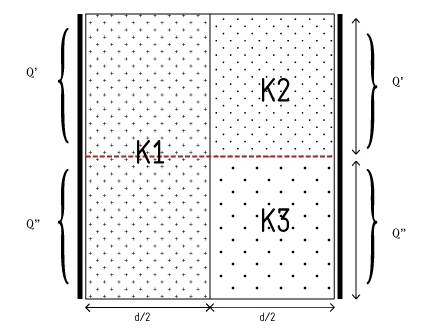
And the direction of given capacitor plates is always considered to be horizontal. Right?
 
Physics news on Phys.org
  • #62
gracy said:
And the direction of given capacitor plates is always considered to be horizontal. Right?
Yes.
 
  • #63
gracy said:
given capacitor plates
The plate which are at extreme positions i.e the left and right most.
 
  • #64
gracy said:
The plate which are at extreme positions i.e the left and right most.
If the partition is parallel to the plates, they're in series and if the partition is perpendicular to the plates, they're in parallel.
 
  • Like
Likes gracy
  • #65
cnh1995 said:
If the partition is parallel to the plates, they're in series and if the partition is perpendicular to the plates, they're in parallel.
Any exceptions?
 
  • #66
gracy said:
Any exceptions?
None. But the partitions should be continuous from one end to the other.
 
Last edited:
  • #67
cnh1995 said:
But the partions should be continuous from one end to the other.
You mean there should not be empty space in between ?
 
  • #68
I meant something like this..
%2F%2Fwww.physicsforums.com%2Fproxy.php%3Fimage%3Dhttp%253A%252F%252Fi.stack.imgur.com%252FeWBHL.jpg
 
  • #69
The two plates of parallel capacitors should have same area . Is that correct?
 
  • #70
gracy said:
The two plates of parallel capacitors should have same area . Is that correct?
What do you mean by "two plates"? Which two plates?
 
  • #71
http://astarmathsandphysics.com/university-physics/electricity-and-magnetism/parallel-plate-capacitors-html-9fd61e5.gif

Here the two plates have same area "A" ,I want to ask what if they had different areas , will they still form parallel plate capacitors together?
 
Last edited by a moderator:
  • #72
gracy said:
http://astarmathsandphysics.com/university-physics/electricity-and-magnetism/parallel-plate-capacitors-html-9fd61e5.gif

Here the two plates have same area "A" ,I want to ask what if they had different areas , will they still form parallel plate capacitors together?
Yes. But the capacitance will be different.
 
Last edited by a moderator:
  • #73
What will we write in place of A in the below formula ? A or B?
##\frac{Aε0}{d}## If one plate has area "A" and the other "B"
 
  • #74
The charges have to be uniformly distributed on both the plates and the plates have different areas. I believe the capacitance calculation will be a little complicated.
 
  • #75
Ok. What will be the formula of capacitance for the plate 2 here

kdi.png
 
  • #76
What are those blue portions? Dielectrics? What are the red lines joining them? Wires?
 
  • #77
cnh1995 said:
What are those blue portions? Dielectrics? What are the red lines joining them? Wires?
Yes and yes.
 
  • #78
Given the area, separation and permitivitty, its capacitance would be C=Aε/d..
 
  • #79
A is area of ? And why there isn't "K" present?
 
  • #80
gracy said:
A is area of ? And why there isn't "K" present?
What's the need of k when there is 'ε' which is itself kεo? A is the area of each plate(which is same throughout). I don't understand why you are analyzing this diagram.
 
  • #81
Ok. Fine. Let's end this thread here as it is going off topic.
 

Similar threads

  • · Replies 10 ·
Replies
10
Views
2K
  • · Replies 9 ·
Replies
9
Views
2K
  • · Replies 12 ·
Replies
12
Views
2K
  • · Replies 1 ·
Replies
1
Views
1K
  • · Replies 16 ·
Replies
16
Views
3K
Replies
2
Views
2K
  • · Replies 15 ·
Replies
15
Views
2K
  • · Replies 2 ·
Replies
2
Views
1K
Replies
7
Views
2K
  • · Replies 6 ·
Replies
6
Views
6K