What Defines the Transition from Static to Kinetic Friction in Physics?

Click For Summary
The discussion focuses on the transition from static to kinetic friction, questioning the nature of the undifferentiable point on the graph representing these forces. Participants explore whether movement begins when force equals or exceeds a certain value, noting that this distinction may not be practically significant. The curve observed in friction values is attributed to the elasticity of surfaces, suggesting that not all parts transition simultaneously. The complexity of friction is emphasized, indicating that the simplified school version does not capture the full nuances of the phenomenon. Overall, the conversation highlights the intricacies involved in understanding frictional forces in physics.
aspodkfpo
Messages
148
Reaction score
5
Homework Statement
Does the object begin to move at the threshold of motion?
Relevant Equations
none
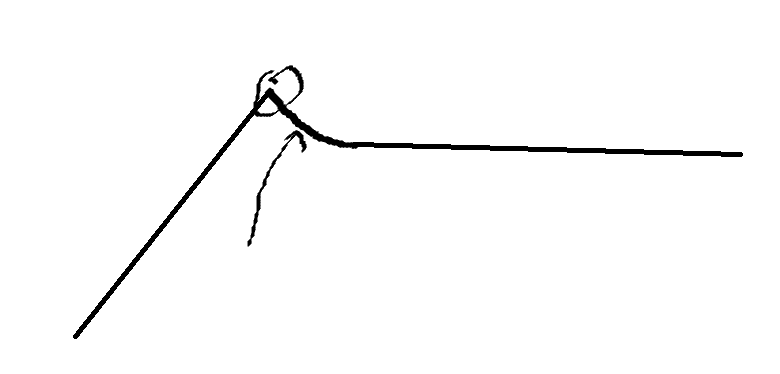
Just wondering, what is the general consensus on the undifferentiable point in a graph of static friction and kinetic friction values regarding whether the object moves or doesn't move? Also wondering what the space between that point and where kinetic friction straightens out is called?
1597922608144.png
 
Physics news on Phys.org
Whether it moves or doesn’t right at that point has no practical consequence.
Why do you think it curves like that just to the right of that point? Could it drop vertically? Certainly, traversing right to left I doubt the friction will start to climb before motion ceases.
 
haruspex said:
Whether it moves or doesn’t right at that point has no practical consequence.
Why do you think it curves like that just to the right of that point? Could it drop vertically? Certainly, traversing right to left I doubt the friction will start to climb before motion ceases.

Some questions say at what force is begins to move, so it does have use when solving questions and determining whether to put a > or = sign.

Google has multiple results of it not dropping vertically, and generally things tend to be smooth.
 
aspodkfpo said:
Some questions say at what force is begins to move, so it does have use when solving questions and determining whether to put a > or = sign.
No, that does not follow. Does it begin to move when the force equals some particular value or when it exceeds it? There is no way to distinguish.

Regarding the transition, seems we need to allow that not all parts of the surface transition at the same instant. There will be some elasticity in the bodies. This gives the smooth curve. Not sure how different it wouid be with the reverse transition.
 
haruspex said:
No, that does not follow. Does it begin to move when the force equals some particular value or when it exceeds it? There is no way to distinguish.

Actually, nevermind that.

So what about the curve, any name for it, is there a curve?
 
aspodkfpo said:
So what about the curve, any name for it, is there a curve?
I had not come across this before, but I see how it could work.
Think of the block as made of jelly. As you pull on one end, say, it will distort, leading to a higher demand for frictional force at the leading end, so the static friction gives way there first. If the applied force is increased extremely slowly, it might even be possible to be in a state where parts of the surface, though static, have partly detached.

Or even if we hold the force constant after this detachment has started, maybe it will spread, so the shape of the curve depends on how slowly we increase the force.

Bottom line is that friction is really quite a complicated topic. The school version is very simplified.
 
The book claims the answer is that all the magnitudes are the same because "the gravitational force on the penguin is the same". I'm having trouble understanding this. I thought the buoyant force was equal to the weight of the fluid displaced. Weight depends on mass which depends on density. Therefore, due to the differing densities the buoyant force will be different in each case? Is this incorrect?

Similar threads

  • · Replies 7 ·
Replies
7
Views
1K
  • · Replies 14 ·
Replies
14
Views
2K
  • · Replies 15 ·
Replies
15
Views
1K
  • · Replies 1 ·
Replies
1
Views
1K
  • · Replies 4 ·
Replies
4
Views
3K
Replies
6
Views
1K
  • · Replies 11 ·
Replies
11
Views
2K
Replies
1
Views
2K
  • · Replies 1 ·
Replies
1
Views
3K
  • · Replies 1 ·
Replies
1
Views
2K