Throttle body modeling and simulation

Click For Summary

Discussion Overview

The discussion centers around modeling a throttle body in Simulink, specifically focusing on how to model the position of the gas pedal and its effect on the throttle body actuator. Participants explore the relationship between the gas pedal position, the input voltage to the actuator, and the conversion of the driver's push force into a usable signal for the engine control unit (ECU).

Discussion Character

  • Technical explanation
  • Exploratory
  • Homework-related

Main Points Raised

  • One participant inquires about how to model the gas pedal's position in Simulink so that changes in position affect the throttle body actuator's input voltage.
  • Another participant suggests looking at the "ANGLE TO VOLTAGE" block in Simulink documentation for guidance on expected inputs.
  • A participant expresses confusion about the use of large font in the discussion, indicating a misunderstanding of communication norms.
  • One participant proposes that there may be methods in Simulink to sweep a variable over a range, potentially using a look-up table or signal generator.
  • Links to external resources on variable sweeping in Simulink are provided for further exploration.

Areas of Agreement / Disagreement

Participants do not reach a consensus on the best approach to model the gas pedal input, and multiple suggestions and methods are proposed without resolution.

Contextual Notes

Limitations include potential gaps in understanding Simulink's functionalities and the specific requirements for modeling the gas pedal input. The discussion does not clarify the exact mathematical relationships or assumptions involved in the modeling process.

Who May Find This Useful

Individuals interested in automotive engineering, control systems, or those working with Simulink for modeling and simulation may find this discussion relevant.

amare
Messages
18
Reaction score
2
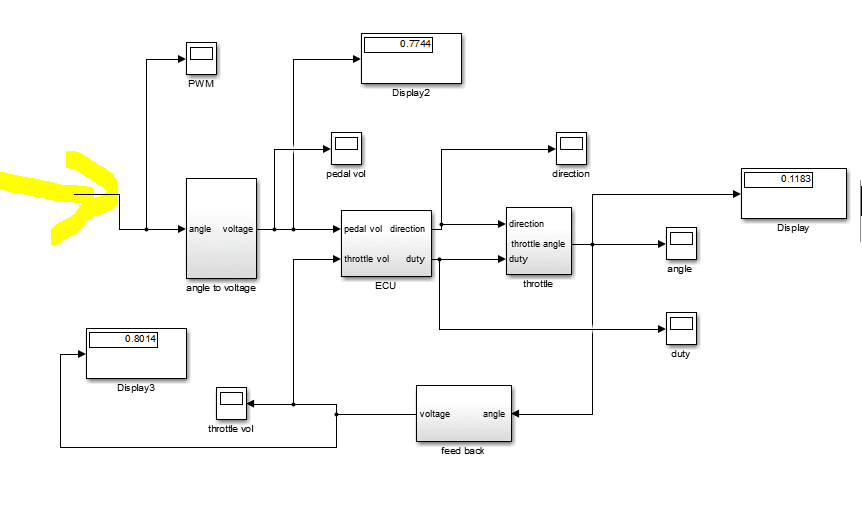
I modeled a throttle body in Simulink. How do I model the position of the gas pedal so that if the position of the gas pedal changes the input voltage to the throttle body actuator will change and open the throttle? why should i give on the left side to get position of the gas pedal from the potentiometer sensor?
243783
 

Attachments

  • 1558185957404.png
    1558185957404.png
    8.6 KB · Views: 444
Engineering news on Phys.org
amare said:
I modeled a throttle body in Simulink.
Jeez, fella, stop SCREAMING
 
phinds said:
Jeez, fella, stop SCREAMING
I am sorry i do not understand ! am I screaming ?
 
amare said:
I am sorry i do not understand ! am I screaming ?
Yes. Using a HUGE font is screaming.
 
The signal you are asking about connects to the block "ANGLE TO VOLTAGE." Look at the documentation for that block and use what it says is expected for input.
 
Tom.G said:
The signal you are asking about connects to the block "ANGLE TO VOLTAGE." Look at the documentation for that block and use what it says is expected for input.
yes I understand that. my question was how do I model the gas pedal to be an input? that means the position change of the gas pedal by the press from the driver will be converted to angles and sent to the ECU. then the ECUwill sent a voltage equivalent to it to the throttle actuator. so to be specific I need how the push force of the driver to be changed to position of the gas pedal...
 
Ahh, OK.

Unfortunately I'm not familiar with Simulink, but there is probably a way of telling it to 'Sweep' a variable over a range. Their method may be a look-up table, or a signal generator, or a loop construct of some sort as in a 'For Loop.'

I found this page at the Simulink supplier (mathworks.com) that may help find the answer.
https://www.mathworks.com/search/si...ep&q2=&q3=&notq=&c[]=capabilities&c[]=answers
If that doesn't work try this.
https://www.google.com/search?&q=simulink+variable+sweep
Cheers,
Tom
 
  • Like
Likes   Reactions: amare

Similar threads

  • · Replies 3 ·
Replies
3
Views
2K
  • · Replies 6 ·
Replies
6
Views
1K
Replies
17
Views
4K
  • · Replies 16 ·
Replies
16
Views
13K
Replies
1
Views
3K
Replies
2
Views
2K
  • · Replies 0 ·
Replies
0
Views
2K
  • · Replies 6 ·
Replies
6
Views
3K
  • · Replies 24 ·
Replies
24
Views
4K
  • · Replies 22 ·
Replies
22
Views
2K