robartinc
- 1
- 0
Hello,
I'm working on a hypothetical situation involving a planetary body orbiting a black hole (similar to the scenario in Interstellar, but for different reasons), trying to balance tidal forces with orbital distance and time dilation.
First, I'm interested in the effect of gravitational forces on tidal heating, so I calculated that based on an equation derived in an astrobiology class:

The intent is that the effects of tidal forces would be enough to power massive generators via geothermal energy without being enough to melt or rip apart the planet.
Given a black hole of stellar mass, planetary body the size of our moon, 1000AU orbit, 0.5% orbital variation, and 5% efficiency* converting tidal force into heat, I get a temperature of about 600K - high but potentially manageable (depending especially on if the body has an atmosphere, and how the heat is converted into usable energy).
*still looking for data on the calculated efficiency of tidal heating, eg. on Jupiter's moons; this is just an estimate.
Second, I want to ensure that the planet at this orbital distance would not have a significant time dilation due to those gravitational effects. Assuming a static black hole for now, but a moving observer (i.e. on the orbiting planetary body itself), I used the equation,
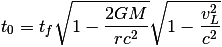
from https://www.physicsforums.com/threads/calculating-gravitational-time-dilation.385822/
At 1000AU, I expect they would not be very large, but my calculations are showing a time dilation factor of less than two parts per hundred billion (10^11). When I alter the parameters to see what would be 'significant' on the order of one part in a thousand, it would require the planet orbit at only 2km, when the Schwarzschild radius is 3000km, and photon sphere is 4400km.
This seems counter-intuitive to me, that the planet would have to be so close to 'experience' (relative to an outside observer) time dilation on an appreciable magnitude. Again, my goal is to have the planet orbit outside this region, but I want to be sure my calculations are based on a reasonably accurate representation of the situation.
I've skimmed through these threads as well:
https://www.physicsforums.com/threa...-body-in-orbit-around-kerr-black-hole.781691/
https://www.physicsforums.com/threads/distance-from-black-hole-to-experience-time-dilation.805105/
but I still don't think I have what I need to make this work yet.
Any suggestions for getting a handle on the time dilation especially would be greatly appreciated!
I'm working on a hypothetical situation involving a planetary body orbiting a black hole (similar to the scenario in Interstellar, but for different reasons), trying to balance tidal forces with orbital distance and time dilation.
First, I'm interested in the effect of gravitational forces on tidal heating, so I calculated that based on an equation derived in an astrobiology class:
The intent is that the effects of tidal forces would be enough to power massive generators via geothermal energy without being enough to melt or rip apart the planet.
Given a black hole of stellar mass, planetary body the size of our moon, 1000AU orbit, 0.5% orbital variation, and 5% efficiency* converting tidal force into heat, I get a temperature of about 600K - high but potentially manageable (depending especially on if the body has an atmosphere, and how the heat is converted into usable energy).
*still looking for data on the calculated efficiency of tidal heating, eg. on Jupiter's moons; this is just an estimate.
Second, I want to ensure that the planet at this orbital distance would not have a significant time dilation due to those gravitational effects. Assuming a static black hole for now, but a moving observer (i.e. on the orbiting planetary body itself), I used the equation,
from https://www.physicsforums.com/threads/calculating-gravitational-time-dilation.385822/
At 1000AU, I expect they would not be very large, but my calculations are showing a time dilation factor of less than two parts per hundred billion (10^11). When I alter the parameters to see what would be 'significant' on the order of one part in a thousand, it would require the planet orbit at only 2km, when the Schwarzschild radius is 3000km, and photon sphere is 4400km.
This seems counter-intuitive to me, that the planet would have to be so close to 'experience' (relative to an outside observer) time dilation on an appreciable magnitude. Again, my goal is to have the planet orbit outside this region, but I want to be sure my calculations are based on a reasonably accurate representation of the situation.
I've skimmed through these threads as well:
https://www.physicsforums.com/threa...-body-in-orbit-around-kerr-black-hole.781691/
https://www.physicsforums.com/threads/distance-from-black-hole-to-experience-time-dilation.805105/
but I still don't think I have what I need to make this work yet.
Any suggestions for getting a handle on the time dilation especially would be greatly appreciated!