To find the true velocity of wind from relative velocity

Click For Summary

Homework Help Overview

The discussion revolves around determining the true velocity of wind relative to a ship, utilizing concepts from vector analysis and relative motion. Participants are examining the relationships between the velocities of the wind and the ship, as well as the implications of their respective angles and magnitudes.

Discussion Character

  • Exploratory, Assumption checking, Mathematical reasoning

Approaches and Questions Raised

  • Participants discuss the setup of equations based on relative velocities, questioning the correctness of diagrams and equations. There are attempts to equate coefficients from vector components and discussions about significant figures in the context of the problem.

Discussion Status

There has been a progression in understanding, with some participants identifying errors in initial assumptions and diagrams. A participant has indicated that they have resolved their confusion and agree with the book's answer, while others have suggested further clarifications and corrections to the equations presented.

Contextual Notes

Participants are navigating through potential misinterpretations of the problem setup, particularly regarding the significance of the ship's speed and the angles involved. There is an acknowledgment of the need for careful consideration of significant figures in the context of the problem.

gnits
Messages
137
Reaction score
46
Homework Statement
To find the true winde velocity from the relative wind velocity
Relevant Equations
Vr = Va - Vb
Please can I ask for help with the following as to where I'm going wrong.

1586429392364.png


Book answer is 20 knots and 315 degrees

My solution:

In the below diagram I have sketched the two situations, k is the true speed of the wind.

First question is, is my diagram correct?
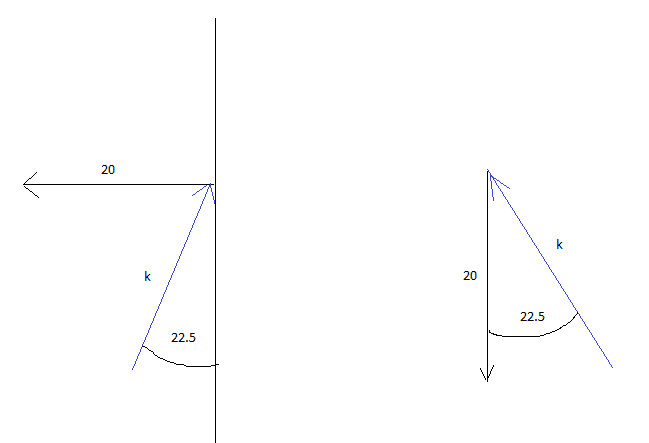
1586429514124.png


The velocity of the wind relaive to the ship ##V_{ws}## is given by:

##V_{ws}=V_w - V_s##

Where ##V_w## is the true velocity of the wind and ##V_s## is the true velocity of the ship.

Let i and j be unit vectors in the directions of east and north respectively
So in the two situations I have:

##k\,sin(22.5)i + k\,cos(22.5)j=V_{w_x}i+V_{w_y}j+20i##

and

##-k\,sin(22.5)i+k\,cos(22.5)j=V_{w_x}i+V_{w_y}j+20j##

Equating coefficients of i and j and solving for ##V_{w_x}## I get:

##V_{w_x}=-10##

and so:

##k=\frac{10}{sin(22.5)}=26.13##

and therefore

##V_{w_y}##=26.13*cos(22.5)=24.13

Which leads to a speed of 26.13 which is not the books answer.

Thanks,
Mitch.
 
Physics news on Phys.org
If you add the two equations, your two component equations pop out with very little algebra. Shouldn’t your last equation be

##V_{w_y} = 26.13*cos(22.5) - 10## ?

Still not the book answer. Everything you did down to there looks right to me
 
Actually, I take that back. That correction DOES give the book answer ... to the proper number of significant figures! It’s annoying because you and I know that in the real world that “0” in the ship’s speed just HAS to be significant. But, if the problem doesn’t explicitly say so ...
 
How did you get Vwy=26.13*cos(22.5)-10 ?
If I compare the coefficients of j in my two component equations do I not get:
k*cos(22.5)=Vwy AND k*cos(22.5)=Vwy+20
Which leads to Vwy=Vwy+20 which has no solution?
 
Last edited:
gnits said:
##k\,sin(22.5)i + k\,cos(22.5)j=V_{w_x}i+V_{w_y}j+20i##
and
##-k\,sin(22.5)i+k\,cos(22.5)j=V_{w_x}i+V_{w_y}j+20j##
That appears to be four scalar equations but only three scalar unknowns. Can you spot your error from that?
 
gnits said:
My solution:

In the below diagram I have sketched the two situations, k is the true speed of the wind.

First question is, is my diagram correct?

View attachment 260294

The velocity of the wind relative to the ship ##V_{ws}## is given by:

##V_{ws}=V_w - V_s##

Where ##V_w## is the true velocity of the wind and ##V_s## is the true velocity of the ship.
...

Thanks,
Mitch.
No, your diagram is not correct.

It's the relative velocity of the wind which is at an angle of ±22.5° . The magnitude of the relative velocity likely is different for the two situations.

Rearrange your equation and make the corresponding sketch.

##\vec {V}_{w}=\vec V_s + \vec V_{ws}##
 
Last edited:
Thanks all for your help, I see now that my original mistake was in the initial diagram. Indeed the speed is not the same in both cases. Have now solved and agree with book.
 
gnits said:
Thanks all for your help, I see now that my original mistake was in the initial diagram. Indeed the speed is not the same in both cases. Have now solved and agree with book.
Thanks for letting us know that you solved the problem. Homework Helpers here at PF are volunteers. Our only reward is knowing that you have been helped, so, yes it's good that you indicted that you have a solution.

However, it's customary to post your solution. That will bring the thread to a nice conclusion and allow others to learn from this exercise.
 
I rewrote the original equations but with a different variable to represent each of the different speeds of the two realtive winds:

##k_1\,sin(22.5)i + k_1\,cos(22.5)j=V_{w_x}i+V_{w_y}j+20i##

##-k_2\,sin(22.5)i+k_2\,cos(22.5)j=V_{w_x}i+V_{w_y}j+20j##

Now there are four equations and four unknowns: ##k_1, k_2, V_{w_x}\,and\,V_{w_y}##

Solving for the latter two gives the book's answer.

I made use of the half angle formula for tan to derive an exact value of ##tan(22.5^{\circ})\,=\,\sqrt{2}-1##
 
  • Like
Likes   Reactions: SammyS

Similar threads

  • · Replies 10 ·
Replies
10
Views
1K
  • · Replies 1 ·
Replies
1
Views
1K
  • · Replies 20 ·
Replies
20
Views
3K
  • · Replies 16 ·
Replies
16
Views
3K
  • · Replies 6 ·
Replies
6
Views
2K
  • · Replies 3 ·
Replies
3
Views
1K
  • · Replies 2 ·
Replies
2
Views
1K
  • · Replies 3 ·
Replies
3
Views
2K
Replies
2
Views
9K
  • · Replies 15 ·
Replies
15
Views
1K