Torque Balancing and Virtual Work: Solving for Equations in Force Balancing

  • Thread starter Thread starter cupcake_rainbow
  • Start date Start date
  • Tags Tags
    Torque Virtual work
Click For Summary

Homework Help Overview

The discussion revolves around the concepts of torque balancing and virtual work in the context of force balancing equations. Participants are exploring the relationships between angles and forces in a mechanical system.

Discussion Character

  • Exploratory, Conceptual clarification, Assumption checking

Approaches and Questions Raised

  • The original poster attempts to use force balancing and torque balancing to derive equations but expresses difficulty in achieving the correct answer. They also inquire about the application of virtual work in this context. Other participants point out potential errors in the original equations and discuss the conditions under which virtual work may be preferable to torque balancing.

Discussion Status

Some participants have provided feedback on the original equations, noting possible errors. There is ongoing exploration of how to formulate the virtual work equation and when to apply this method versus torque balancing. The discussion reflects a mix of interpretations and approaches without a definitive consensus.

Contextual Notes

Participants are considering the geometric constraints of the system and the implications of applying virtual work, particularly regarding fixed angles and constraint forces. There is mention of specific angles and their relationships, which may be critical to the problem setup.

cupcake_rainbow
Messages
2
Reaction score
0
Homework Statement
Two weights P and Q are suspended from a fixed point 0 by strings OA, OB and are kept apart by a light rod AB. If the strings OA and OB make angles alpha and beta with the rod AB, show that the angle theta which the rod makes with the vertical is given by tan theta = (P+Q)/(Pcot alpha -Qcot beta)
Relevant Equations
torque balancing
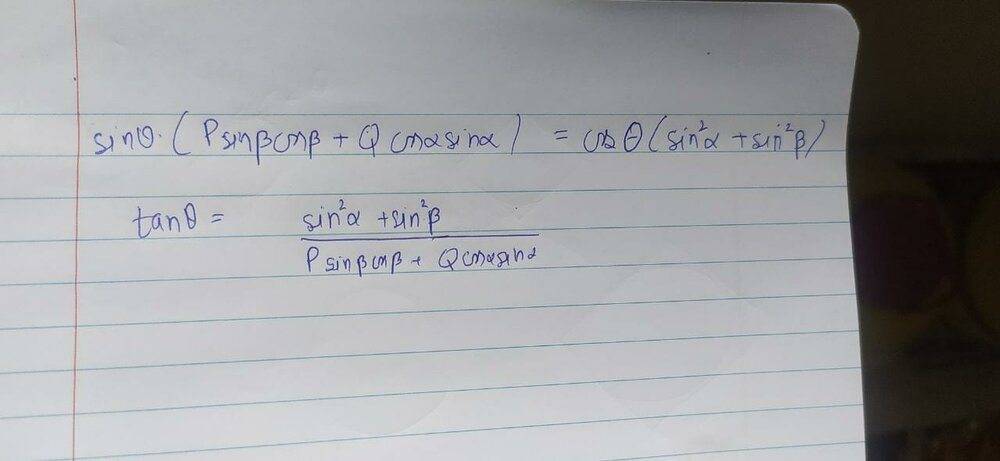
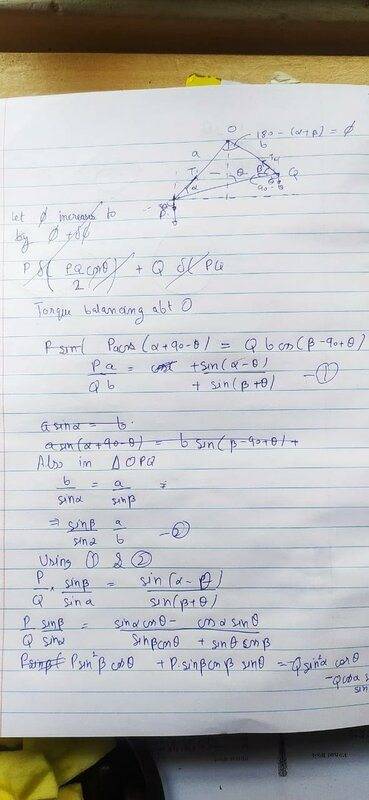
So I tried using force balancing.
I have attached files of my solution in my notebook
Torque balancing about O which gives me equation 1
And I used property of triangle, for equation 2
But i can't seem to get the right answer
Also, I was wondering if it could be done by concept of virtual work.
1.jpeg
2.jpeg
 
Physics news on Phys.org
I think you have a couple of errors in eqn (1). α and β seem to have got crossed over, and a sign looks wrong.
 
  • Like
Likes   Reactions: cupcake_rainbow
haruspex said:
I think you have a couple of errors in eqn (1). α and β seem to have got crossed over, and a sign looks wrong.
Yup got the answer now, thanks
I am interested in finding out how to write the virtual work equation for this. I thought of increasing angle POQ, say ##\phi## to ##\phi +d\phi## but i couldn't relate ##d\alpha## and ##d\beta## . So if anyone can write the equation, that would be great.
Also I want to know when it's better to use virtual work and when just torque balancing is better.
 
cupcake_rainbow said:
thought of increasing angle POQ
But POQ is fixed by the geometry. To apply virtual work you wouid consider a small change to theta.
cupcake_rainbow said:
when it's better to use virtual work
Generally speaking, virtual work is useful when there are constraint forces that do no work, such as a bead sliding on wire. Using v.w. you can ignore such forces.
 
  • Like
Likes   Reactions: cupcake_rainbow

Similar threads

  • · Replies 2 ·
Replies
2
Views
911
  • · Replies 10 ·
Replies
10
Views
1K
  • · Replies 12 ·
Replies
12
Views
1K
  • · Replies 3 ·
Replies
3
Views
2K
Replies
14
Views
2K
  • · Replies 26 ·
Replies
26
Views
7K
Replies
16
Views
1K
  • · Replies 7 ·
Replies
7
Views
1K
  • · Replies 15 ·
Replies
15
Views
3K
  • · Replies 6 ·
Replies
6
Views
1K