Transfer function of cascaded filters

Click For Summary
The discussion centers on finding the transfer function H(s) of cascaded filters using nodal analysis with Cramer's method and decomposition into simpler sections. The user reports that while the transfer functions H(s)1 and H(s)2 appear similar, they differ by a term in the denominator, leading to confusion. It is highlighted that without a buffer amplifier between the filters, the output of the first filter affects the input of the second, complicating the analysis. The loading effect must be considered, as it can distort the expected independence of the transfer functions. The conversation emphasizes the importance of minimizing loading effects to justify treating the filters as independent systems.
FrankJ777
Messages
140
Reaction score
6
1. Problem statement
Find the transfer function , H(s) by two methods. Use Nodal analysis with Cramer's method, and decompose into simpler sections and use the property, H(s) = H1(s) * H2(s).

Homework Equations


H(s) = H1(s) * H2(s)
H(s) = Vout/Vin
Cramer's Rule. X = Dx/D : where D is the determinant and Dx is the determinate with the x column.[/B]

The Attempt at a Solution


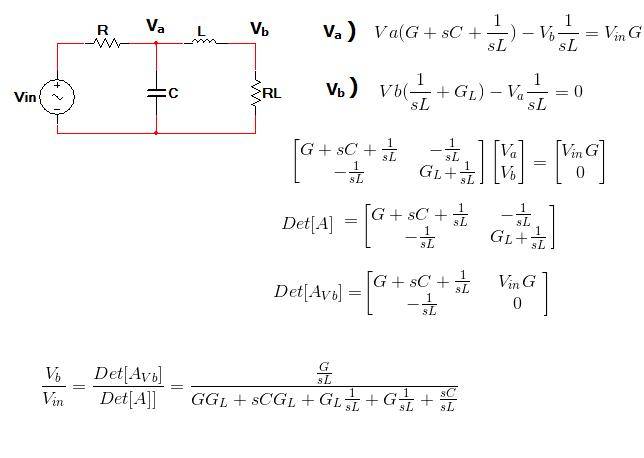
I used nodal with Cramer's Method, and decomposed into to sections. The transfer functions were similar but the denominators differ by a term, and I don't know why.

First using nodal with Cramer's method. [/B]
s4p6wy.jpg

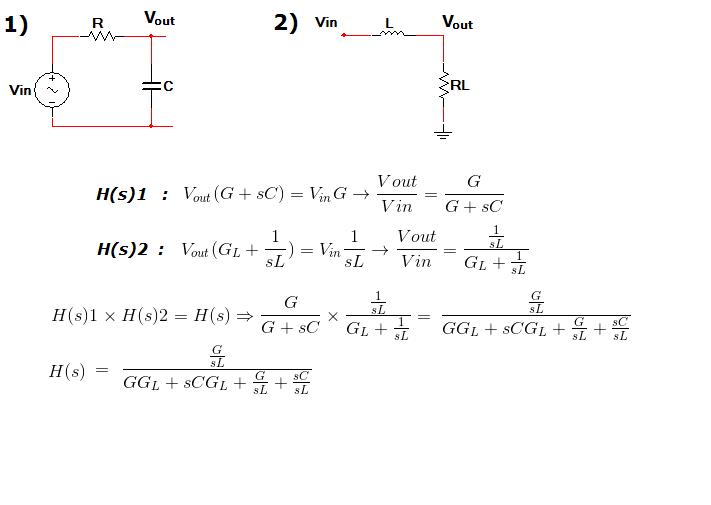
Then decomposing the filter into two filters, finding H(s)1,H(s)2, then H(s)=H(s)1xH(s)2.
2605xmf.jpg

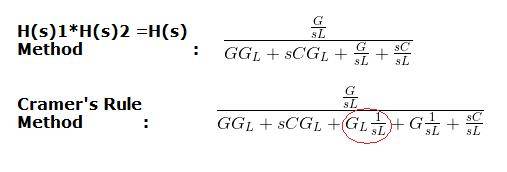
Here are the two transfer functions. You can see that they differ by a single term in the denominator, GL/sL circled in red.
149tms9.jpg

I'm sure they should be the same, but I'm not sure where I'm going wrong. Can anyone point me in the right direction?
Thanks a lot.
 
Physics news on Phys.org
FrankJ777 said:
Then decomposing the filter into two filters, finding H(s)1,H(s)2, then H(s)=H(s)1xH(s)2.

Separated the two transfer functions, H(s)1 and H(s)2, are correct. But when you connect the filters, the input of (2) will load the output of (1).
Thus the transfer function H(s)1 will depend on L and RL.

( I don't know Cramers method. )
 
Last edited:
To treat it as two simple transfer functions and apply H = H1 x H2
there must exist a buffer amplifier between the two. Without that buffer stage, the signal output of filter 1 is determined not only by the CR elements in filter 1 but also by the elements in the second filter (the so-called 'loading' effect). This absence of a buffer stage means you cannot separate the network into independent blocks; it must be analysed as a whole.

The only way you may be able to justify analysing the network as a pair of independent filters is if you ensure the loading effect is minimal by setting the impedance of the L-R stage to be >> the impedance of the C-R stage. The result will still be an approximation, and this is rarely acceptable in any filter application.
 
http://www.learnabout-electronics.org/Amplifiers/images/Zin-Zout.gif

Lets look at two amplifiers, a1 and a2. they are connected in series, with the output of a1 going into a2.
each amplifier has a input resistance Rinx and an output resistance Routx

the gain of source 1 will be dependant upon the relationship between the output resistance of source 1, and the input resistance of source 2. the relationship is essentially a voltage divider.

Since our source is a perfect voltage source, it has zero output impedance, so the input gain will be 1.

the output of stage one will be
H1=a1*Rin2 /(Rin2+Rout1)

now knowing that, how would you proceed with your system?
 

Similar threads

  • · Replies 5 ·
Replies
5
Views
3K
  • · Replies 1 ·
Replies
1
Views
2K
  • · Replies 4 ·
Replies
4
Views
763
Replies
1
Views
3K
  • · Replies 1 ·
Replies
1
Views
2K
  • · Replies 3 ·
Replies
3
Views
2K
  • · Replies 11 ·
Replies
11
Views
4K
  • · Replies 14 ·
Replies
14
Views
2K
  • · Replies 4 ·
Replies
4
Views
2K
  • · Replies 2 ·
Replies
2
Views
2K